aka KanColle
Number of Episodes: 12 + Movie (KanColle: the Movie)
What Wikipedia says: In a world where humanity faces the threat of the abyssal fleet which has taken over the seas, special human girls who don weaponized outfits and possess the spirit of historical naval vessels known as kanmusu (艦娘, literally "fleet girls" or "ship girls") are the only ones capable of countering them. The kanmusu live together at a naval base, where they spend their everyday lives as they begin training for battle.
The series features the destroyer Fubuki as the main character, with the storyline based on her point of view. Fubuki arrives at the naval base, where she meets other girls that she will eventually fight alongside. Despite lacking adequate combat training, she is recommended into the Third Torpedo Squadron by the admiral, and quickly finds herself sortied into battle. Upon being rescued by Akagi in a dangerous situation, Fubuki strives to do her best in order to train, with the hopes of eventually being able to fight alongside Akagi.
What KoanMan says: It took some time for this to gel with KoanMan. The concept of girls skating around on water and firing guns strapped on detracted somewhat from KoanMan’s enjoyment. It is a key element of the story, that the girls are warships, and some will love it. One found the mysterious “Abyssals” intriguing, and somehow the concept worked better with them. The plot is predictable, but moves well without feeling too slow, nor rushed.
The action moved well, with good animation and some epic tropical scenery that helped the story along, blending well with steady character development and the maritime setting. Director Keizou Kusakawa does an adequate job following the trials and tribulations of the special destroyer Fubuki and the other girls.
Interestingly, theme music was left to producer WEST GROUND (an alias of Flying Dog music producer Makoto Nishibe).
So How Does it End? (Spoiler free): The movie is both darker and a little more confusing than the series, and while probably less satisfying as a result, it really does try to make make sense of the ridiculous world that is KanColle, and resolve the major plot lines. [tTPO]
Overall Grade: Some risks were taken to make this, and it became more engaging as it moved through the episodes. Overall KoanMan gives this a B.
What tTPO says: Another entry in the anime genre of "she's a girl, but she's also a..." (gun? plan? ship? superweapon?) this managed to connect with tTPO, and encouraged me to go and look up how actual history played out in WWII (compared with the reimagined version in this anime). Unlike some reviewers who took exception to the revisionist history tTPO didn't find this disturbing, because, you know, it's an anime, with girls in short skirts, not a documentary on the History channel. The cast of thousands were largely one dimensional, and it's no future classic, but it was well paced, well drawn, has a a few platonic yuri tones, and me and Mrs tTPO enjoyed it. B.
An anime review website for the older otaku, where work, family and life mean that every anime watching hour is precious and should not be wasted on shows that do not deserve it. Scoring is judged on overall enjoyment, music and the ending, with longer series having to stand up to more strict criteria than shorter ones. Reviews are kept short and to the point. Because time is always pressing.
Showing posts with label Supernatural. Show all posts
Tuesday, 21 April 2020
Kantai Collection
Labels:
Action,
Drama,
Fighting,
Grade B,
Historical,
Military,
Moe,
Mystery,
Supernatural
Saturday, 24 November 2018
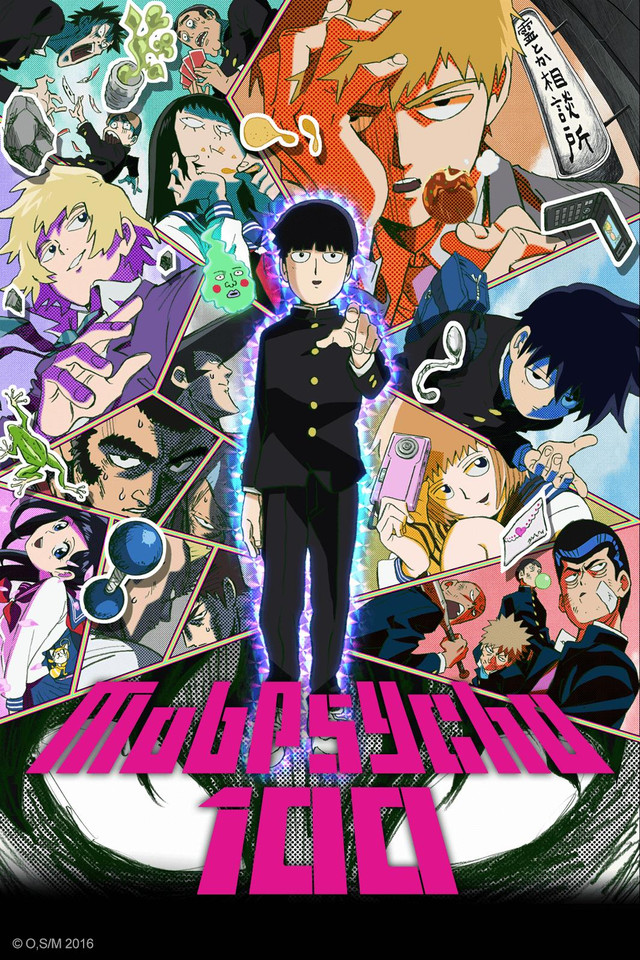
Mob Psycho 100
Number of Episodes: 12
What Wikipedia says: Shigeo Kageyama is an average middle school boy, nicknamed Mob (モブ Mobu) (meaning "background character") for lacking a sense of presence. Although he looks like an inconspicuous person, he is in fact a powerful esper. As he grows older, Mob realizes that his psychic powers are strengthening and becoming more dangerous. To avoid his power getting out of control, he constantly lives a life under an emotional shackle. Mob wants to live a normal life just like the others, but a barrage of trouble keeps coming after him. With the suppressed emotions growing inside Mob little by little, his power threatens to break through its limits.
What KoanMan says: "Mob Psycho 100", by Yuzuru Tachikawa and produced by ONE, is a similar style of animation to One Punch Man by the same, though visually a little rough. The storylines are vaguely similar, however they present different viewing experiences. Characters centre on Mob, who is a socially clueless super-being, who follows a meandering plot through his personal development. Lots of action and likeable, though shallow, personalities make this an enjoyable watch, without much brain owner required.
What Wikipedia says: Shigeo Kageyama is an average middle school boy, nicknamed Mob (モブ Mobu) (meaning "background character") for lacking a sense of presence. Although he looks like an inconspicuous person, he is in fact a powerful esper. As he grows older, Mob realizes that his psychic powers are strengthening and becoming more dangerous. To avoid his power getting out of control, he constantly lives a life under an emotional shackle. Mob wants to live a normal life just like the others, but a barrage of trouble keeps coming after him. With the suppressed emotions growing inside Mob little by little, his power threatens to break through its limits.
What KoanMan says: "Mob Psycho 100", by Yuzuru Tachikawa and produced by ONE, is a similar style of animation to One Punch Man by the same, though visually a little rough. The storylines are vaguely similar, however they present different viewing experiences. Characters centre on Mob, who is a socially clueless super-being, who follows a meandering plot through his personal development. Lots of action and likeable, though shallow, personalities make this an enjoyable watch, without much brain owner required.
So How Does it End? (Spoiler free): Well rounded, but with plenty of room for season 2 (coming late 2018/early 2019).
How About the Music? The music is OK, and the Japanese phonetic counting in English in the opening credits song is very cute.
Overall Grade: Mob Psycho 100 is an enjoyable, non-taxing, short series, and is a good way to pass time, with some great visual ideas. Koan Man gives this a C.
Addendum by tTPO: This is one of those series where KoanMan doesn't quite know what he is talking about. While this is no One Punch Man, it is no C either, either enough humour, action and originality (a rare commodity) to well justify a B.
Labels:
Action,
Comedy,
Fighting,
Grade B,
Grade C,
School,
Science Fiction,
Supernatural
Sunday, 24 January 2016
School Live!
Number of Episodes: 12
What Wikipedia says: Yuki Takeya is a
cheerful school girl who, along with her friends Kurumi Ebisuzawa, Yūri
Wakasa, and Miki Naoki, is a member of the Megurigaoka Private High
School's School Living Club. As Yuki seeks out fun school activities
every day while living at school, the other girls work to keep her safe,
because in reality, they are the sole survivors of their school after a
zombie outbreak overruns the city.
What KoanMan says: A "cutesy" first episode, with what appeared to be very little substance, had KoanMan wondering "why watch this"? Then the second episode starts to show small cracks in the delightful world of Yuki Takeya. Cracks that reveal a world of ZOMBIES!! Awesome!
School Live! is a carefully crafted journey into the lives of Yuki
Takeya, Yuuri Wakasa (club president), Kurumi Ebisuzawa (shovel wielding
tough girl), Miki Naoki (troubled junior), Megumi Sakura (class
teacher) and the ever-perky Taroumaru (the club canine mascot), and by
perky, KoanMan means annoying. Oh, and about a billion other local
residents and school-goers..... the "z-o-m-b-i-e-s"..... (say that with a
ghoulish voice).
In keeping with most Zombie apocalypse stories, there is an endless
supply of undead corpses that need dismemberment. However, unlike most
of these stories, this one delves much more deeply into the minds and
feelings of those few remaining alive. It is this story that really
carries this series, although the pace a few flat spots, and is never
rushed nor particularly action-packed. That said, a lot happens, and the
flash-back style fits well and adds to the journey. Kurumi is a favourite - anyone
who has their own gold-plated shovel for beheading has be cool right? Or
at least respected..... And Yuuri is the warm heart of the group that
keeps everything together at all times.
How About the Music? The music is OK, and mostly fits the mood. [tTPO: The OP is fantastically moe and gives little indication of the true nature of the show.]
So How Does it End? (Spoiler free): It is not a let down.
Overall Grade: With a bit more action and faster pace this could easily have been an A. So close..... KoanMan liked this, and gives a solid B.
Addendum by tTPO: tTPO has just a little more patience than KoanMan, maybe because Koanman has a tendency to marathon and tTPO watch a week at a time. In any case tTPO and Mrs tTPO were big fans of this series, and while is may have missed that little bit of magic that makes and A, it was not far off. A-.
Labels:
Action,
Drama,
Grade A,
Grade B,
Horror,
Moe,
School,
Slice of Life,
Supernatural
Saturday, 10 October 2015
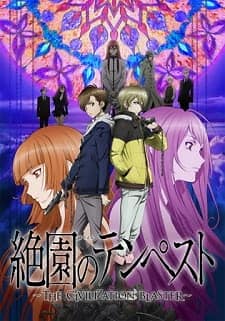
Zetsuen no Tempest
aka Blast of Tempest
Number of Episodes: 24
What Wikipedia says: "The story revolves around Mahiro Fuwa, a teenager whose sister was mysteriously murdered one year before, and his friend Yoshino Takigawa. Mahiro is contacted by Hakaze Kusaribe, the leader of the Kusaribe clan who was left stranded on an unknown deserted island by her followers, and agrees to help Hakaze in exchange for her help to find out the culprit for the death of his family. Upon learning of his friend's intentions, Yoshino joins him on his quest to stand against the Kusaribe clan who intends to awaken the "Tree of Exodus" whose power can bring ruin to the entire world.
Several dialogues and plot elements in Zetsuen no Tempest pay homage to two works of William Shakespeare, Hamlet and The Tempest, which are two stories about retribution, albeit with completely opposing outcomes."
KoanMan says: Logic, magic, and really powerful trees. This series is an interesting tale of two average high school friends, Yoshino Takigawa and Mahiro Fuwa, that find themselves tormented by the murder of Aika Fuwa. Events then escalate from normal to holocaust as magic is used as a weapon in the war between two trees representing opposing philosophies on human civilization and its future. The boys are quickly introduced to Hakaze Kusaribe, the princess Mage of the Tree of Genesis.
There is a lot of time for characters to develop, although most characters have an unusual quirk somewhere in their make-up which adds a little light-hearted fun to proceedings.
Logic is a central pillar of the story, and besides magic, mostly holds up. Dialogue is important, with one discussion spanning several episodes. It is so well done, KoanMan barely realised until 3 episodes into this conversation that it was one conversation. The pace is a little on and off, and the story is a little disjointed, although overall the story ebbs and flows well. Plot is convoluted though does follow a solid central direction.
How About the Music? Music is OK, with opening and closing credits music quite average, however, the inclusion at times of selected classical music pieces added greatly to the mood. This was not consistent enough throughout the series for KoanMan and this could have been a stand-out feature if done well.
Special mention goes to Michiru Oshima for his orchestral arrangement of Beethoven's "Tempest (mvt 3)" - fantastic.
Overall Grade: KoanMan liked this series, and it gets extra marks for keeping interest throughout some very long blocks of dialogue. Zetsuen no Tempest gets a B.
Addendum (by tTPO): Both tTPO and Mrs tTPO like this series a lot. The long slabs of adversarial dialogue taking place in small areas that punctuated the series had more ebbs and flows than many many more physical fights and as such made a refreshing change for the medium. It really did reflect the theatrical themes on which the story was based. The plot was complex without being too complex or self indulgent and the only letdown for tTPO was the inevitability of main conclusion which was not bad by any means, but given the excellent journey to get there was just not quite as good.
Blast of Tempest gets a B from us too.
Number of Episodes: 24
What Wikipedia says: "The story revolves around Mahiro Fuwa, a teenager whose sister was mysteriously murdered one year before, and his friend Yoshino Takigawa. Mahiro is contacted by Hakaze Kusaribe, the leader of the Kusaribe clan who was left stranded on an unknown deserted island by her followers, and agrees to help Hakaze in exchange for her help to find out the culprit for the death of his family. Upon learning of his friend's intentions, Yoshino joins him on his quest to stand against the Kusaribe clan who intends to awaken the "Tree of Exodus" whose power can bring ruin to the entire world.
Several dialogues and plot elements in Zetsuen no Tempest pay homage to two works of William Shakespeare, Hamlet and The Tempest, which are two stories about retribution, albeit with completely opposing outcomes."
KoanMan says: Logic, magic, and really powerful trees. This series is an interesting tale of two average high school friends, Yoshino Takigawa and Mahiro Fuwa, that find themselves tormented by the murder of Aika Fuwa. Events then escalate from normal to holocaust as magic is used as a weapon in the war between two trees representing opposing philosophies on human civilization and its future. The boys are quickly introduced to Hakaze Kusaribe, the princess Mage of the Tree of Genesis.
There is a lot of time for characters to develop, although most characters have an unusual quirk somewhere in their make-up which adds a little light-hearted fun to proceedings.
Logic is a central pillar of the story, and besides magic, mostly holds up. Dialogue is important, with one discussion spanning several episodes. It is so well done, KoanMan barely realised until 3 episodes into this conversation that it was one conversation. The pace is a little on and off, and the story is a little disjointed, although overall the story ebbs and flows well. Plot is convoluted though does follow a solid central direction.
How About the Music? Music is OK, with opening and closing credits music quite average, however, the inclusion at times of selected classical music pieces added greatly to the mood. This was not consistent enough throughout the series for KoanMan and this could have been a stand-out feature if done well.
Special mention goes to Michiru Oshima for his orchestral arrangement of Beethoven's "Tempest (mvt 3)" - fantastic.
Overall Grade: KoanMan liked this series, and it gets extra marks for keeping interest throughout some very long blocks of dialogue. Zetsuen no Tempest gets a B.
Addendum (by tTPO): Both tTPO and Mrs tTPO like this series a lot. The long slabs of adversarial dialogue taking place in small areas that punctuated the series had more ebbs and flows than many many more physical fights and as such made a refreshing change for the medium. It really did reflect the theatrical themes on which the story was based. The plot was complex without being too complex or self indulgent and the only letdown for tTPO was the inevitability of main conclusion which was not bad by any means, but given the excellent journey to get there was just not quite as good.
Blast of Tempest gets a B from us too.
Tuesday, 10 March 2015
Nanana's Buried Treasure
aka Ryūgajō Nanana no Maizōkin
Number of Episodes: 11
What Wikipedia says: On the "Special Student Zone" artificial island – Nanaejima, the story centers on a beautiful, optimistic, but NEET (not in education, employment or training) girl Nanana Ryūgajō, who was mysteriously killed in her own apartment.
Number of Episodes: 11
What Wikipedia says: On the "Special Student Zone" artificial island – Nanaejima, the story centers on a beautiful, optimistic, but NEET (not in education, employment or training) girl Nanana Ryūgajō, who was mysteriously killed in her own apartment.
Ten years later, a boy named Juugo Yama was forced to transfer to a high school on the island. With only a certain amount of money to live on, Juugo chooses a low-rent apartment that happens to be haunted by the ghostly Nanana, who is bound to her former home and unable to move on. Juugo and members of the school's adventure club join a "treasure hunt royale" on the island for the Nanana Collection, treasures that possess mysterious powers.
tTPO says: This is just a disappointing series. Maybe the whole thing was designed as a glorified advertisement for the light novels but if that was the plan I still don't want to read them. Even if I could read kanji. So what were the problems? For me it was probably two things - the treasure-of-the-week format (tough to avoid when this is the central tenent of the show), but mostly the fact the series not only went nowhere after 11 episodes, but had time to put in distracting side plots in that trip to nowhere.
You would think, when plotting out an 11 episode anime that someone may have said "Hey, we only have 11 episodes here. We had better keep things tight." I am pretty sure this conversation never happened.
On the upside, the characters are not all cookie cutter cliches, including the somewhat conflicted protagonist Juugo. It was this, as well as the (vain) hope there would be some form of resolution for Nanana that kept me watching.
How About the Music? Meh.
So How Does it End? (Spoiler free): In desperate,desperate need of more episodes to give the plot some semblance of resolution.
Overall Grade: Better than Amnesia, but still a D. A second season to pull this together may result in a revision but till then, still a D.
Sunday, 5 October 2014
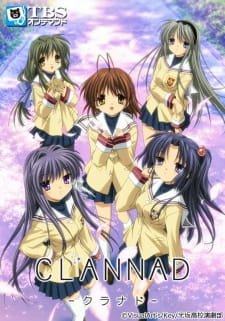
Clannad & Clannad After Story
Number of Episodes: 44 + 1 Extra + 1 Recap + 3 Alternate endings + 1 Movie
WhatWikipedia Anime News Network says: "Tomoya Okazaki is a third year high school student resentful of
his life. His mother passed away from a car accident when he was
younger, causing his father to resort to alcohol and gambling. This
results in fights between the two until Tomoya's shoulder is injured in a
fight. Since then, Tomoya has had distant relationships with his
father, causing him to become a delinquent over time. While on a walk to
school, he meets a strange girl named Nagisa Furukawa who is a year
older, but is repeating due to illness. Due to this, she is often alone
as most of her friends have moved on. The two begin hanging out and
slowly, as time goes by, Tomoya finds his life shifting in a new
direction."
tTPO says: Clannad starts out as a somewhat conventional somewhat comedic high school harem series but it does not take long before other supernatural, emotional and family elements start veering this away from the conventional. The prominent roles of the parents of the main characters deserve special mention - more often than not parents just don't hae a significant role to play in most school anime, and if they are there are just in the background, always at work, or annoyances.
Where Clannad really differs is where it goes with After Story. So many series simply resolve the high school romance and leave that as the conclusion. But After Story is different and follows through in the years following school and the consequences the decision made there, ultimately leading to the karma filled, emotionally satisfying but slightly confusing, finale.
tTPO loved this series. I watched it some time ago but occasionally just randomly watch an episode to experience the inevitable feels that this series is packed with. Now I am a father the emotional impact of the parental roles in this series, as well as nearly all the events of After Story has only increased not decreased with time.
It is important to make some notes about the movie here. The short piece of advice is just don't do it. It is a largely joyless affair that focuses on Okasaki and Nagisa, and leaves out the whole karmic redemption theme that is so fundamental to the series which makes the darker moments more tolerable. Admittedly Nagisa's school play performance done much better. But that alone is not enough to watch it.
What
tTPO says: Clannad starts out as a somewhat conventional somewhat comedic high school harem series but it does not take long before other supernatural, emotional and family elements start veering this away from the conventional. The prominent roles of the parents of the main characters deserve special mention - more often than not parents just don't hae a significant role to play in most school anime, and if they are there are just in the background, always at work, or annoyances.
Where Clannad really differs is where it goes with After Story. So many series simply resolve the high school romance and leave that as the conclusion. But After Story is different and follows through in the years following school and the consequences the decision made there, ultimately leading to the karma filled, emotionally satisfying but slightly confusing, finale.
tTPO loved this series. I watched it some time ago but occasionally just randomly watch an episode to experience the inevitable feels that this series is packed with. Now I am a father the emotional impact of the parental roles in this series, as well as nearly all the events of After Story has only increased not decreased with time.
It is important to make some notes about the movie here. The short piece of advice is just don't do it. It is a largely joyless affair that focuses on Okasaki and Nagisa, and leaves out the whole karmic redemption theme that is so fundamental to the series which makes the darker moments more tolerable. Admittedly Nagisa's school play performance done much better. But that alone is not enough to watch it.
How About the Music?: For this tTPO, the music to this series is near perfect. Years after first watching it still elicits a pavlovian bittersweet response. All the themes deserve a mention. Except maybe "Torch". Sorry Lia.
OP1:"Megumeru ~cuckool mix 2007~" by eufonius
ED1: "Dango Daikazoku" by Chata
ED2: "Ana" by Lia
ED2: "Ana" by Lia
OP2: "Toki o Kizamu Uta" ("A Song to Pass the Time") by Lia
ED3: "TORCH" by Lia
So how does it end? (Spoiler Free): The ending brings everything together leaving few threads dangling. Though saying that, it would be a lie to say that the events as we head towards the end are particularly easy to understand. A rewatch or two puts most of the big points into context, though there still remain some significant debate on the interwebs as to the finer details. ie. You feel you know what just happened but explaining it to someone else may not be so easy. In all of these interpretations though, despite their disparity there is a significant point - this is NOT a deus ex machina ending, it is a a conclusion that brings together the events leading to this point.
For your and my convenience, the best of the explanatory links are here (long), here (diagrammatic), here (short) and here (point form).
Overall Grade: Clannad and Clannad After Story set the benchmark for harem and romance, and that doesn't even touch the genuine drama, comedy, and supernatural elements this series has. Despite the length (or perhaps because of it) this is well worth the journey, even for the tTPO. Though you could skip the extra, the recap and the movie. For the love of god though do not skip the alternate endings. While this series seems to divide the viewing public, for tTPO this is one of the best series ever. Grade A.
Addendum by KoanMan: For the TPO, this series may be a little long, but as a depiction of school life for friends facing their own challenges and discovering their own dreams, this has a lot to offer. Nagisa Furukawa and Tomoya Okazaki are the primary characters, and their relationship meanders around and through various goals and the lives of their friends as they tackle school and then then real world after school. As gentle as this begins, there are some seriously gut-wrenching moments. The "other world" parallelism is interesting, and adds some depth to the storyline. Series 1 [Clannad] has a goodly serving of humour, and the "kick count" is an inspired touch - look out for it! Great! Series 2 [Clannad After Story] is a lot more serious, with much less humour, although no less engaging. Throughout, Nagisa's father Akio Furukawa is a standout, and unsurprisingly, to those who know KoanMan, Tomoyo Sakagami and Kyou Fujibayashi rounded out the three favourites.
The music is OK, although the opening credit score of the second series is awesome. The final credits the first series "The Dango Song" took almost the entire first series to grow on KoanMan, who likes it now..... although it did not start out like that.
KoanMan loved this series, and for a non-action, non-violent story, this is impressive. Despite the length, this one was worth it. KoanMan gives this an A.
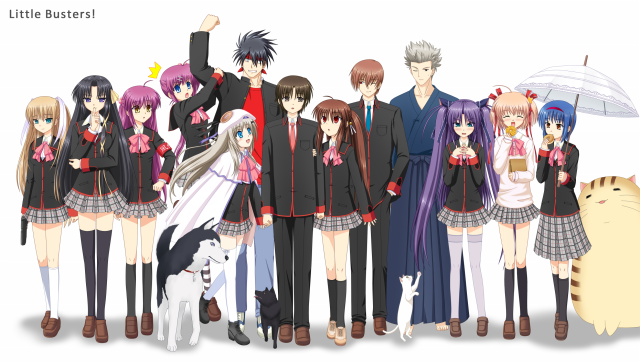
Little Busters! + Little Busters! Refrain + Little Busters! EX
Number of Episodes: 26 + 13 + 8
What TTPO says: It's hard to know where to start with this series. In the past I seem to have been a little plagued by some really good anime series with disappointing endings, which inevitably leave just a little sour taste in the mouth afterwards. Little Busters! turns this around. The first 26 episodes are really just a pretty average setup for the next much more emotionally intense 13 (Requiem) leaving the 8 OVAs (EX) the icing on the cake. And this is where the problem lies - can the TTPO really afford to get through 26 episodes which are by and large just average to get to the meat of the series?
How About the Music? The music is largely by Jun Maede and once again he manages to create music that is catchy without being trite, and still manages to trigger a near pavlovian response of bittersweet emotions associated with the series. The OP ("Little Busters!" by Rita) and ED ("Alicemagic" by Rita) are standouts, and almost up the the standard of the music of Angel Beats. Note quite though.
So how does it end? (Spoiler free): As previously stated the events of Refrain which is like one long ending to the series are what make the series are good as it is. Very satisfying indeed.
Overall Grade: If you had plenty of time of your hands I would give this a B or maybe a B+. But half a good series does not a good series make, even when it is the most important bit that is good. So in answer to my own question above, no I don't think I can in good faith recommend this if you are time pressed, and for that this will be the series probably remain the series I will have enjoyed the most to ever get a D.
What Wikipedia MyAnimeList says: "When tragedy struck Riki Naoe as a child, he was rescued from grief over his parents' deaths when four other kids "recruited" him for their group—the "Little Busters." Now in high school, Riki and the other Busters are still fast friends, and though their vision of being heroes for justice may have faded, they'd still do anything for each other. Which is why Riki is now on TWO special missions. The not so secret one: recruiting new members so the Busters can form a baseball team. Preferably FEMALE recruits, as the current dude/babe ratio is an inconvenient 4 to 1. The OTHER mission, though. That's the strange one. Because Riki and Rin, the group's singular girl, are receiving odd messages, delivered by cats, concerning the existence of a "secret world" and assigning them tasks they have to complete. Were their youthful dreams of being crusaders not so fanciful after all? Or is there something even more vital at stake? Between steeling his courage to talk to girls, dealing with his own narcolepsy and facing his feelings concerning Rin, Riki may just need the strength of a superhero to solve the ultimate mystery of the Little Busters!"
What TTPO says: It's hard to know where to start with this series. In the past I seem to have been a little plagued by some really good anime series with disappointing endings, which inevitably leave just a little sour taste in the mouth afterwards. Little Busters! turns this around. The first 26 episodes are really just a pretty average setup for the next much more emotionally intense 13 (Requiem) leaving the 8 OVAs (EX) the icing on the cake. And this is where the problem lies - can the TTPO really afford to get through 26 episodes which are by and large just average to get to the meat of the series?
Well, there is a large cast and it took most of the first 26 episodes to just introduce and spend enough time with them to then care about what happens in Requiem. Which is important, because as with many of Key's previous productions (this show is also a visual novel adaptation) there is a fair amount of hardship the characters go through before they (and I) got to the end, and this improved the emotional payoff. Bittersweet is a good word to use to describe this, and is a word I will shamelessly use again in this review. The other good thing about the characters was they were all distinct - I did not have to try too hard to remember who did what in the mini-arcs that make up the first series. There are implied harem overtones to the story but these are not well developed nor are the focus of the story.
The OVAs are an interesting bunch focusing on 3 side characters from the main story with 3 mini-arcs that occur variously before and after the events of Refrain. While in no way essential to the plot they flesh out the world and these characters well, and I generally preferred them and their far more focussed nature to the character overburdened original series.
How About the Music? The music is largely by Jun Maede and once again he manages to create music that is catchy without being trite, and still manages to trigger a near pavlovian response of bittersweet emotions associated with the series. The OP ("Little Busters!" by Rita) and ED ("Alicemagic" by Rita) are standouts, and almost up the the standard of the music of Angel Beats. Note quite though.
So how does it end? (Spoiler free): As previously stated the events of Refrain which is like one long ending to the series are what make the series are good as it is. Very satisfying indeed.
Overall Grade: If you had plenty of time of your hands I would give this a B or maybe a B+. But half a good series does not a good series make, even when it is the most important bit that is good. So in answer to my own question above, no I don't think I can in good faith recommend this if you are time pressed, and for that this will be the series probably remain the series I will have enjoyed the most to ever get a D.
Wednesday, 29 January 2014
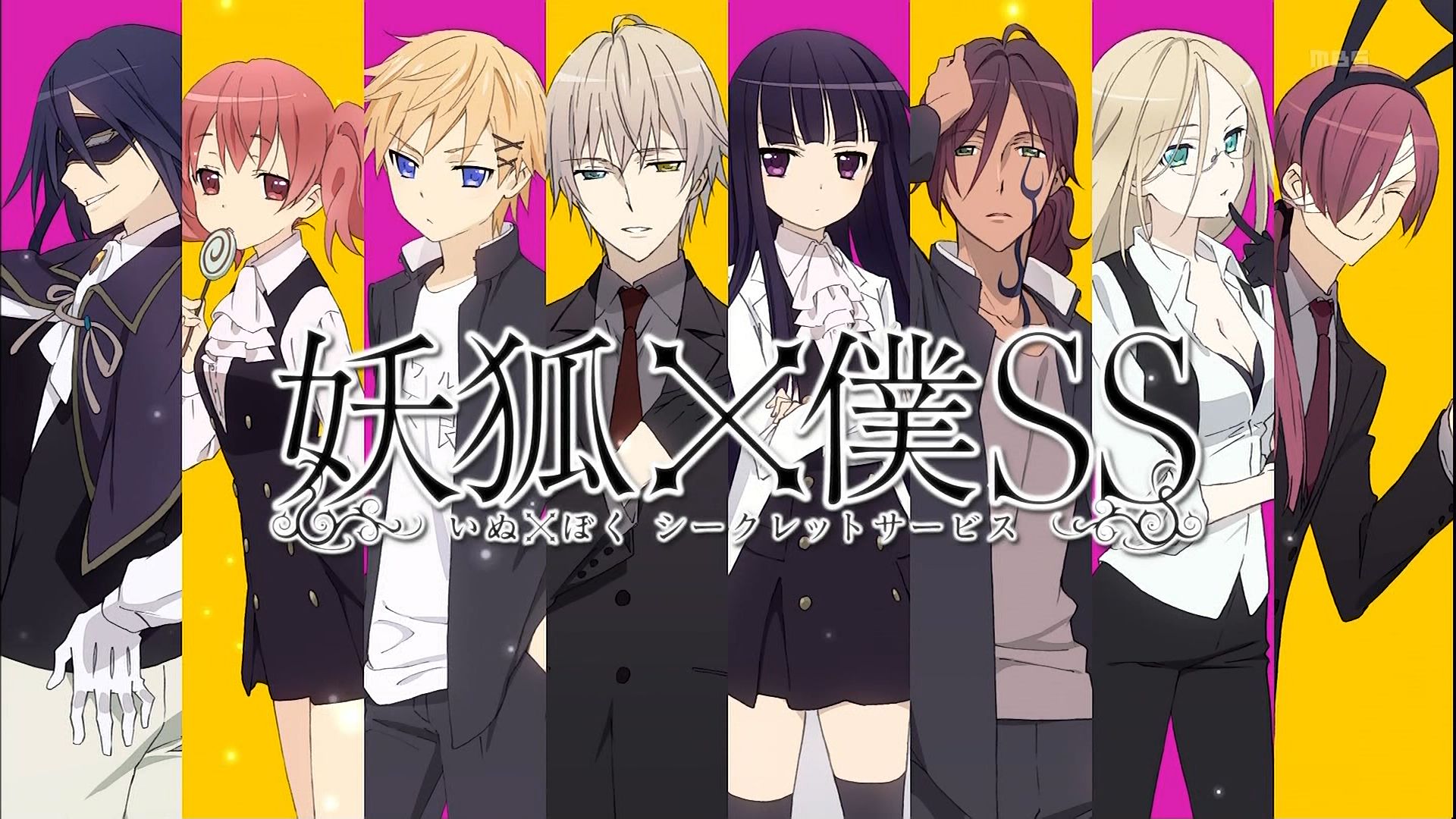
Inu x Boku Secret Service
aka Inu × Boku SS, Inu Boku Shīkuretto Sābisu, The Dog and Me Secret Service), Youko x Boku
Number of Episodes: 12
What Wikipaedia says: "The Maison de Ayakashi, better known as the Ayakashikan, is a high security apartment building where humans with demon ancestors, or yōkai, reside, each guarded by their own Secret Service bodyguard. A yōkai girl named Ririchiyo Shirakiin moves into the Ayakashikan hoping for some peace and quiet. Instead, she finds herself with the service of the Secret Service agent, Soushi Miketsukami."
tTPO says: This show was what it was. It set out to be a romantic non-harem series with some side characters and ended up being exactly that. It was not plot heavy and kept its focus sensibly, for a short series, on the characters and the place they lived.
The main characters certainly (and the side characters to a variable extent) have some background and depth giving motivation to their actions, though it would wrong to say there were not some characters present there for comic relief and to just stir the pot. Not that this is a bad thing - if it was good enough for Shakespeare to have a jester or 2 then it's difficult to criticise it in anime.
Problems? Putting aside the seven year difference between the 22 year old male protagonist and the (nearly) 15 year old female protagonist (and no there was nothing even resembling a hint of sex at any stage, despite no shortage of fan service with some of the side characters) there is little in here to offend anyone. Also the supernatural backgrounds of the main characters don't get much exploration, and all things considered there is not much serious drama or tension. It all seems just a little easy at times. Is that good enough?
How About the Music?: The OP ("Nirvana" by MUCC) is a proficient bit of J-rock though erring on the generic side. Has a bit more get up and go in the live format though. I'm not sure the image of the band (now I've seen them) matches with the anime. I'm guessing it was all about the music.
There were a few too many EDs to talk about.
So How Does it End? (Spoiler Free): The show ended well, with a good reveal in the second to last episode which tied up some loose ends, leaving things to wind down nicely in the last episode. Satisfying.
Overall Grade: C. It set its aim low, and easily cleared the bar. However, there are more compelling shows you should probably be watching.
(NB: When reading up to write this review I see that there are dramatic events that occur in the manga not long subsequent to the end of where the anime ceases. So much so that the events of the anime are considered a prologue to what comes later. I didn't see that coming. If the anime had gone down that road though things may have been rated very differently.)
Number of Episodes: 12
What Wikipaedia says: "The Maison de Ayakashi, better known as the Ayakashikan, is a high security apartment building where humans with demon ancestors, or yōkai, reside, each guarded by their own Secret Service bodyguard. A yōkai girl named Ririchiyo Shirakiin moves into the Ayakashikan hoping for some peace and quiet. Instead, she finds herself with the service of the Secret Service agent, Soushi Miketsukami."
tTPO says: This show was what it was. It set out to be a romantic non-harem series with some side characters and ended up being exactly that. It was not plot heavy and kept its focus sensibly, for a short series, on the characters and the place they lived.
The main characters certainly (and the side characters to a variable extent) have some background and depth giving motivation to their actions, though it would wrong to say there were not some characters present there for comic relief and to just stir the pot. Not that this is a bad thing - if it was good enough for Shakespeare to have a jester or 2 then it's difficult to criticise it in anime.
Problems? Putting aside the seven year difference between the 22 year old male protagonist and the (nearly) 15 year old female protagonist (and no there was nothing even resembling a hint of sex at any stage, despite no shortage of fan service with some of the side characters) there is little in here to offend anyone. Also the supernatural backgrounds of the main characters don't get much exploration, and all things considered there is not much serious drama or tension. It all seems just a little easy at times. Is that good enough?
How About the Music?: The OP ("Nirvana" by MUCC) is a proficient bit of J-rock though erring on the generic side. Has a bit more get up and go in the live format though. I'm not sure the image of the band (now I've seen them) matches with the anime. I'm guessing it was all about the music.
There were a few too many EDs to talk about.
So How Does it End? (Spoiler Free): The show ended well, with a good reveal in the second to last episode which tied up some loose ends, leaving things to wind down nicely in the last episode. Satisfying.
Overall Grade: C. It set its aim low, and easily cleared the bar. However, there are more compelling shows you should probably be watching.
(NB: When reading up to write this review I see that there are dramatic events that occur in the manga not long subsequent to the end of where the anime ceases. So much so that the events of the anime are considered a prologue to what comes later. I didn't see that coming. If the anime had gone down that road though things may have been rated very differently.)
Tuesday, 26 November 2013
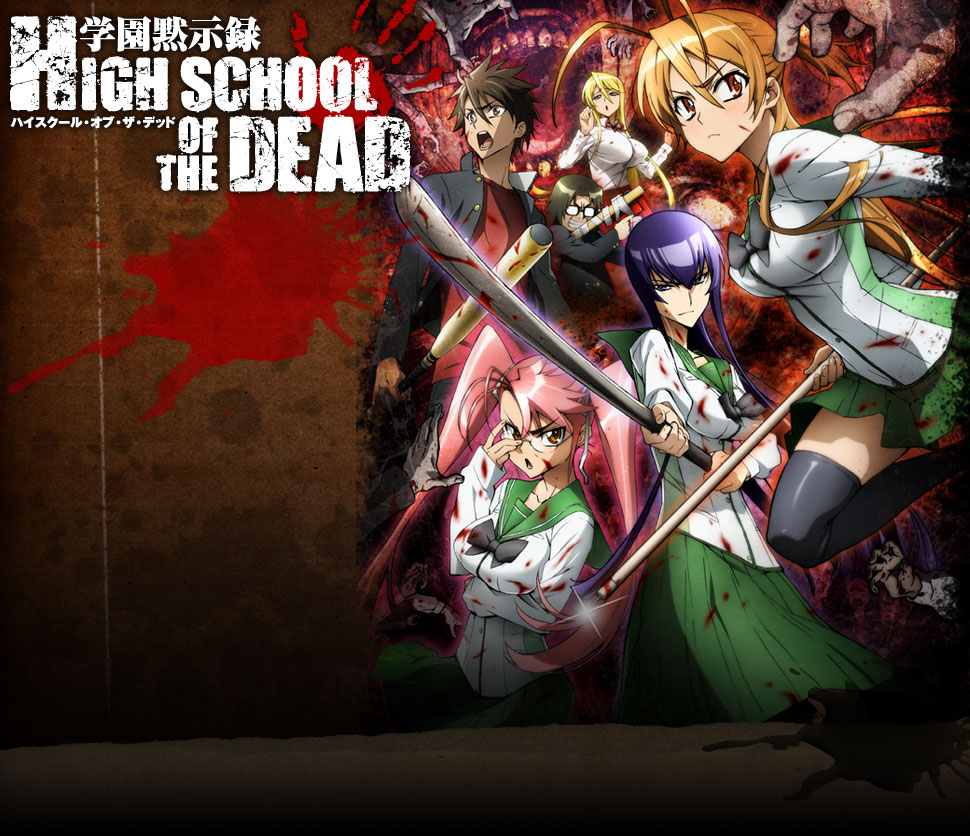
High School of the Dead
Number of Episodes: 12 + 1 OVA

What Wikipedia says: "Highschool of the Dead is an anime series adapted from the manga of the same name written by Daisuke Sato and illustrated by Shoji Sato. The series is set in the present day, beginning as the world is struck by a deadly pandemic that turns humans into zombies. The story follows Takashi Komuro, a student at Fujimi High School who survived the initial outbreak along with several of his classmates and the school nurse, and occasionally jumps to the perspective of other characters. As the group tries to survive the zombie apocalypse, they must also face dangerous fellow survivors and the decay of their own moral codes."
KoanMan says: The director of "Highschool of the Dead" Tetsuo Araki certainly had booty on his mind when he rendered this anime, originally penned by Manga author Daisuke Satō.
The plot is reasonably simple, this is a Zombie movie after all. However it is surprising, that terribly cheesy moments, complete with the silly sound effects, are interspersed with moments of intense gravity. The character and relationship development is great with the formation of their erstwhile "family" one of the most enjoyable aspects. The personalities are different enough to add real texture to the story.
The OVA is not important to the general story, but includes a little humour.
How About the Music?: Beyond the copious décolletage, the opening sequence music, "Highschool of the Dead" by Kishida Kyoudan and the Akeboshi Rockets (live version at the link), is fantastic! KoanMan realises this is completely personal, but it fits perfectly with the post-modern pop style of the visuals, and goes well with the Zombie apocalypse theme. There are more EDs than you can poke a stick at (each episode has a different one) so I'm sure there is something for everyone here.
So How Does it End? (Spoiler Free): Satisfactorily. But the journey is very much a continuing one.
Overall Grade: KoanMan gives this a solid B. One is male, of course. Roll on Season 2.
Addendum (by tTPO): HOTD is not without its flaws - there is a recap episode at episode 4 (is that some kind of record?) and as a show focussing on teenagers it fails to escape the trope that most adults are useless and as KoanMan has outline already, there are more than a few cheesy moments. It does succeed though at many things. The animation is great, the scale of the disaster is awesome thought the journey is personal, and by the end of the series there has been more than a little development of the main characters. But most importantly, for a show which is defined to a large extent by the fan service, the creative team seem to have really given some thought to how can we do this differently, and I think they succeeded. Not all the time mind you (note the obligatory bathhouse episode and the unneccessary OVA) but they did the near impossible in making some gratuitous fan service interesting. Put oll of this together and you have and entertaining and above-average series. B+
What Wikipedia says: "Highschool of the Dead is an anime series adapted from the manga of the same name written by Daisuke Sato and illustrated by Shoji Sato. The series is set in the present day, beginning as the world is struck by a deadly pandemic that turns humans into zombies. The story follows Takashi Komuro, a student at Fujimi High School who survived the initial outbreak along with several of his classmates and the school nurse, and occasionally jumps to the perspective of other characters. As the group tries to survive the zombie apocalypse, they must also face dangerous fellow survivors and the decay of their own moral codes."
KoanMan says: The director of "Highschool of the Dead" Tetsuo Araki certainly had booty on his mind when he rendered this anime, originally penned by Manga author Daisuke Satō.
The plot is reasonably simple, this is a Zombie movie after all. However it is surprising, that terribly cheesy moments, complete with the silly sound effects, are interspersed with moments of intense gravity. The character and relationship development is great with the formation of their erstwhile "family" one of the most enjoyable aspects. The personalities are different enough to add real texture to the story.
The OVA is not important to the general story, but includes a little humour.
How About the Music?: Beyond the copious décolletage, the opening sequence music, "Highschool of the Dead" by Kishida Kyoudan and the Akeboshi Rockets (live version at the link), is fantastic! KoanMan realises this is completely personal, but it fits perfectly with the post-modern pop style of the visuals, and goes well with the Zombie apocalypse theme. There are more EDs than you can poke a stick at (each episode has a different one) so I'm sure there is something for everyone here.
So How Does it End? (Spoiler Free): Satisfactorily. But the journey is very much a continuing one.
Overall Grade: KoanMan gives this a solid B. One is male, of course. Roll on Season 2.
Addendum (by tTPO): HOTD is not without its flaws - there is a recap episode at episode 4 (is that some kind of record?) and as a show focussing on teenagers it fails to escape the trope that most adults are useless and as KoanMan has outline already, there are more than a few cheesy moments. It does succeed though at many things. The animation is great, the scale of the disaster is awesome thought the journey is personal, and by the end of the series there has been more than a little development of the main characters. But most importantly, for a show which is defined to a large extent by the fan service, the creative team seem to have really given some thought to how can we do this differently, and I think they succeeded. Not all the time mind you (note the obligatory bathhouse episode and the unneccessary OVA) but they did the near impossible in making some gratuitous fan service interesting. Put oll of this together and you have and entertaining and above-average series. B+
Saturday, 30 March 2013
Amnesia
Number of Episodes: 12
What Anime News Network
tTPO says: And so it begins. It seemed interesting enough. Until you realise the main protagonist is not getting her memories back, and remains vague, distant and amazingly uninteresting for nearly all of the show. Ironically enough, the male (harem) characters all tease us with the fact she is not as lively as she used to be before she lost her memories. Sadly we never get to see that potentially involving character we may have had some empathy with.
The five main male characters have at least a little depth to them. Bar one though they are all pretty unlikeable because they are either extradimensional and impotent, or have a varying degree of psychological pathology. The only sane guy (Ken) gets shoveled into a single episode only.
If I was being kind I would say the character design was a bit interesting, especially the eyes. And the Clamp style elongated characters. But that's hardly a reason to spend 4 hours watching the series.
How About the Music?: There is a bright light here. The OP ("Zoetrope" by Nagi Yanagi) is actually a bit of dark powergirl rock that may be the next most interesting thing in the series aside from the drawing of the irises. The ED ("Recall" by Ray) is from the same genre but doesn't work as well as the OP.
So How Does it End? (Spoiler Free): Awfully. Never before have I seen such a literal use of deus ex machina. It is a resolution. But a very bad one.
Overall Grade: This is a series that sucks you in at the beginning, hoping there may be some development. But there isn't. Amnesia flips you the bird and you will never get that time back. Grade D. Just execrable.
Sunday, 30 September 2012
Binbō-gami ga!
Number of Episodes: 13
What Wikipedia says: "Ichiko Sakura is a 16-year old high schooler who has always been pretty lucky throughout her life. This is due to her body possessing an extraordinary amount of Fortune energy, which draws from its surroundings, causing the world to fall out of balance. To rectify this, a God of Misfortune named Momiji is sent to the human world to target Ichiko and steal her Fortune energy in order to rebalance the world.."
tTPO says: The summary above pretty much sums things up with the focus on this continually amusing and comically violent struggle. The comedy is pretty straightforward most of the time (and very self aware and self deprecating, and not lacking in fan service) and there are some anime in-jokes to reward the true otaku (I am sure I probably missed some of these). The cast slowly builds with time and this is a good thing as it allows some character development in an otherwise (deliberately) shallow series.
This to me sums up the spirit of the show - the studio & writers (it is based on a manga) did not sacrifice the basics of good pacing both within and between episodes, interesting main characters with some development and having a coherent plot just because it was not a story heavy series. Nothing disappointments me more as a viewer than gaping plot holes or rubbish pacing when these issues are so easily recitified.
How About the Music?: The OP ("Make my Day!" by Piko) was pleasantly frenetic and a good way to start things. The ED ("Love Riot" by HAPPY BIRTHDAY) is a bit demented 60's of sorts, but for me a bit more meh.
So how does it end? (Spoiler Free): Surprisingly well. There is not a vast complex plot here (Steins;Gate this is not) and yet they took what they had and fashioned a more than satisfactory ending, while leaving a few things open ended for another series. And had an all to brief awesome fight on top of moving traffic.
Overall Grade: Even if not overly ambitious, this is a series that got the balance pretty much about right. Grade B.
Tuesday, 26 June 2012
Dusk Maiden of Amnesia
aka Tasogare Otome × Amunejia
Number of Episodes: 12
What Wikipedia says: "The story revolves around a first-year middle school student, Teiichi Niiya who had just enrolled at Seikyou Private Academy. When he gets lost in one of the school's old building, he meets a girl named Yuuko Kanoe who reveals herself as a ghost with no memories. Teiichi then decides to investigate her death by looking through the school's seven mysteries revolving around her. Throughout the story, Teiichi and Yuko discover the truth about these ghost stories and help those who are troubled."
tTPO says: I must admit I was a bit unsure of this series when it started as it didn't really seem to know where it was going initially - comedy was mixed in with gratuitous fan service next to the romance, suspense, mystery and mild supernatural horror. However Mrs tTPO and I stuck with it and were glad we did. As the series progressed and more was revealed the plot and the feel of the show came more coherent, focusing more on the main characters and plot. In the process of doing this it lost much of the trivial fan service and comedy (though not quite) and gained more drama and atmosphere. The pacing at the end was pretty good and I am glad this was not a 24 episode series.
How About the Music?: The OP (Choir Jail by Konomi Suzuki) comes from the Evanescence / Paramore school of rock power ballads with female vocals. This is not my favourite genre but dammit if the song is not a) appropriate and b) a bit catchy.
The ED (Karandorie / Calendrier by Aki Okui) has a folky village waltz feel to it, and reminded me an awful lot of the opening theme to Spice and Wolf (Tabi no Tochuu). This is not necessariy a bad thing though (and I may be biased here) I felt the waltz time probably suited the medieval feel of Spice and Wolf better.
So how does it end? (Spoiler Free): As well as it possibly could have. The ending carried significant emotional weight and was consistent with its own internal logic, and I don't think you can ask for more than that. Though we were left thinking whether the final outcome was actually going to be the best outcome for Teiichi long term.
Overall Grade: This was another series that got a boost from a good ending. Despite the slightly wacky initial pacing and feel, stick with it - the latter half of the series more than makes up for it. Mrs tTPO and I agree: Grade B.
Monday, 23 April 2012
Another
Number of Episodes: 12 + OVA Prequel
What Wikipedia says: "In 1972, popular honors student Misaki died partway through the school year in Yomiyama North Middle School’s class 3-3. The rest of the students and teachers, devastated by the unexpected loss, decided to carry on as if Misaki were still alive, going so far as to keep the desk in the classroom and bringing it to the graduation ceremony. Yet no one could explain why Misaki was present on the graduation photo, deathly pale yet smiling with the rest.
In spring 1998, 15-year-old Kōichi Sakakibara arrives in Yomiyama from Tokyo, to stay with his grandparents while his father works in India. He transfers into Class 3-3, but misses the first few weeks by a pneumothorax of his left lung. While in the hospital, he receives a visit from some of his new classmates. Later, he meets a mysterious girl wearing the school uniform and an eyepatch, named Mei Misaki, who seems to be visiting the morgue.
What Wikipedia says: "In 1972, popular honors student Misaki died partway through the school year in Yomiyama North Middle School’s class 3-3. The rest of the students and teachers, devastated by the unexpected loss, decided to carry on as if Misaki were still alive, going so far as to keep the desk in the classroom and bringing it to the graduation ceremony. Yet no one could explain why Misaki was present on the graduation photo, deathly pale yet smiling with the rest.
In spring 1998, 15-year-old Kōichi Sakakibara arrives in Yomiyama from Tokyo, to stay with his grandparents while his father works in India. He transfers into Class 3-3, but misses the first few weeks by a pneumothorax of his left lung. While in the hospital, he receives a visit from some of his new classmates. Later, he meets a mysterious girl wearing the school uniform and an eyepatch, named Mei Misaki, who seems to be visiting the morgue.
Once recovered, Kōichi goes to school and tries to adapt. His aunt Reiko, a teacher at Yomiyama North, gives him a few pointers, but, like his peers, remains evasive when it comes to their behavior towards Mei, whom they treat as if she doesn't exist. Kōichi is further confounded by the air of mystery around Class 3-3 and its isolation from other classes, even practicing P.E. separately.
Tensions suddenly rise when one of Kōichi's classmates, Yukari Sakuragi, slips while running down the stairs and dies, impaled on the sharp end of her umbrella. This is one of many deaths related to Class 3-3 which have Kōichi and his friends Mei, Naoya Teshigawara, Tomohiko Kazami, and Yūya Mochizuki, trying to unravel the mystery of 1972’s Misaki and the senseless "Curse of Class 3-3"."
What tTPO says: This series is horror done (mostly) right. The heavy atmosphere and sense of suspense and forboding (think "The Others") dominate the majority of the episodes (even the beach episode which was an achievement in itself) and I mean this in a good way. It opens with several anime and horror genre cliche's that left me wondering about the substance of what was to follow but fortunately most of these were quickly subverted. What did then follow was a well paced unfolding of events and characters with deliciously gradual reveals that slowly built up the fairly detailed plot that had me looking forward to the next episode. The mechanics of the curse I found generally consistent and understandable (though this blog is handy if there are any bits you miss) though I can't say this was always the case with repect to how it affected human behaviour. Some things apparently you just have to go with the flow. You'll see what I mean starting the end of episode 6.
How About the Music? If I close my eyes and listen to the OP (Kyoumu Densen by Ali Project) I can just imagine I am listening to the ED1 of Code Geass (Hero Youth Song, strangely enough also by Ali Project). This is not really a good thing. Ali Project should learn to write another song. Or maybe not since they have probably got some good pocket money from having done the themes to two different animes.
The ED ("anamnesis" by Annabel, though I am unsure of what a medical history has to do with the series) on the other hand is a perfect choice and captures the sadness of the series perfectly. Win.
So how does it end? (Spoiler Free. Mostly. You are warned.): And now to the Achilles heel of the series. I have read some other reviews that thought that the ending of the manga was not as good as the anime. I have to disagree. That is not to say the ending is bad because the plot is pretty well resolved (with a recap on the clues in case you missed), but the feeling of the series goes from atmospheric horror, to slasher. Some characters die that really don't have to, and at least one characters death which is left pleasantly ambiguous in the manga is clarified in the anime, but ironically this just lead to more confusion (to me at least). And for a series that is so dependent on its tone and had executed the tone so well it is all a bit jarring for a series that was near perfect to that point. :(
Overall Grade: Grade A-. If they just got the tone of the ending right this would have gone an A. So very close. Watch it anyway. Then read the last few episodes of the manga.
(Addendum: Watch the OVA prequel. While this does not fix the ending issues it does flesh out very nicely where this all started. More of the good stuff and worth watching afterwards.)
What KoanMan says: It has been a while since KoanMan indulged in a good ghost story and "Another" is just that. The plot is a little light-on and moves slowly, although the body-count certainly helps distract from that. There is blood - and regularly.
However, the stand-out feature of this series is the mood. The director has used every trick in the "spooky" book to generate a great atmosphere, which continues throughout every episode. The music is great, and with exceptional sound effects, adds to the experience. The whole team has put in some serious effort here and it shows.
The characters could have done with more development, and with more clues could have been a mystery as well. The clues are there, although they were easily missed. Even in retrospect, they are sparse.... It would have added another dimension (pardon the pun).
The story is cohesive and finished well. A good watch without going overboard on the ghost theme - this type of story can be overdone though this was not the case here.
"Another" came very close to full marks, and with more plot and character development it could have been there. KoanMan gives this a solid B.
Friday, 20 April 2012
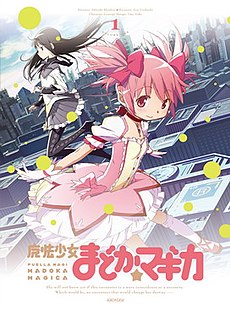
Puella Magi Madoka Magica
Number of Episodes: 12
What Wikipedia says: "In this world, there exist strange creatures who have the power to grant one wish to a chosen girl. However, in exchange, that girl must then become a magical girl and use her powers to fight against witches, evil creatures born from darkness that are responsible for murders and suicides.
In the city of Mitakihara, a schoolgirl named Madoka Kaname and her friend Sayaka Miki are approached by a familiar named Kyubey, who offers to grant each of them one wish in return for making each of them a magical girl. Another magical girl named Homura Akemi tries to prevent Madoka from making such a deal, while Kyubey urges Madoka by telling her she will become the most powerful magical girl. However, contrary to the glamorous notions one would expect, a magical girl finds herself dealing with death, isolation, loss of humanity, agony over the value of her wish, and existential crisis. Madoka, following her friends, soon sees the darker side of being a magical girl, and because of knowing the truth about being a magical girl, she questions if she should become one as well."
What tTPO says: Holy crap. Just finished this and my mind is melting with the goodness of this series. For tTPO anything this good crammed into 12 episodes where the pacing never faulters is a great start. It seems that each episode has a reveal of some sort that changes the direction of the whole series and to keep this up for the whole series is just amazing. It really is a masterclass in pacing.
Some anime series leave a lot to the imagination and for the viewer to do the work (see Mawaru-Penguindrum). This is not one of those series and it goes to great lengths to make sure (maybe with the exception of the last episode) the viewer knows what is going on. Usually not at the time you see it, so you still have time to puzzle it out yourself, but eventually most things are explained well. And boy does the plot all tie together nicely. Even the 'physics' of the show. I liked that.
The animation of this was also facinating. On one hand you get the impression that the budget for this show was not a lot (I have no idea if this is the case or not) but what they did with artistic vision and imagination was just stunning, making this (in my limited experience) a unique visual presentation for the genre and anime generally.
Lastly there is the feel of the show. Many other reviews talk about the deconstructive nature of this series and it is just so true. It really does dismember the magical girl genre in the face of 'reality' methodically and brilliantly. For me it ended up with the same sinking feeling as Watchmen when I first saw (then read) it. I am guessing the core themes of the superhero genre and the magical girl genre are not so far apart.
How About the Music? The OP (Connect by ClariS, and while a video is hard to find this one is particularly awesome) is a fully serviceable bit of J-Pop that I think is improved by the series it fronts. Usually its the other way round but I do like this song. While on that note the opening credits are amusing in that they are typical for the genre but really only serve to lead the viewer astray as to the direction of the series. ED1 is a light J-pop song but only last 2 episodes before the series and the EDs tread a darker path. The ED2 (Magia by Kalafina) is a lot more epic in an emo-rock kind of way but did not work quite so well for me. ED3 (And I'm Home by Ai Nonaka & Eri Kitamura) only lasts a single episode (#9) but for me is the pick of the EDs. And then someone slowed it down by 8 times thus producing shoegaze epic which sounds even better (and uncannily like Slowdive). Who would have thought?
So how does it end? (Spoiler Free): I did wonder how the hell this was going to end and they managed to do it on an epic scale in a way that actually made sense within the context of the story, and was not just a big hit of the reset button. In a strange way it ends up establishing the typical ground rules for the genre it deconstructs. If I had a complaint though it would be that the epic nature of the ending made it just a little less personal and consequently less involving with the characters we knew and loved. But that is a very minor complaint.
Overall Grade: Grade A. Ignore that fact this seems to be a show about magical girls. Just watch it. I'm talking to you Beukesy and Koanman.
Addendum by Koanman: Every now and then, a series provokes genuine thought, and this series is one of those. It is nothing short of majestic in its scope. It challenges the idea of universal morality, or confirms natural amorality, depending on your stance. This series was riveting from start to finish, with interesting new additions to the plot constantly keeping things on the move. The visual effects are second to none, at times disturbing, and yet appear fashioned from the simplest animation techniques.
Madoka Kaname and her side-kick Sayaka Miki are super-sweet personalities, luckily balanced by some sincerely dark undertones. Which brings us to Homura Akemi, who is a more interesting character that really does take the entire series to fully develop. This is a real personal-power story, incorporating beautiful images at some times, and superb portrayals of anger at others. There is a lot that one can associate closely with in this series. It gets an A.
Addendum by Koanman: Every now and then, a series provokes genuine thought, and this series is one of those. It is nothing short of majestic in its scope. It challenges the idea of universal morality, or confirms natural amorality, depending on your stance. This series was riveting from start to finish, with interesting new additions to the plot constantly keeping things on the move. The visual effects are second to none, at times disturbing, and yet appear fashioned from the simplest animation techniques.
Madoka Kaname and her side-kick Sayaka Miki are super-sweet personalities, luckily balanced by some sincerely dark undertones. Which brings us to Homura Akemi, who is a more interesting character that really does take the entire series to fully develop. This is a real personal-power story, incorporating beautiful images at some times, and superb portrayals of anger at others. There is a lot that one can associate closely with in this series. It gets an A.
Labels:
Action,
Arty,
Drama,
Fighting,
Grade A,
Mystery,
School,
Science Fiction,
Supernatural
Wednesday, 11 April 2012
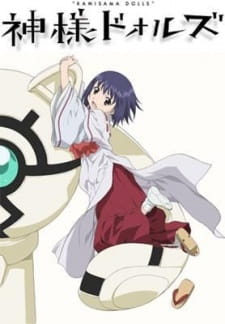
Kamisama Dolls
Number of Episodes: 13 + 6 bonus mini-episodes
WhatWikipeda Anime News Network says: "
Kyouhei Kuga is a young man who has left his small hometown to
escape from its anachronistic rules and traditions. He wants to try a
new life in Tokyo as a simple university student. In the past he was a
seki, title given to individuals who are able to control the mysterious
kakashis. Considered as gods in the small Karakami village, the kakashi
are ancient wooden wonders able to perform incredible feats. The escape
of a seki from the provincial town abruptly brings to Tokyo a handful of
other seki who are searching for him. Despite being so far away,
Kyouhei is still haunted by the old laws and hatred between the two main
families, the Kuga and the Hyuga."
What
tTPO says: This series actually has a pretty interesting premise, and a bunch of good characters whose backgrounds and motivations are well explored. Well, except for one particularly annoying female but even her motivation is pretty clear. Where it all somes to pieces is the plot (such as it is). It just rolls along with events just sort of flowing into each other without any clear direction. Instead of a beginning, a middle and an end, it ends up being a middle, a beginning (told in pieces and probably the most interesting bit), followed by more middle, finally disappearing up its own backside in a series of amazingly irrelevant (even by their generally low standards) two minute 'specials'. Even the fanservice was unimaginative.
Yet another plot annoyance was that, given the initial secrecy associated with the dolls, there are a number of extremely public doll battles in and over Tokyo of which there seems to be no public consequence.
How About the Music?: The OP, "Fukanzen Nunshou" by Chiaki Ishikawa (this link is a fancover but finding the original is rather hard) is a refreshing flamenco piece, and significantly better than the series it fronts. The ED I struggle to describe aside from being interesting and no J-pop or rock. Worth a listen. And also better than the series.
So how does it end? (Spoiler Free): Not well. This series can be added to the unfortunate
group where there is little resolution to the story and if you get a
second series (good luck) then you may or may not get some sort of
satisfaction.
Overall Grade: Despite initial appearances, there is no satisfaction to be had with the plot or ending here, only frustration at what could have been. Of course if there is a second series I may need to re-evaluate this. I'm not holding my breath. And I'm not bothering with the manga. Grade D.
Tuesday, 29 November 2011
Shiki
Number of episodes: 22 + 2 OVA
What Wikipedia says: "Shiki (Eng. Corpse Demon) is a horror novel by Japanese novelist Fuyumi Ono, originally published...in 1998. An anime adaptation by Daume began broadcasting on July 8, 2010. The story takes place in a particularly hot summer in the nineties, in a small quiet village called Sotoba. A series of mysterious deaths begin to spread in the village, at the same time when a strange family moves into the long abandoned Kanemasa mansion. Toshio Ozaki, dean of the only hospital in Sotoba, initially suspects an epidemic. But as investigations continue and the deaths begin to pile up, he becomes convinced that they are the work of the undead plaguing the village. A young man named Natsuno Yuuki, who hates living in the village, begins to be pursued and surrounded by death."
What tTPO says (mild spoilers of a very general nature): Shiki is an interesting twist on the currently popular vampire genre. The animation is smoothly done with appealing character drawing though I know of a few people somewhat disturbed by the eyes of the vampires. The story opens slowly, but don't be mislead by the walking pace of the early episodes. They are a reflection of the slow pace of life in Sotoba, and necessary to start introducing the massive cast (which seems to cover most of the small villages occupants). Thankfully, there are a more manageable number of main characters to follow. Events turn bad only slowly with the tension gradually building in a somewhat Shakespearean way culminating in Dr Osaki proving he is one of the hardest bastards ever to hit anime. (There is another main character who is the yin to his yang and turns out to be one of the most spineless characters anime has seen for some time. But that is the sort of extremes typical for this series.) After that the conflict is well and truly on right to the end of the series and the body count on all sides is staggering. As in most wars, there no real winners and the moral high ground, initially held by the humans is all but left abandoned by the end of the series.
There are many striking moments during the conflict (no punches are pulled) including one of the blackest humorous deaths I can remember in the last episode - you will know it when you see it. Another interesting aspect of Shiki, courtesy of Dr Ozaki in the early part of the series, is the consideration of vampirism as a disease. This scientific approach (and being trained in such things his science is pretty solid for a piece of fiction) appears to fuel his apparently dispassionate attitude, which contrasts with the ironically more emotional approach of his adversaries. All this irony just adds to the central question of the series - just who are the monsters here?
How about the music?: The music is distinctive and works very well for the series. The OP1 reflected the tension in the earlier episodes and the ED1 the sadness. The second half series songs are a bit more dramtic, with the OP2 a faster paced more Evanescence-esqe number (not my style but still very appropriate for the increasing action in the series). The reflective but pulsing ED2 is probably my least favourite, but in amongst the good company here, that does not mean much and it remains orders of magnitude above much of the generic J-rock dross that pollutes the credits of anime.
So how does it end? (Spoiler Free): Plot heavy series need good endings. Shiki does not disappoint. The series is wrapped up well in episode 22 with the two OVA filling in some of the missing details of some of the events only heard about by the main characters in the main body of the series. There are only a few minor plot points left unexplained. These are easily forgiven.
Overall Grade: Grade A (Compulsory viewing). This is a headstrong, deliberately paced, plot driven anime with strong characterisations within its massive cast (which keeping track of would be my only small complaint). Avoid if you are not prepared for significant violence, and a less than optimistic view of humanity. For everyone else, it is like a slow-motion car crash, and hard not to watch.
What Wikipedia says: "Shiki (Eng. Corpse Demon) is a horror novel by Japanese novelist Fuyumi Ono, originally published...in 1998. An anime adaptation by Daume began broadcasting on July 8, 2010. The story takes place in a particularly hot summer in the nineties, in a small quiet village called Sotoba. A series of mysterious deaths begin to spread in the village, at the same time when a strange family moves into the long abandoned Kanemasa mansion. Toshio Ozaki, dean of the only hospital in Sotoba, initially suspects an epidemic. But as investigations continue and the deaths begin to pile up, he becomes convinced that they are the work of the undead plaguing the village. A young man named Natsuno Yuuki, who hates living in the village, begins to be pursued and surrounded by death."
What tTPO says (mild spoilers of a very general nature): Shiki is an interesting twist on the currently popular vampire genre. The animation is smoothly done with appealing character drawing though I know of a few people somewhat disturbed by the eyes of the vampires. The story opens slowly, but don't be mislead by the walking pace of the early episodes. They are a reflection of the slow pace of life in Sotoba, and necessary to start introducing the massive cast (which seems to cover most of the small villages occupants). Thankfully, there are a more manageable number of main characters to follow. Events turn bad only slowly with the tension gradually building in a somewhat Shakespearean way culminating in Dr Osaki proving he is one of the hardest bastards ever to hit anime. (There is another main character who is the yin to his yang and turns out to be one of the most spineless characters anime has seen for some time. But that is the sort of extremes typical for this series.) After that the conflict is well and truly on right to the end of the series and the body count on all sides is staggering. As in most wars, there no real winners and the moral high ground, initially held by the humans is all but left abandoned by the end of the series.
There are many striking moments during the conflict (no punches are pulled) including one of the blackest humorous deaths I can remember in the last episode - you will know it when you see it. Another interesting aspect of Shiki, courtesy of Dr Ozaki in the early part of the series, is the consideration of vampirism as a disease. This scientific approach (and being trained in such things his science is pretty solid for a piece of fiction) appears to fuel his apparently dispassionate attitude, which contrasts with the ironically more emotional approach of his adversaries. All this irony just adds to the central question of the series - just who are the monsters here?
How about the music?: The music is distinctive and works very well for the series. The OP1 reflected the tension in the earlier episodes and the ED1 the sadness. The second half series songs are a bit more dramtic, with the OP2 a faster paced more Evanescence-esqe number (not my style but still very appropriate for the increasing action in the series). The reflective but pulsing ED2 is probably my least favourite, but in amongst the good company here, that does not mean much and it remains orders of magnitude above much of the generic J-rock dross that pollutes the credits of anime.
So how does it end? (Spoiler Free): Plot heavy series need good endings. Shiki does not disappoint. The series is wrapped up well in episode 22 with the two OVA filling in some of the missing details of some of the events only heard about by the main characters in the main body of the series. There are only a few minor plot points left unexplained. These are easily forgiven.
Overall Grade: Grade A (Compulsory viewing). This is a headstrong, deliberately paced, plot driven anime with strong characterisations within its massive cast (which keeping track of would be my only small complaint). Avoid if you are not prepared for significant violence, and a less than optimistic view of humanity. For everyone else, it is like a slow-motion car crash, and hard not to watch.
Labels:
Drama,
Grade A,
Horror,
Supernatural
Sunday, 16 October 2011
Angel Beats
Number of episodes: 13+OVA+Another Epilogue
What Wikipedia says: "The story was originally conceived by Jun Maeda, who also wrote the screenplay and composed the music with the group Anant-Garde Eyes, with original character design by Na-Ga; both Maeda and Na-Ga are from the visual novel brand Key, who produced such titles as Kanon, Air, and Clannad.
The story takes place in the afterlife and focuses on Otonashi, a boy who lost his memories of his life after dying. He is enrolled into the afterlife school and meets a girl named Yuri who invites him to join the Battlefront (Shinda Sekai Sensen (SSS)) — an organization she leads which fights against God for the cruel fates the SSS members experienced in life. The Battlefront fight against the student council president Angel, a girl with supernatural powers. While the injury or cause of death are gone, those in the afterlife school can still feel pain or other things as they did when they were alive, as well as dying again, only to awaken with no injuries several minutes later."
What tTPO says: This series is full of comedy, violence, imagination and love with the overall flavour inherently bittersweet. All the characters are dead, all (bar one) are in limbo because they have some baggage from their previous lives, and are all broken to some extent. Yuri (bearing more than a passing resemblance to Haruhi Suzumiya, though I didn't see this as a bad thing - some may do though) carries more than most, leading to her anger with God, often taken out on other characters, and the formation of the SSS.
It is unfortunate though, due to the short length of the series, that many of the character backstories (as well as the backstories of the truly fascinating setup of the SSS and school itself) are not explored more. Which brings me to the major flaw of the series, which was its pacing. AAARGH! Why, when you know you have only a limited number of episodes, and you have a lot of story to tell, do you waste several episodes on largely stand-alone stories, entertaining though they were? The perfect example of this was the OVA. Instead of taking the opportunity to explore one of the numerous characters (and the cast is large for such a short series) more in depth, they have a ridiculous (albeit amusing) stand-alone episode (which fits in about episode 5-6 which is where I would strongly recommend watching it).
While this may sound like we are heading down the same road as Occult Academy, the two series otherwise could not be further apart. I loved the characters of Angel Beats and their stories, and the world in which the story takes place operates by its own interesting rules and I wanted to find out more about it. Also the fact no-one can die when you are already dead means there is more than a fair share of amusing (and some not so amusing) deaths. However, because the characters feel the pain of death, dying is never a completely frivolous matter.
How about the music?: Jun Maeda's love of music shines though in this series, where not only is it moving and brilliant, it is fundamental to the series. The opening (both versions - normal and rock) and closing themes are note perfect and some of my favourite music ever to come from an anime. There are multiple songs we hear through the course of the anime from the band Girl Dead Monster (made up of 4 members of the SSS), and while these, to my ear at least, are not quite as good as the OPs and ED, one ballad in particular is very affecting. It rarely gets better than this. Thus ends the gush.
So how does it end? (Spoiler Free): The major plotline is well wrapped up (you do need to pay attention to make the chronology of this add up, but it does) and it is a shameless tearjerker. I certainly shed a few. Maybe there is a bit too much of a change in one character but I have a lot of forgiveness for this. However, in the rush for time many minor character stories are left untold.
Overall Grade: Grade A (Must see this). This is not the perfect series. But despite the MAJOR pacing issues that plague this series (and an occasional plot hole), it engages on so many levels there can only be one grade. This will likely be the most flawed show to get the top grade. And when you have done with this go and read the light novels and/or the manga to fill in some of the story that never made it to the screen. Jun Maeda, I salute you. Now I am going to go and decide whether I should wear my Kanade, or my Angel handsonic-01 t-shirt?
Angel Beats will get a recommendation from KoanMan though it
did not make it to the top of the list.
It gets a B.
What Wikipedia says: "The story was originally conceived by Jun Maeda, who also wrote the screenplay and composed the music with the group Anant-Garde Eyes, with original character design by Na-Ga; both Maeda and Na-Ga are from the visual novel brand Key, who produced such titles as Kanon, Air, and Clannad.
The story takes place in the afterlife and focuses on Otonashi, a boy who lost his memories of his life after dying. He is enrolled into the afterlife school and meets a girl named Yuri who invites him to join the Battlefront (Shinda Sekai Sensen (SSS)) — an organization she leads which fights against God for the cruel fates the SSS members experienced in life. The Battlefront fight against the student council president Angel, a girl with supernatural powers. While the injury or cause of death are gone, those in the afterlife school can still feel pain or other things as they did when they were alive, as well as dying again, only to awaken with no injuries several minutes later."
What tTPO says: This series is full of comedy, violence, imagination and love with the overall flavour inherently bittersweet. All the characters are dead, all (bar one) are in limbo because they have some baggage from their previous lives, and are all broken to some extent. Yuri (bearing more than a passing resemblance to Haruhi Suzumiya, though I didn't see this as a bad thing - some may do though) carries more than most, leading to her anger with God, often taken out on other characters, and the formation of the SSS.
It is unfortunate though, due to the short length of the series, that many of the character backstories (as well as the backstories of the truly fascinating setup of the SSS and school itself) are not explored more. Which brings me to the major flaw of the series, which was its pacing. AAARGH! Why, when you know you have only a limited number of episodes, and you have a lot of story to tell, do you waste several episodes on largely stand-alone stories, entertaining though they were? The perfect example of this was the OVA. Instead of taking the opportunity to explore one of the numerous characters (and the cast is large for such a short series) more in depth, they have a ridiculous (albeit amusing) stand-alone episode (which fits in about episode 5-6 which is where I would strongly recommend watching it).
While this may sound like we are heading down the same road as Occult Academy, the two series otherwise could not be further apart. I loved the characters of Angel Beats and their stories, and the world in which the story takes place operates by its own interesting rules and I wanted to find out more about it. Also the fact no-one can die when you are already dead means there is more than a fair share of amusing (and some not so amusing) deaths. However, because the characters feel the pain of death, dying is never a completely frivolous matter.
How about the music?: Jun Maeda's love of music shines though in this series, where not only is it moving and brilliant, it is fundamental to the series. The opening (both versions - normal and rock) and closing themes are note perfect and some of my favourite music ever to come from an anime. There are multiple songs we hear through the course of the anime from the band Girl Dead Monster (made up of 4 members of the SSS), and while these, to my ear at least, are not quite as good as the OPs and ED, one ballad in particular is very affecting. It rarely gets better than this. Thus ends the gush.
So how does it end? (Spoiler Free): The major plotline is well wrapped up (you do need to pay attention to make the chronology of this add up, but it does) and it is a shameless tearjerker. I certainly shed a few. Maybe there is a bit too much of a change in one character but I have a lot of forgiveness for this. However, in the rush for time many minor character stories are left untold.
Overall Grade: Grade A (Must see this). This is not the perfect series. But despite the MAJOR pacing issues that plague this series (and an occasional plot hole), it engages on so many levels there can only be one grade. This will likely be the most flawed show to get the top grade. And when you have done with this go and read the light novels and/or the manga to fill in some of the story that never made it to the screen. Jun Maeda, I salute you. Now I am going to go and decide whether I should wear my Kanade, or my Angel handsonic-01 t-shirt?
Addendum by Koan Man: Angel Beats is and interesting if quirky concept, involving
a transcendental journey of self-discovery for the characters stuck between
life and death. The mood is up-beat (no
pun intended) with the over the top violence providing some dark humour
throughout. While I found pace
irregular, I did enjoy learning something new about the Angel Beats world or
the characters in almost every episode. The characters are surprisingly well
drawn, with vastly different personalities that somehow manage to mostly stay
together in one big dysfunctional family. It is a complex world with much that
goes unexplored in the time-frame, but a little of my own imagination in connecting
the dots here seemed to make the story as a whole even more interesting. Until
the end that is. While the conclusion
seems inevitable in hind-sight, it left me feeling like I had just missed out
on something, and did not live up to the rest of the story.
Saturday, 8 October 2011
Occult Academy
aka Seikimatsu Okaruto Gakuin
Number of episodes: 13
What Wikipedia says: "Set in the year of 1999, the story
revolves around the mysteries of the Waldstein
Academy also known as the "Occult Academy"
due to its unorthodox researches involving myths, legends and paranormal
activity. The main protagonists are Maya Kumashiro, daughter of the late
principal of the Academy who assumes his position and Fumiaki Uchida, a time traveller
sent from the year 2012 with the mission of finding and destroying the 'Nostradamus
Key', an unknown item that the Nostradamus Prophecies foretold to be the
cause of an alien invasion that will devastate Earth."
What tTPO says: Occult
Academy really had few
excuses. It was written for television (rather than having to face the
challenges of adapting from another medium), and the premise, which while
interesting enough, was not overly complex. Yet somewhere between conception
and execution things went very wrong. The series starts out satisfactorily
enough but soon wanders off into filler episodes with the main characters (charged
with saving the world) soon getting distracted by relatively trivial matters. I mean, why wouldn't you? It is only the END OF THE WORLD AS WE KNOW IT we are talking about here. Then,
around about episode 11, someone in production appears to have decided "we
had better finish this", and the final 3 episodes rush towards the finish
with several minor characters abruptly changing. It doesn't help that there is
not much to like about Maya (who doesn't appear to have worn any different clothes since she was about 6, just the same ones in larger sizes) or Uchida, though in later episodes there is a
little sympathy for Uchida as his childhood is revealed. At least the animation
is pretty.
How about the music?: The OP (by Japanese idol Nakagawa Shoko) is very likely the best thing about this series. Awesomely catchy J-rock
song with a singer that is more entertaining to watch than the show it opens
for. The ED is a bit of more generic pop.
So how does it end? (Spoiler Free): In a hurry, but ultimately most loose ends are
wrapped up satisfactorily. As you would hope in a made for TV anime.
Overall Grade: D (Don't bother). This is not the worst piece
of anime to hit the small screen but I cannot in good faith recommend this to
anyone. Poor pacing, unlikeable characters - it could have been so much better.
Enjoy Shoko-tan's version of the OP then go and find yourself something
else to watch.
Subscribe to:
Posts (Atom)