aka KanColle
Number of Episodes: 12 + Movie (KanColle: the Movie)
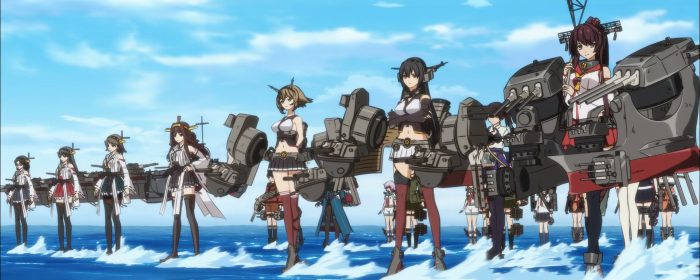
What Wikipedia says: In a world where humanity faces the threat of the abyssal fleet which has taken over the seas, special human girls who don weaponized outfits and possess the spirit of historical naval vessels known as kanmusu (艦娘, literally "fleet girls" or "ship girls") are the only ones capable of countering them. The kanmusu live together at a naval base, where they spend their everyday lives as they begin training for battle.
The series features the destroyer Fubuki as the main character, with the storyline based on her point of view. Fubuki arrives at the naval base, where she meets other girls that she will eventually fight alongside. Despite lacking adequate combat training, she is recommended into the Third Torpedo Squadron by the admiral, and quickly finds herself sortied into battle. Upon being rescued by Akagi in a dangerous situation, Fubuki strives to do her best in order to train, with the hopes of eventually being able to fight alongside Akagi.
What KoanMan says: It took some time for this to gel with KoanMan. The concept of girls skating around on water and firing guns strapped on detracted somewhat from KoanMan’s enjoyment. It is a key element of the story, that the girls are warships, and some will love it. One found the mysterious “Abyssals” intriguing, and somehow the concept worked better with them. The plot is predictable, but moves well without feeling too slow, nor rushed.
The action moved well, with good animation and some epic tropical scenery that helped the story along, blending well with steady character development and the maritime setting. Director Keizou Kusakawa does an adequate job following the trials and tribulations of the special destroyer Fubuki and the other girls.
Interestingly, theme music was left to producer WEST GROUND (an alias of Flying Dog music producer Makoto Nishibe).
So How Does it End? (Spoiler free): The movie is both darker and a little more confusing than the series, and while probably less satisfying as a result, it really does try to make make sense of the ridiculous world that is KanColle, and resolve the major plot lines. [tTPO]
Overall Grade: Some risks were taken to make this, and it became more engaging as it moved through the episodes. Overall KoanMan gives this a B.
What tTPO says: Another entry in the anime genre of "she's a girl, but she's also a..." (gun? plan? ship? superweapon?) this managed to connect with tTPO, and encouraged me to go and look up how actual history played out in WWII (compared with the reimagined version in this anime). Unlike some reviewers who took exception to the revisionist history tTPO didn't find this disturbing, because, you know, it's an anime, with girls in short skirts, not a documentary on the History channel. The cast of thousands were largely one dimensional, and it's no future classic, but it was well paced, well drawn, has a a few platonic yuri tones, and me and Mrs tTPO enjoyed it. B.
An anime review website for the older otaku, where work, family and life mean that every anime watching hour is precious and should not be wasted on shows that do not deserve it. Scoring is judged on overall enjoyment, music and the ending, with longer series having to stand up to more strict criteria than shorter ones. Reviews are kept short and to the point. Because time is always pressing.
Showing posts with label Fighting. Show all posts
Tuesday, 21 April 2020
Kantai Collection
Labels:
Action,
Drama,
Fighting,
Grade B,
Historical,
Military,
Moe,
Mystery,
Supernatural
Sunday, 25 November 2018
Megalobox
Number of Episodes: 13
What ANN says: In the not too distant future, boxing has become a sport enhanced by “Gear,” machine exoskeletons worn over the shoulders and arms to allow boxers to punch farther and harder than before. Known as “Megalobox,” the sport is popular as both a regular sporting event and as one during which underground bets are laid, with dramatic differences between the fanbases. Junk Dog, a young Megaloboxer, is struggling both to make a name for himself in the underground fights as well as with whether he's really happy with his current situation. When he hears that the upscale Shirato Group is sponsoring a worldwide Megaloboxing tournament in a special arena, he's largely ambivalent, seeing it as both not worth it and beyond his grasp. But he's getting tired of the rigged fights he's forced to participate in. Then he encounters Yuri, the reigning champ of the sport, and might change his mind.
What Wikipedia says: Megalo Box (メガロボクス Megaro Bokusu) is a 2018 anime television series created in commemoration of the 50th anniversary of the manga Ashita no Joe.It is produced by the studio TMS Entertainment, who also produced the second Ashita no Joe anime in 1980.
What KoanMan says: Gritty, grungy, unkempt and seedy, Megalobox captures the rough and brutal nature of this boxing underworld. Inspired by Ashita no Joe, director Yo Moriyama brings Chikara Sakuma’s story to life in authentic fashion, following Joe, a young upstart with a simple dream, and tenacious spirit.
The plot moves steadily and builds to an intense climax, with good music, good character development, and a slightly rough, worn style that fits perfectly with the story - like old sweaty gym shoes and gloves long past their prime. A tribute to masculinity and fairness, struggle and ambition, that may not be well understood in the politically correct, tree-hugging society of today, it is never-the-less a timeless and enduring tale.
So How Does it End? (Spoiler free): Well. No sequels here.
Overall Grade: KoanMan gives this a solid A.
Addendum by tTPO: Not surprisingly, Megalobox is unashamedly old school with the animation style more consistent with 1998s Cowboy Bebop than anything more recent. The basic linear nature of the plot reflects this also but this is not a drawback with the pacing of the series kept just right. The inevitable climax avoids cliches and the ending was, for tTPO at least, both not quite what I expected, but very consistent with the characters motivations.
With all of that, this series was almost faultlessly executed, but with nothing profoundly original to say the rating remains a solid B from me.
Saturday, 24 November 2018
Mob Psycho 100
Number of Episodes: 12
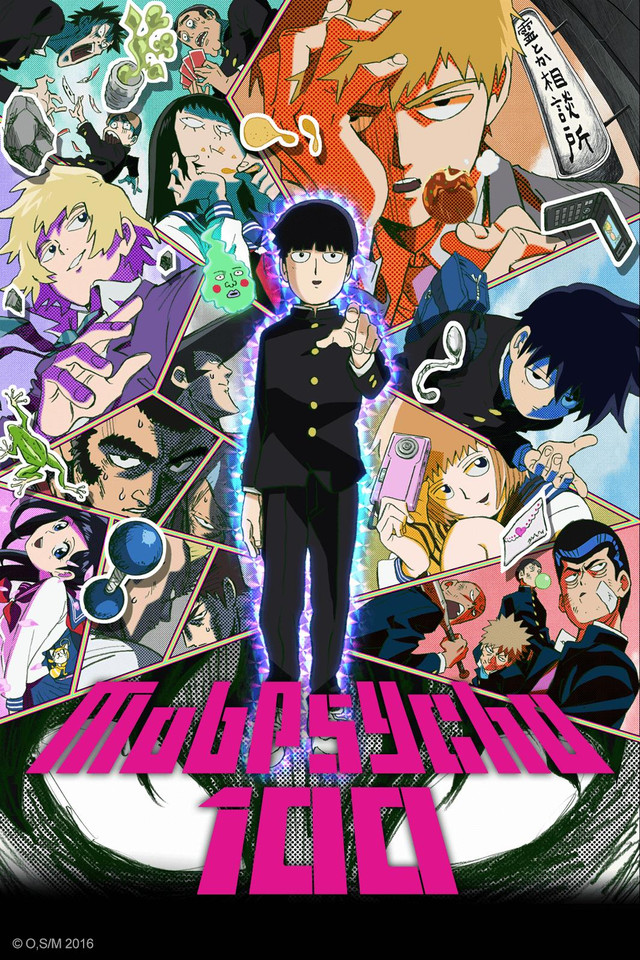
What Wikipedia says: Shigeo Kageyama is an average middle school boy, nicknamed Mob (モブ Mobu) (meaning "background character") for lacking a sense of presence. Although he looks like an inconspicuous person, he is in fact a powerful esper. As he grows older, Mob realizes that his psychic powers are strengthening and becoming more dangerous. To avoid his power getting out of control, he constantly lives a life under an emotional shackle. Mob wants to live a normal life just like the others, but a barrage of trouble keeps coming after him. With the suppressed emotions growing inside Mob little by little, his power threatens to break through its limits.
What KoanMan says: "Mob Psycho 100", by Yuzuru Tachikawa and produced by ONE, is a similar style of animation to One Punch Man by the same, though visually a little rough. The storylines are vaguely similar, however they present different viewing experiences. Characters centre on Mob, who is a socially clueless super-being, who follows a meandering plot through his personal development. Lots of action and likeable, though shallow, personalities make this an enjoyable watch, without much brain owner required.
What Wikipedia says: Shigeo Kageyama is an average middle school boy, nicknamed Mob (モブ Mobu) (meaning "background character") for lacking a sense of presence. Although he looks like an inconspicuous person, he is in fact a powerful esper. As he grows older, Mob realizes that his psychic powers are strengthening and becoming more dangerous. To avoid his power getting out of control, he constantly lives a life under an emotional shackle. Mob wants to live a normal life just like the others, but a barrage of trouble keeps coming after him. With the suppressed emotions growing inside Mob little by little, his power threatens to break through its limits.
What KoanMan says: "Mob Psycho 100", by Yuzuru Tachikawa and produced by ONE, is a similar style of animation to One Punch Man by the same, though visually a little rough. The storylines are vaguely similar, however they present different viewing experiences. Characters centre on Mob, who is a socially clueless super-being, who follows a meandering plot through his personal development. Lots of action and likeable, though shallow, personalities make this an enjoyable watch, without much brain owner required.
So How Does it End? (Spoiler free): Well rounded, but with plenty of room for season 2 (coming late 2018/early 2019).
How About the Music? The music is OK, and the Japanese phonetic counting in English in the opening credits song is very cute.
Overall Grade: Mob Psycho 100 is an enjoyable, non-taxing, short series, and is a good way to pass time, with some great visual ideas. Koan Man gives this a C.
Addendum by tTPO: This is one of those series where KoanMan doesn't quite know what he is talking about. While this is no One Punch Man, it is no C either, either enough humour, action and originality (a rare commodity) to well justify a B.
Labels:
Action,
Comedy,
Fighting,
Grade B,
Grade C,
School,
Science Fiction,
Supernatural
Monday, 17 July 2017
Gangsta
Number of Episodes: 12+ 1 recap episode
What Wikipedia says: The series revolves around two "Handymen" who take on jobs for both the mob and the police force that no one else can handle. The two, named Worick Arcangelo and Nicolas Brown, work in the town of Ergastulum, which is full of mafia, hoodlums, prostitutes, and dirty cops.
What KoanMan says: As the name suggests, this is a story of mafioso, and the associated lifestyle, focussing on two men who have survived the rubble of their lives. They are “The Handymen”. Nic and Worick survive on their particular skills, which make them both dangerous and valued, thereby also requiring neutrality amongst the various criminal organisations…. Good storyline, and pace that starts slow, building to a climax...
So How Does it End? (NOT Spoiler free): ...that does not ever happen.
The reader should be aware that Manglobe, the company that produced the anime, went bankrupt in late 2015. The series ends part-way through, at Ep 12. Just when it was really getting going…. To be clear, there is no end to the anime - just no more episodes. The manga will have to suffice, although the gods of fortune have not been smiling there either, as the author, Kohske, has been ill since 2015 and has not been able to continue the Gangsta manga since then.
Be that as it may, GANGSTA is an enjoyable watch was only marred by a few minor issues. The main points were repeated a few times early on, and the “recap” Ep 9.5 seemed redundant. Some animation appears to be of lesser quality.
How About the Music? KoanMan found the music, by Tsutchie, to be spot-on for the sleazy underworld feel that series director Koichi Hatsumi was going for.
Overall Grade: Interesting characters that develop well throughout, an intriguing plot, and interesting twists in the story-line make this abortive series worth a watch, though all more frustrating for the lack of an ending. KoanMan scores this a C, though with a complete series it may well have been a B or even an A. Who knows?….
Addendum by tTPO: Grade D. It's not that tTPO did not like this series while it was there, but I cannot recommend the investment in viewing time without some sort of payoff at the end. The journey alone is good, but unlike say, Spice and Wolf (which KoanMan still needs to see), it's not enough to justify watching. Save your efforts for Black Lagoon or Darker than Black.
Saturday, 31 December 2016
One-Punch Man
What Wikipedia says: One-Punch Man (Japanese: ワンパンマン) is an ongoing Japanese superhero parody webcomic created by an author using the pseudonym One which began publication in early 2009.A television anime adaptation by Madhouse aired in Japan between October and December 2015. A second season is currently in the works.
On an Earth-like super-continent planet, strange monsters have been mysteriously appearing and causing disasters resulting in the world's superheroes rising to combat them alongside the local supervillains. Saitama, the protagonist of the series, is the strongest hero alive in the entire franchise, hailing from the metropolis of City Z who easily defeats the monsters or other villains with a single punch to the point where monsters just explode when struck. However, due to his immeasurable strength, Saitama has become bored with his power and is constantly trying to find stronger opponents who can present a challenge to him.
What KoanMan says: One Punch Man is an easy watch. If you are looking to minimise your mental exercise and still get entertained, you might enjoy this. Described as an action-comedy, One Punch Man certainly delivers, with KoanMan coming very close to rupturing a lung simply laughing in Episode 2.
With episodes consisting of simple short stories, most of them within a single episode, the back story builds slowly but surely throughout the series. The series flows nicely and the pace is good. Supplemented by the OVA and the Special Episodes, and given the format, there is plenty of room for a second series.
Characters are magnificent in their depiction, each with character flaws that you will recognise immediately in people you know..... Nicely done.
How About the Music? Music
is good throughout with the exception of the end credits for Eps 1-11,
"Hoshi yori Saki ni Mitsukete Ageru", which seems strangely at odds with
the style and feel of the rest of the musical score. The suspense music
is really good.
So How Does it End? (Spoiler free): It finishes neatly with plenty of room for more.
Overall Grade: KoanMan enjoyed this series. Solid A for One Punch Man.
Addendum by tTPO: One Punch Man is a rare series that get so much so right. Humour, action, pathos, mystery about in an immense world of seemingly endless superheroes and monsters. It is hard to believe at time all this just came out of one author. Even in some of the OVAs where Saitama barely features there is enough depth that the other characters more than carry the episode. Can't recommend it enough. A
Sunday, 8 March 2015
Akame ga Kill
aka Akame ga Kiru!
Number of Episodes: 24
What Wikipedia says: The story focuses on Tatsumi, a young villager who travels to the Capital to raise money for his home only to discover a strong corruption in the area. The assassin group Night Raid recruits the young man to help them in their fight against the Empire to end its corruption.
KoanMan says: Looking for action? Looking for some violence? Look no further. This fast-paced, action-packed series is just the medicine. It should be noted that while many will see pointless blood, KoanMan found that all the violence was well within the plot and kept to the story-line. There was nothing especially gratuitous at all. That said, this is not a series for the kiddies.
The characters are reasonably developed, though there remains plenty unknown about them, however, with this much action and plot to push through, there seems little time for further development. The unusual twists in character presence early on do go some way to preparing the viewer for events as they unfold later in the series. A parallel may be drawn to the popular TV series involving thrones and a game.... You will understand this when you watch. The story-line proceeds with some gusto, and there is certainly a lot of story to get through - all thoroughly enjoyable. Pacing, while fast, is steady throughout - very nice. Only one major flaw presented itself, with a missing fight that should have occurred between Ep19 and Ep 20 - perhaps an addition will produced/released? Ep19.5 maybe?
As an aside, Prime Minister Onest and Esdeath get special mentions as two of the most principles driven characters, in their own way, right up there with Doctor Toshio Ozaki (Shiki) and Satsuma Kiryuin (Kill la Kill). To be fair, the principles that drive Prime Minister Onest are very different to those that drive the others listed here.
How About the Music? The music is OK, though during the adrenaline-filled action fight scenes, can be a little cheesy - tTPO did not even notice the music during the fight scenes, probably due the high level of adrenaline coursing through him at these moments. It was probably Ep11 before KoanMan even noticed! Such good action....
So How Does it End? (Spoiler free): (tTPO here) It ends and ends definitively. Though having said that the ending is anime original, and it seems rather likely at this stage the manga ending will be a) different and b) better. As KoanMan implied above, events seem to get a little more incoherent towards the end and the series suffers a little because of this. But such good action...
Overall Grade: The result? KoanMan rates this page-turner an A. Viva la Revolución!
ADDENDUM (by tTPO): Despite the flaws of this show it remains compelling for the action fan for most of its run, aided at least in part by the somewhat more complex moral nature of most (though by no means all) of the 'villains'. The series seems to have divided the blogosphere but I think the trick is just not to overthink it - just sit back and enjoy the ride. This would have been an A if I didn't know about the manga, but instead just a little less: A-.
Number of Episodes: 24
What Wikipedia says: The story focuses on Tatsumi, a young villager who travels to the Capital to raise money for his home only to discover a strong corruption in the area. The assassin group Night Raid recruits the young man to help them in their fight against the Empire to end its corruption.
KoanMan says: Looking for action? Looking for some violence? Look no further. This fast-paced, action-packed series is just the medicine. It should be noted that while many will see pointless blood, KoanMan found that all the violence was well within the plot and kept to the story-line. There was nothing especially gratuitous at all. That said, this is not a series for the kiddies.
The characters are reasonably developed, though there remains plenty unknown about them, however, with this much action and plot to push through, there seems little time for further development. The unusual twists in character presence early on do go some way to preparing the viewer for events as they unfold later in the series. A parallel may be drawn to the popular TV series involving thrones and a game.... You will understand this when you watch. The story-line proceeds with some gusto, and there is certainly a lot of story to get through - all thoroughly enjoyable. Pacing, while fast, is steady throughout - very nice. Only one major flaw presented itself, with a missing fight that should have occurred between Ep19 and Ep 20 - perhaps an addition will produced/released? Ep19.5 maybe?
As an aside, Prime Minister Onest and Esdeath get special mentions as two of the most principles driven characters, in their own way, right up there with Doctor Toshio Ozaki (Shiki) and Satsuma Kiryuin (Kill la Kill). To be fair, the principles that drive Prime Minister Onest are very different to those that drive the others listed here.
How About the Music? The music is OK, though during the adrenaline-filled action fight scenes, can be a little cheesy - tTPO did not even notice the music during the fight scenes, probably due the high level of adrenaline coursing through him at these moments. It was probably Ep11 before KoanMan even noticed! Such good action....
So How Does it End? (Spoiler free): (tTPO here) It ends and ends definitively. Though having said that the ending is anime original, and it seems rather likely at this stage the manga ending will be a) different and b) better. As KoanMan implied above, events seem to get a little more incoherent towards the end and the series suffers a little because of this. But such good action...
Overall Grade: The result? KoanMan rates this page-turner an A. Viva la Revolución!
ADDENDUM (by tTPO): Despite the flaws of this show it remains compelling for the action fan for most of its run, aided at least in part by the somewhat more complex moral nature of most (though by no means all) of the 'villains'. The series seems to have divided the blogosphere but I think the trick is just not to overthink it - just sit back and enjoy the ride. This would have been an A if I didn't know about the manga, but instead just a little less: A-.
Sunday, 17 August 2014
Black Lagoon
Number of Episodes: 24 + 5 x OVAs
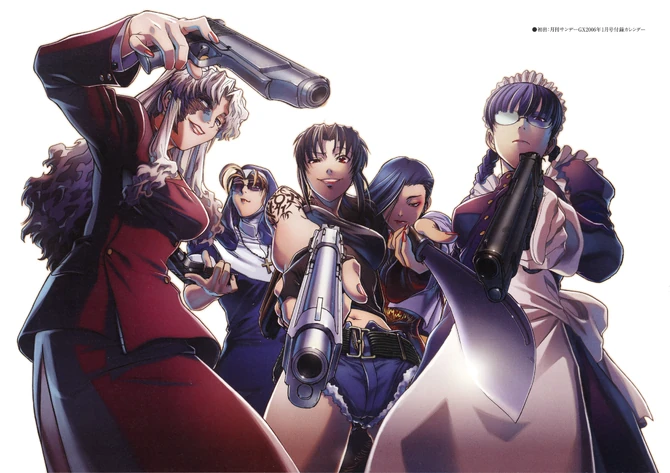
What Wikipaedia says: The story follows a team of pirate mercenaries known as Lagoon Company, that smuggles goods in and around the seas of Southeast Asia in the early to mid 1990s. Their base of operations is located in the fictional harbor city of Roanapur in southeast Thailand (somewhere in the Amphoe Mueang Trat district, likely on the mainland north/northeast of the Ko Chang island or on the island itself). The island is home to the Yakuza, the Triad, Cuban and French cartels, and a wide assortment of pickpockets, thugs, mercenaries, thieves, prostitutes, assassins, and Gunmen of all sorts. They transport goods in the 80-foot (24 m) Elco-type PT boat Black Lagoon. Lagoon Company does business with various clients, but has a particularly friendly relationship with the Russian crime syndicate Hotel Moscow. The team takes on a variety of missions—which may involve violent firefights, hand-to-hand combat, and nautical battles—in various Southeast Asian locations, even going as far as Phu Quoc island of Vietnam and when not doing much, the members of the Lagoon Company spend much of their down time at The Yellow Flag, a bar in Roanapur which is often (tTPO. Spoiler!).
What KoanMan says: A. Yep, an A.
It is uncommon for KoanMan to lead with the result, but this series warrants it. Just go watch it. For more review, read on, but if this takes precious time away from watching, then ditch this review and go watch it. It's good!
Still reading? Okay, so how did one arrive at this score? Well, pretty much by the time the opening credits music had started. Red Fraction by Mell is a great choice, and sets an edgy mood that continues throughout. It is counterbalanced by the haunting Don't Look Behind by Edison - an odd choice that is unexpected at first, but really works. The music is good, and has been chosen to fit the mood on-screen. Superb.
Rei Hiroe started the Manga Black Lagoon in 2002, inspired by news reports of piracy in the East China Sea during the early 1990's, and the work of greats Stephen King, Quentin Tarantino and the Coen brothers, James Elroy and John Woo (read the interview in Otaku USA with Rei Hiroe). There is a lot of inspiration here, and it shows in the results - Black Lagoon, Black Lagoon: The Second Barrage, and Black Lagoon: Roberta's Blood Trail. Gritty, dirty, violent....awesome! This is not to say that it is not subtle. Subtle? Like a rock to the head you say? Nay, one replies! There is some seriously deep soul-searching and intensely personal moments. These moments are often painful and dark, though exceptionally well crafted. Beyond that, there are some of the toughest "moments" in anime that KoanMan has ever encountered. There are two such moments early in The Second Barrage. Although these moments were different for KoanMan than for tTPO. Confronting none the less.
The general feel is similar to the weekly adventure/hero serials that were popular from the 1920's through to the 1960's. A modern take on the swashbuckling tales of old. Director Sunao Katabuchi has given a superb storyline real punch. This has been enhanced by the collaborative efforts of the english dubbed version director, James Corrigal and his North American voice-over crew, who took some liberties to provide new options to the editing team, particularly when it came to Revy. Having watched the the english subtitled version and the english dubbed version, KoanMan can say absolutely that the dubbed version is more enjoyable. Revy has a harder edge to her language, and there are english subtitled translations that do not work nearly as well as they would in Japanese. The significant changes in the dubbed version include a mistranslation in Ep18 with Shenhua telling Eda in Ep18 that she was an "atheist" (she is actually Taoist), and Revy calls Shenhua "Chinglish" ("Yes Lady" is the term used in the Manga and the subtitled version). KoanMan thinks this is an improvement, as the term "Yes Lady" lacks impact in english, although in Japanese it may be very abusive? Maybe? Abuse can be very culturally specific....
Character development is amazing, Rock (Rokuro Okajima), the meek outsider, kidnapped into the seedy underworld of the South East Asia, is balanced by Revy (Rebecca), the gun-toting, hard-living, trash-talking tough girl. Mmmmmmmm. Then there is the leader of "The Lagoon Company", the cool, man's man, Dutch, and the computer geek Benny (very "Shaggy"-ish). Chang and soviet soldier girl Belalaika, Shenhua, "the twins", Roberta... Awesome.
It is not hard to understand the popularity of this series in north America - there are a lot of guns. Interestingly, all the main female characters are seriously powered-up! To our knowledge only one girl is a bit normal, that is to say, not rabidly detonating stuff, although in this setting she comes across as almost pathetic - see if you can spot her. She may also be the only character that does not smoke; one can only suppose the tobacco lobby bank-rolled this whole production, as everyone has a durry, all the time. Smokers will surely feel loved and embraced.
Overall grade: Bottom line.... an excellent watch! Can't wait for season 3, which is coming soon (tTPO. Is it?). KoanMan gives this a A
Go watch it! Now!
Thursday, 15 May 2014
Kill la Kill
Number of Episodes: 24 + OVA
What Wikipaedia says: "Kill la Kill is set at Honnouji Academy, a fictional high school in Tokyo Bay set in Japan that is dominated by its fearsome student council, led by Satsuki Kiryuin. The council members wear special uniforms called Goku Uniforms that grant them superhuman abilities, which they use to oppress the rest of the school's students and staff. Ryuko Matoi, a student wielding half of a scissor-shaped longsword, transfers to Honnouji Academy in search of the owner of the other half of the scissor blade, the person who killed her father, Isshin Matoi."
KoanMan says: Kill la Kill. The name implies a lot. And KoanMan believes it delivers.
Blood is a common feature of this action-packed anime, as is the fanfare that goes with the life-fibre (Goku) suit transformations. KoanMan had just completed the Freezing series immediately prior, so the fanfare went almost unnoticed until it came time to write the review of Kill la Kill.
It is apparent that the characters are pretty tough lot, as the punishment dealt to various characters is prodigious. That said, KoanMan could only spot two deaths in the whole series, with one other suspected, though not confirmed one way or the other.
Characters are exceptionally well developed, and the storyline is superb. The animation itself is much less polished than most anime productions, though this is soon forgotten as the pace sets sail from the start and steadily builds over the initial episodes, before settling into an almost perfect rhythm. The underlying character relationships add an unusual depth despite some humourously cheesy scenes, and equally cheesy one-liners sprinkled throughout. KoanMan is not generally a fan of super-cutesy, but when it does happen, it fits almost perfectly with the high-action, high-stakes, serious stuff - not because it fits, but precisely because it doesn't fit... and somehow it all works!
How About the Music?: Opening and closing credits had little relevance for KoanMan. Although the closing credit music was OK, music is not a feature. But it does not matter!
Overall Grade: This is a great watch. KoanMan gives this A.
tTPO says: tTPO liked this series a lot. It started out with a fairly standard fight of the week format (OK but nothing too special) but then became so much more. Along the way there is high humour and more than a little fun poked at the nature of fan service in anime, as well as some serious character development, an epic plotline, many arterial spurts and more than a couple of shout out loud moments for several characters doing their best. For such a great series though the emotional climax was really the second last episode, leaving the last episode just a little predictable, though not without its own emotional journey. And it wasn't even a bad last episode - it just couldn't quite stack up to the second last one. As much as I would like to give this an A then I can't bring myself to do it. So A- it is, but only just. You should still watch it. And the OVA too.
What Wikipaedia says: "Kill la Kill is set at Honnouji Academy, a fictional high school in Tokyo Bay set in Japan that is dominated by its fearsome student council, led by Satsuki Kiryuin. The council members wear special uniforms called Goku Uniforms that grant them superhuman abilities, which they use to oppress the rest of the school's students and staff. Ryuko Matoi, a student wielding half of a scissor-shaped longsword, transfers to Honnouji Academy in search of the owner of the other half of the scissor blade, the person who killed her father, Isshin Matoi."
KoanMan says: Kill la Kill. The name implies a lot. And KoanMan believes it delivers.
Blood is a common feature of this action-packed anime, as is the fanfare that goes with the life-fibre (Goku) suit transformations. KoanMan had just completed the Freezing series immediately prior, so the fanfare went almost unnoticed until it came time to write the review of Kill la Kill.
It is apparent that the characters are pretty tough lot, as the punishment dealt to various characters is prodigious. That said, KoanMan could only spot two deaths in the whole series, with one other suspected, though not confirmed one way or the other.
Characters are exceptionally well developed, and the storyline is superb. The animation itself is much less polished than most anime productions, though this is soon forgotten as the pace sets sail from the start and steadily builds over the initial episodes, before settling into an almost perfect rhythm. The underlying character relationships add an unusual depth despite some humourously cheesy scenes, and equally cheesy one-liners sprinkled throughout. KoanMan is not generally a fan of super-cutesy, but when it does happen, it fits almost perfectly with the high-action, high-stakes, serious stuff - not because it fits, but precisely because it doesn't fit... and somehow it all works!
How About the Music?: Opening and closing credits had little relevance for KoanMan. Although the closing credit music was OK, music is not a feature. But it does not matter!
Overall Grade: This is a great watch. KoanMan gives this A.
tTPO says: tTPO liked this series a lot. It started out with a fairly standard fight of the week format (OK but nothing too special) but then became so much more. Along the way there is high humour and more than a little fun poked at the nature of fan service in anime, as well as some serious character development, an epic plotline, many arterial spurts and more than a couple of shout out loud moments for several characters doing their best. For such a great series though the emotional climax was really the second last episode, leaving the last episode just a little predictable, though not without its own emotional journey. And it wasn't even a bad last episode - it just couldn't quite stack up to the second last one. As much as I would like to give this an A then I can't bring myself to do it. So A- it is, but only just. You should still watch it. And the OVA too.
Wednesday, 29 January 2014
Wanna be the Strongest in the World
aka Sekai de Ichiban Tsuyoku Naritai!
Number of Episodes: 12
What Wikipaedia says: "Sekai de Ichiban Tsuyoku Naritai! follows the story of Sakura Hagiwara, a pop idol and member of the fictional japanese idol group Sweet Diva that impulsively decides to turn into a pro-wrestler in order to avenge another fellow Sweet Diva member who got a beating from a female wrestler."
tTPO says: This show clearly divided the blogosphere into people that thought it crass fan-service filled torture porn, and me. Once you get past the gratuitous crotch and cleavage shots, prolonged scenes of entwined female bodies inflicting pain on each other, and endless moans of pain which could be easily mistaken for pleasure, you actually have a quite reasonable shounen (fighting) series with interesting characters, something quite resembling a plot and a well developed background. There was even some genuine drama, and also a good plot twist towards the end.
As with most shounen series it often comes down to a 'fight-of-the-week' plot structure but given the nature of the series this should not be surprising. It is quite satisfying to see that the main character (minor spoiler warning) is not an instant legend with it taking a long time and a large number of losses before things start turning around. So long so that it does beg the question why she was not retired (or solved some of her technique issues) much earlier than she did because once these were sorted she got significantly better (end spoiler warning). The fact that this was the main plot weakness I think speaks volumes about this show. Which is mostly good. Mostly.
How About the Music?: The OP ("Beautiful Dreamer" by Kyōko Narumi) is a bit meh. The ED ("Fan Fanfare!!!" by Sweet Diva) is marginally better being a thematically consistent bit of girl group J-pop with some get up and go. But the song itself is just OK.
So How Does it End? (Spoiler Free): This has a good solid ending, dealing with the main issues facing the main characters, and leaves it wide open (pun intended) for a second series. I liked it.
Overall Grade: C+. If not for the obvious issues above, you could happily sit down with your daughter and watch this. Maybe they ought to make an edited version with more tastefully edited fights. The episodes would probably only be about 10 minutes long you could still enjoy the show I think, and many people may enjoy it more. As it stands you will have the headphones on and hope your significant other doesn't catch you watching it. Unless your significant other also enjoys this sort of thing.
KoanMan says: Are you between animes? Are you waiting the interminable chronological distance that is the week between episodes of your current viewing? Like dramatic, anime-style boobs and butt? Then Wanna Be The Strongest In The World!, or Sekai de ichiban tsuoku naritai!, may be just the thing.
With a plot as scanty as the clothing, this series has superficial character development, cheesy music, and a cast composed of super-hot babe’s. This one will not tax your cerebrum, although the sado-masochistic tones may appeal to some. This version of wrestling certainly seems to involve a lot of pain. There is also some dancing and singing, but mostly pain. And hot babes.
Director Rion Kujo has really fleshed out Kazuho Hyodo’s script (pardon the pun) with potent visuals, based on Kiyohito Natsuki’s manga illustrations, that animate ESE's Wanna Be The Strongest In The World! manga. Beyond the optic athleticism, clearly tailored to those who enjoy the female form, there is very little else. KoanMan found it a reasonable way to pass the time, but only if you can agree with the first few questions asked herein.
KoanMan rates Wanna Be The Strongest In The World! a C.
Note: There is some low-grade nudity (boobs), so if you are uncomfortable with your kids seeing that/them, you will need to decide what is appropriate yourself. Everything else is clothed, though very little is left to the imagination.
Number of Episodes: 12
What Wikipaedia says: "Sekai de Ichiban Tsuyoku Naritai! follows the story of Sakura Hagiwara, a pop idol and member of the fictional japanese idol group Sweet Diva that impulsively decides to turn into a pro-wrestler in order to avenge another fellow Sweet Diva member who got a beating from a female wrestler."
tTPO says: This show clearly divided the blogosphere into people that thought it crass fan-service filled torture porn, and me. Once you get past the gratuitous crotch and cleavage shots, prolonged scenes of entwined female bodies inflicting pain on each other, and endless moans of pain which could be easily mistaken for pleasure, you actually have a quite reasonable shounen (fighting) series with interesting characters, something quite resembling a plot and a well developed background. There was even some genuine drama, and also a good plot twist towards the end.
As with most shounen series it often comes down to a 'fight-of-the-week' plot structure but given the nature of the series this should not be surprising. It is quite satisfying to see that the main character (minor spoiler warning) is not an instant legend with it taking a long time and a large number of losses before things start turning around. So long so that it does beg the question why she was not retired (or solved some of her technique issues) much earlier than she did because once these were sorted she got significantly better (end spoiler warning). The fact that this was the main plot weakness I think speaks volumes about this show. Which is mostly good. Mostly.
How About the Music?: The OP ("Beautiful Dreamer" by Kyōko Narumi) is a bit meh. The ED ("Fan Fanfare!!!" by Sweet Diva) is marginally better being a thematically consistent bit of girl group J-pop with some get up and go. But the song itself is just OK.
So How Does it End? (Spoiler Free): This has a good solid ending, dealing with the main issues facing the main characters, and leaves it wide open (pun intended) for a second series. I liked it.
Overall Grade: C+. If not for the obvious issues above, you could happily sit down with your daughter and watch this. Maybe they ought to make an edited version with more tastefully edited fights. The episodes would probably only be about 10 minutes long you could still enjoy the show I think, and many people may enjoy it more. As it stands you will have the headphones on and hope your significant other doesn't catch you watching it. Unless your significant other also enjoys this sort of thing.
KoanMan says: Are you between animes? Are you waiting the interminable chronological distance that is the week between episodes of your current viewing? Like dramatic, anime-style boobs and butt? Then Wanna Be The Strongest In The World!, or Sekai de ichiban tsuoku naritai!, may be just the thing.
With a plot as scanty as the clothing, this series has superficial character development, cheesy music, and a cast composed of super-hot babe’s. This one will not tax your cerebrum, although the sado-masochistic tones may appeal to some. This version of wrestling certainly seems to involve a lot of pain. There is also some dancing and singing, but mostly pain. And hot babes.
Director Rion Kujo has really fleshed out Kazuho Hyodo’s script (pardon the pun) with potent visuals, based on Kiyohito Natsuki’s manga illustrations, that animate ESE's Wanna Be The Strongest In The World! manga. Beyond the optic athleticism, clearly tailored to those who enjoy the female form, there is very little else. KoanMan found it a reasonable way to pass the time, but only if you can agree with the first few questions asked herein.
KoanMan rates Wanna Be The Strongest In The World! a C.
Note: There is some low-grade nudity (boobs), so if you are uncomfortable with your kids seeing that/them, you will need to decide what is appropriate yourself. Everything else is clothed, though very little is left to the imagination.
Tuesday, 26 November 2013
High School of the Dead
Number of Episodes: 12 + 1 OVA

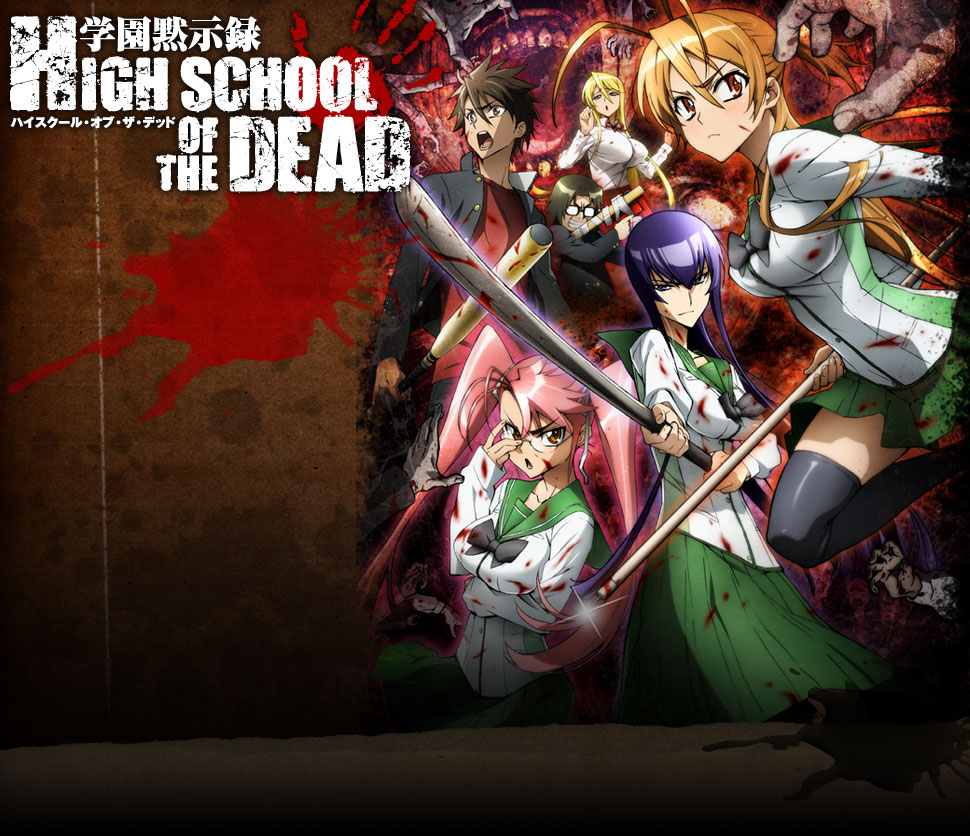
What Wikipedia says: "Highschool of the Dead is an anime series adapted from the manga of the same name written by Daisuke Sato and illustrated by Shoji Sato. The series is set in the present day, beginning as the world is struck by a deadly pandemic that turns humans into zombies. The story follows Takashi Komuro, a student at Fujimi High School who survived the initial outbreak along with several of his classmates and the school nurse, and occasionally jumps to the perspective of other characters. As the group tries to survive the zombie apocalypse, they must also face dangerous fellow survivors and the decay of their own moral codes."
KoanMan says: The director of "Highschool of the Dead" Tetsuo Araki certainly had booty on his mind when he rendered this anime, originally penned by Manga author Daisuke Satō.
The plot is reasonably simple, this is a Zombie movie after all. However it is surprising, that terribly cheesy moments, complete with the silly sound effects, are interspersed with moments of intense gravity. The character and relationship development is great with the formation of their erstwhile "family" one of the most enjoyable aspects. The personalities are different enough to add real texture to the story.
The OVA is not important to the general story, but includes a little humour.
How About the Music?: Beyond the copious décolletage, the opening sequence music, "Highschool of the Dead" by Kishida Kyoudan and the Akeboshi Rockets (live version at the link), is fantastic! KoanMan realises this is completely personal, but it fits perfectly with the post-modern pop style of the visuals, and goes well with the Zombie apocalypse theme. There are more EDs than you can poke a stick at (each episode has a different one) so I'm sure there is something for everyone here.
So How Does it End? (Spoiler Free): Satisfactorily. But the journey is very much a continuing one.
Overall Grade: KoanMan gives this a solid B. One is male, of course. Roll on Season 2.
Addendum (by tTPO): HOTD is not without its flaws - there is a recap episode at episode 4 (is that some kind of record?) and as a show focussing on teenagers it fails to escape the trope that most adults are useless and as KoanMan has outline already, there are more than a few cheesy moments. It does succeed though at many things. The animation is great, the scale of the disaster is awesome thought the journey is personal, and by the end of the series there has been more than a little development of the main characters. But most importantly, for a show which is defined to a large extent by the fan service, the creative team seem to have really given some thought to how can we do this differently, and I think they succeeded. Not all the time mind you (note the obligatory bathhouse episode and the unneccessary OVA) but they did the near impossible in making some gratuitous fan service interesting. Put oll of this together and you have and entertaining and above-average series. B+
What Wikipedia says: "Highschool of the Dead is an anime series adapted from the manga of the same name written by Daisuke Sato and illustrated by Shoji Sato. The series is set in the present day, beginning as the world is struck by a deadly pandemic that turns humans into zombies. The story follows Takashi Komuro, a student at Fujimi High School who survived the initial outbreak along with several of his classmates and the school nurse, and occasionally jumps to the perspective of other characters. As the group tries to survive the zombie apocalypse, they must also face dangerous fellow survivors and the decay of their own moral codes."
KoanMan says: The director of "Highschool of the Dead" Tetsuo Araki certainly had booty on his mind when he rendered this anime, originally penned by Manga author Daisuke Satō.
The plot is reasonably simple, this is a Zombie movie after all. However it is surprising, that terribly cheesy moments, complete with the silly sound effects, are interspersed with moments of intense gravity. The character and relationship development is great with the formation of their erstwhile "family" one of the most enjoyable aspects. The personalities are different enough to add real texture to the story.
The OVA is not important to the general story, but includes a little humour.
How About the Music?: Beyond the copious décolletage, the opening sequence music, "Highschool of the Dead" by Kishida Kyoudan and the Akeboshi Rockets (live version at the link), is fantastic! KoanMan realises this is completely personal, but it fits perfectly with the post-modern pop style of the visuals, and goes well with the Zombie apocalypse theme. There are more EDs than you can poke a stick at (each episode has a different one) so I'm sure there is something for everyone here.
So How Does it End? (Spoiler Free): Satisfactorily. But the journey is very much a continuing one.
Overall Grade: KoanMan gives this a solid B. One is male, of course. Roll on Season 2.
Addendum (by tTPO): HOTD is not without its flaws - there is a recap episode at episode 4 (is that some kind of record?) and as a show focussing on teenagers it fails to escape the trope that most adults are useless and as KoanMan has outline already, there are more than a few cheesy moments. It does succeed though at many things. The animation is great, the scale of the disaster is awesome thought the journey is personal, and by the end of the series there has been more than a little development of the main characters. But most importantly, for a show which is defined to a large extent by the fan service, the creative team seem to have really given some thought to how can we do this differently, and I think they succeeded. Not all the time mind you (note the obligatory bathhouse episode and the unneccessary OVA) but they did the near impossible in making some gratuitous fan service interesting. Put oll of this together and you have and entertaining and above-average series. B+
Sunday, 23 December 2012
Sword Art Online
Number of Episodes: 25
What
tTPO says: This series is a pleasant distraction that conveniently takes up the first two major arcs from the light novels the anime is based on. In that respect it is really two shorter series though there is some resolution for both in the final episode. But I get ahead of myself.
The series really promises and delivers no less than suggested in the blurb above. There are good action sequences, the virtual worlds are imaginitive and well thought out, the pacing is just so, and there is plenty of romantic and non-romantic love (the family aspect of this was a pleasant surprise) between the major players that feels about right, and keeps the harem fan inside me happy. I think it is this latter aspect (the love that drives the main characters) that engenders the rather heated support for this series.
So far as flaws go there is is just a little much deus ex machina for my liking and the triumph of 'will' over just about anything, including programming. I have a number of friends in the IT business who assure me life is not this simple. And the second villain, in contrast with the first (who is actually quite complex), is annoyingly underdeveloped and clichéd. But at the end of the day this is a fairly lightweight affair so you just go with the flow and it's all OK. It's not Neon Genesis. Don't overthink it.
How About the Music?: OP1 "crossing field" by LiSA is a pleasant but otherwise unremarkable bit of J-rock. OP2 ("INNOCENCE" by Eir Aoi) is cut from the same mould but for mind has a bit more get up and go.
ED1 ("Yume Sekai" by Haruka Tomatsu) is a pleasant song reflecting more the romance in the series. Has am easy on the ear modulation just before the prechorus. ED2 ("Overfly" by Luna Haruna) takes the same road but again with a bit more rock.
Really, there is not a bad theme in this 4.
So how does it end? (Spoiler Free): More than satisfactorily. Major plot threads are all sorted out, even if some of them are a bit silly, and there is still room for a sequel.
Overall Grade: Nothing really new here, but it does have plenty of heart (and I rate that) and the execution was generally pretty good. B-.
Sunday, 29 April 2012
Freezing + Freezing Vibrations
Number of Episodes: 12 (+ 6 mini-OVAs) + 12 (+ 1 special episode)
What Wikipedia says: "Set in a slightly futuristic world, Earth has been invaded and is at war with aliens from another dimension called the Nova. In order to counter them, Pandoras and Limiters, genetically modified girls with super fighting skills and their male partners who use special "freezing" powers to limit their opponent's mobility, are made to fight against the Nova. The series focuses on Kazuya Aoi, a Limiter whose late sister was a Pandora, and Satellizer el Bridget, a powerful Pandora with a cold personality, both who are enrolled at the West Genetics Academy, one of the many academies where Pandoras and Limiters are trained. In spite of the warnings of all his friends about Satellizer, who has intense aphephobia, Kazuya decides to be her friend and Limiter. They are later joined by Lana Linchen, a Pandora from Tibet in search for her Limiter who believes Kazuya to be her "soulmate", sparking a rivalry with Satellizer. The story follows Kazuya's Relationship with Satellizer, the students of the Academy, and Earth's war against the Nova."
What tTPO says: More to the point is what Wikipedia does not say - that this series has its fair share of blood and boobs. So if you are offended by nudity (no sex though - the worst it gets is some humiliation in episode 3) or reasonable amounts of violence I would be turning off about now. If you put up with this though what awaits is an interesting experience. The blood and boobs are often incorporated (as much as they can ever be) into the plot. The main characters have a fair amount of depth and backstory to them, and the mechanics of the Pandoras / Limiters / Novas are pretty well thought out - moreso if you freeze frame and read the Jinglish-ridden data screens that litter the episodes at various points. The pacing of the plot as it progresses to its inevitable climax is good, and even with the 'fight-of-the-week' phase it goes through I found myself looking to next weeks biff with anticipation. So much so that after watching 3 episodes of this on my own because I was indecisive about whether she would enjoy it or not, I introduced Mrs tTPO to it and she enjoyed it through to the end also.
The big weakness of the anime (as I discovered when I subsequently read the manga) was the lack of depth of the various secondary characters (with the exception of Ingrid Bernstein whose episode was one of the stronger ones as a consequence). In the anime they were often poorly developed charactures acting only as foils to the Aoi and Satellizer, with some of their redeeming battles in the final episodes in the manga, played right down in the anime. The other weakness of the anime in its adaptation of the manga is, that in contrast to what I said above, there were occasions when the fan service was gratuitous, and no more so than episode 8 (a prom queen episode with more wardrobe malfunctions than a Superbowl half-time show) which was an anime original. Or indeed any of the OVAs. Thankfully this episode is a stand alone and can be left out along with the OVAs without too many problems. If this sort of stuff floats your boat though you are in for a treat.
How About the Music? There are occasions I don't need to listen back to remind myself how a song went. The OP (Color by MARiA, a cover of the Hatsune Miku song, and much much better) is one of these, a thumping piece of J rock with some awesome use of synthesiser. The ED (Kimi wo Mamoritai aka To Protect you by Aika Kobayashi) is another pumping electronic J-rock number and while full of energy not quite as catchy as the OP for me.
So how does it end? (Spoiler Free.): Pretty well, but at risk of repeating myself, not quite as well as the manga, with a little bit too much focus on the main characters. That notwithstanding, it's not disappointing.
Overall Grade: Grade B. Don't get me wrong - I liked Freezing a lot, and probably more than this grade would indicate. The story, action and main character development are good enough to carry this series through its weaknesses. But I am not sure the anime adaptation does justice to the source material. Watch this then go and read the manga, because the manga goes all sorts of places after the events covered by the anime finish.
Addendum: Freezing Vibrations continued with a largely self contained story arc. Seeing the first series is not essential but it helps a lot. Unlike Freezing though, I had read the manga upon which this was based before seeing the series and I did wonder how they were going to do it and make it interesting since the 3rd and 4th arcs of the manga do stray away from Satellizer and Kazuya as the central characters and make it more of a ensemble story. So did it work?
For the most, yes. Some nifty writing meant the sometimes drawn out manga was condensed to a neat 12 episode arc, and they shoehorned the rather personal 2nd story arc from the manga into the middle of the 3rd manga arc which was more action oriented and made up the bulk of the story. There were good character moments for many, though Rana did not see much development this time around. There is after all only so much you can do in 12 episodes.
On the downside there were a couple of clunky moments as a consequence of the rearrangement of the arcs (mostly involving Satellizer's step-brother) as well as a vanishing Nova which was forgotten about but in the main the pacing I though was actually better than the manga, leaving the ending neatly wrapped up while still leaving the door open for an eventual series 3.
And there were boobs. And blood. And somehow it all just worked again. Still Grade B. And the OVA was still stunningly gratuitous and can be left out.
KoanMan says: When KoanMan started watching this series (by director Takashi Watanabe as an extension of the manga written by Korean manhwa author Dall-Young Lim and illustrated by Kwang-Hyun Kim) it was immediately obvious that mammophiles will love this. The irony is that the stand-out feature (pardon the pun) of this pair (OK, no more from now) series was in fact not the décolletage, but the story, which could easily have carried the whole production on its own. Of particular note, is that one became strangely accustomed, almost desensitised, to the thoracic theatrics - to the point that by the end of the first series, they were simply there. Just participating as part of the wall-paper....part of the background.
That said, the clothing is linked to the character and their state of composure/health. An interesting detail that actually fits well with the plot, led by a first year student "limiter" Kazuya Aoi, and the aphenphosmphobic second year student "pandora" Satellizer el Bridget (for those interested also see haphephobia and haptephobia). They are joined by Tibetan exchange student "pandora" Rana Linchen to form a comical love triad that continues to entertain. This relieves a lot of the heavy themes of world cataclysm running almost continuously, as characters discover themselves and their place in the world.
Character development is good, and this continued to deepen throughout both series. With the variety of personalities it is easy to have favourites, KoanMan likes the "never give up" attitudes of Rana Linchen and Ganessa Roland. Fantastic!
The second series particularly impressed with its dark undertones, as concepts alluded to in the first are given texture. This, despite what appears to be a complete "changing of the guard" between the series - it is almost as if the whole crew were changed over, with different music, different character portraits, and a mild, though obvious, lower grade of animation production in the second series.
The series one music is awesome, the opening theme is "Color" by MARiA (a cover of a song voiced by a singing synthesiser vocaloid Hatsune Miku), while the ending theme is "To Protect You" by Aika Kobayashi. Awesome. Alas, in series two, the theme music is not so awesome (opening theme "AVENGE WORLD", end theme "The World Embraces Scars" both performed by Konomi Suzuki).
Overall, a good story, good plot and character development. KoanMan enjoyed this, not because of the fan service, but almost in spite of it. KoanMan rates this a solid B.
Wednesday, 25 April 2012
Rinne no Lagrange (season 1; with season 2 addendum)
aka Lagrange: The Flower of Rinne, Flower Declaration of your Heart
Number of Episodes: 12 (first season) + 12 (second season) + 5 mini-OVAs
What Viz Media via Myanimelist.net
Madoka's life is turned upside down when she is suddenly asked by a mysterious girl named Lan to pilot a robot. Motivated by her desire to protect the people and city of Kamogawa, Madoka agrees to pilot the resurrected Vox robot to fight against extraterrestrials that have come to attack Earth."
What tTPO says: From one Madoka to another in the space of three reviews. Compared with Puella Magi though, this series is a bit less coherent and tries just a little hard to be too many things. Describing it as a slice of life-mecha-space opera would not be too far off the mark, but it doesn't really succeed spectacularly as any of these things. The issue for me was that it tended to lose a bit of momentum as it swayed through the different aspects to the series, leaving me a little disconnected with the characters. Having said that is it not an epic fail either, and there is enough character, plot (with the odd hard hitting surprise), background plot and occasional humour to maintain some level of interest. I suspect this may end up being a series that would be better served being seen all at once, rather than week to week as I did, when I found myself asking myself 'so where are we up to with this?' More focused series leave me in no doubt where things are at and looking forward to the next episode despite the gaps between viewings.
How About the Music? For me the ED ("Hello!" by Megumi Nakajima) was the highlight of the music, capturing the generally upbeat mood of Madoka. Not to say the OP ("TRY Unite!" by Megumi Nakajima) was bad, it just didn't work quite as well for me.
So how does it end? (Spoiler Free.): This actually ends in a pretty satisfactory manner, so long as you think the Empire Strikes Back ended in a satisfactory manner - with character development and distinct closure to this chapter, but without closure to the whole story. This clearly is heading into a second season which apparently will start around July 2012. And there is an OVA coming too. I must admit I find it a bit sad that average shows like this get second seasons when better shows (like Chiarafuru) probably won't.
Overall Grade: Grade C. This series is almost the definition of a C. Mrs tTPO thought so to. It did not too much wrong, but really was not otherwise outstanding in plot, characterisation, ideas or execution to rate higher. I am not sure if I will bother with the second season to see how things turn out. We'll see.
Season 2 Addendum: Season 2 is virtually a direct continuation of season 1, to a point where if you are going to sit through this, you should do all 24 episodes, or (more wisely) look at some other and better series. Now that is not to say that this is a bad series. On the contrary, season 2 deals with all the left over plot points from season 1 and wraps them up, and even has a bit of character development. However it does none of these things particularly well, with the various plot endings not really particularly well explained or satisfying, with more than a little deus ex machina required to pull everything back together. Apparently I should have listened to my own advice above.
Still grade C.
Labels:
Action,
Fighting,
Grade C,
School,
Science Fiction,
Slice of Life
Friday, 20 April 2012
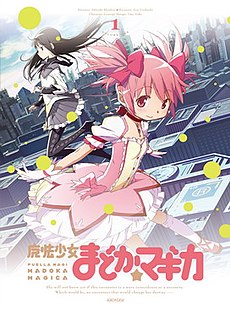
Puella Magi Madoka Magica
Number of Episodes: 12
What Wikipedia says: "In this world, there exist strange creatures who have the power to grant one wish to a chosen girl. However, in exchange, that girl must then become a magical girl and use her powers to fight against witches, evil creatures born from darkness that are responsible for murders and suicides.
In the city of Mitakihara, a schoolgirl named Madoka Kaname and her friend Sayaka Miki are approached by a familiar named Kyubey, who offers to grant each of them one wish in return for making each of them a magical girl. Another magical girl named Homura Akemi tries to prevent Madoka from making such a deal, while Kyubey urges Madoka by telling her she will become the most powerful magical girl. However, contrary to the glamorous notions one would expect, a magical girl finds herself dealing with death, isolation, loss of humanity, agony over the value of her wish, and existential crisis. Madoka, following her friends, soon sees the darker side of being a magical girl, and because of knowing the truth about being a magical girl, she questions if she should become one as well."
What tTPO says: Holy crap. Just finished this and my mind is melting with the goodness of this series. For tTPO anything this good crammed into 12 episodes where the pacing never faulters is a great start. It seems that each episode has a reveal of some sort that changes the direction of the whole series and to keep this up for the whole series is just amazing. It really is a masterclass in pacing.
Some anime series leave a lot to the imagination and for the viewer to do the work (see Mawaru-Penguindrum). This is not one of those series and it goes to great lengths to make sure (maybe with the exception of the last episode) the viewer knows what is going on. Usually not at the time you see it, so you still have time to puzzle it out yourself, but eventually most things are explained well. And boy does the plot all tie together nicely. Even the 'physics' of the show. I liked that.
The animation of this was also facinating. On one hand you get the impression that the budget for this show was not a lot (I have no idea if this is the case or not) but what they did with artistic vision and imagination was just stunning, making this (in my limited experience) a unique visual presentation for the genre and anime generally.
Lastly there is the feel of the show. Many other reviews talk about the deconstructive nature of this series and it is just so true. It really does dismember the magical girl genre in the face of 'reality' methodically and brilliantly. For me it ended up with the same sinking feeling as Watchmen when I first saw (then read) it. I am guessing the core themes of the superhero genre and the magical girl genre are not so far apart.
How About the Music? The OP (Connect by ClariS, and while a video is hard to find this one is particularly awesome) is a fully serviceable bit of J-Pop that I think is improved by the series it fronts. Usually its the other way round but I do like this song. While on that note the opening credits are amusing in that they are typical for the genre but really only serve to lead the viewer astray as to the direction of the series. ED1 is a light J-pop song but only last 2 episodes before the series and the EDs tread a darker path. The ED2 (Magia by Kalafina) is a lot more epic in an emo-rock kind of way but did not work quite so well for me. ED3 (And I'm Home by Ai Nonaka & Eri Kitamura) only lasts a single episode (#9) but for me is the pick of the EDs. And then someone slowed it down by 8 times thus producing shoegaze epic which sounds even better (and uncannily like Slowdive). Who would have thought?
So how does it end? (Spoiler Free): I did wonder how the hell this was going to end and they managed to do it on an epic scale in a way that actually made sense within the context of the story, and was not just a big hit of the reset button. In a strange way it ends up establishing the typical ground rules for the genre it deconstructs. If I had a complaint though it would be that the epic nature of the ending made it just a little less personal and consequently less involving with the characters we knew and loved. But that is a very minor complaint.
Overall Grade: Grade A. Ignore that fact this seems to be a show about magical girls. Just watch it. I'm talking to you Beukesy and Koanman.
Addendum by Koanman: Every now and then, a series provokes genuine thought, and this series is one of those. It is nothing short of majestic in its scope. It challenges the idea of universal morality, or confirms natural amorality, depending on your stance. This series was riveting from start to finish, with interesting new additions to the plot constantly keeping things on the move. The visual effects are second to none, at times disturbing, and yet appear fashioned from the simplest animation techniques.
Madoka Kaname and her side-kick Sayaka Miki are super-sweet personalities, luckily balanced by some sincerely dark undertones. Which brings us to Homura Akemi, who is a more interesting character that really does take the entire series to fully develop. This is a real personal-power story, incorporating beautiful images at some times, and superb portrayals of anger at others. There is a lot that one can associate closely with in this series. It gets an A.
Addendum by Koanman: Every now and then, a series provokes genuine thought, and this series is one of those. It is nothing short of majestic in its scope. It challenges the idea of universal morality, or confirms natural amorality, depending on your stance. This series was riveting from start to finish, with interesting new additions to the plot constantly keeping things on the move. The visual effects are second to none, at times disturbing, and yet appear fashioned from the simplest animation techniques.
Madoka Kaname and her side-kick Sayaka Miki are super-sweet personalities, luckily balanced by some sincerely dark undertones. Which brings us to Homura Akemi, who is a more interesting character that really does take the entire series to fully develop. This is a real personal-power story, incorporating beautiful images at some times, and superb portrayals of anger at others. There is a lot that one can associate closely with in this series. It gets an A.
Labels:
Action,
Arty,
Drama,
Fighting,
Grade A,
Mystery,
School,
Science Fiction,
Supernatural
Wednesday, 11 April 2012
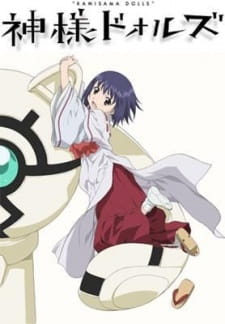
Kamisama Dolls
Number of Episodes: 13 + 6 bonus mini-episodes
WhatWikipeda Anime News Network says: "
Kyouhei Kuga is a young man who has left his small hometown to
escape from its anachronistic rules and traditions. He wants to try a
new life in Tokyo as a simple university student. In the past he was a
seki, title given to individuals who are able to control the mysterious
kakashis. Considered as gods in the small Karakami village, the kakashi
are ancient wooden wonders able to perform incredible feats. The escape
of a seki from the provincial town abruptly brings to Tokyo a handful of
other seki who are searching for him. Despite being so far away,
Kyouhei is still haunted by the old laws and hatred between the two main
families, the Kuga and the Hyuga."
What
tTPO says: This series actually has a pretty interesting premise, and a bunch of good characters whose backgrounds and motivations are well explored. Well, except for one particularly annoying female but even her motivation is pretty clear. Where it all somes to pieces is the plot (such as it is). It just rolls along with events just sort of flowing into each other without any clear direction. Instead of a beginning, a middle and an end, it ends up being a middle, a beginning (told in pieces and probably the most interesting bit), followed by more middle, finally disappearing up its own backside in a series of amazingly irrelevant (even by their generally low standards) two minute 'specials'. Even the fanservice was unimaginative.
Yet another plot annoyance was that, given the initial secrecy associated with the dolls, there are a number of extremely public doll battles in and over Tokyo of which there seems to be no public consequence.
How About the Music?: The OP, "Fukanzen Nunshou" by Chiaki Ishikawa (this link is a fancover but finding the original is rather hard) is a refreshing flamenco piece, and significantly better than the series it fronts. The ED I struggle to describe aside from being interesting and no J-pop or rock. Worth a listen. And also better than the series.
So how does it end? (Spoiler Free): Not well. This series can be added to the unfortunate
group where there is little resolution to the story and if you get a
second series (good luck) then you may or may not get some sort of
satisfaction.
Overall Grade: Despite initial appearances, there is no satisfaction to be had with the plot or ending here, only frustration at what could have been. Of course if there is a second series I may need to re-evaluate this. I'm not holding my breath. And I'm not bothering with the manga. Grade D.
Saturday, 18 February 2012
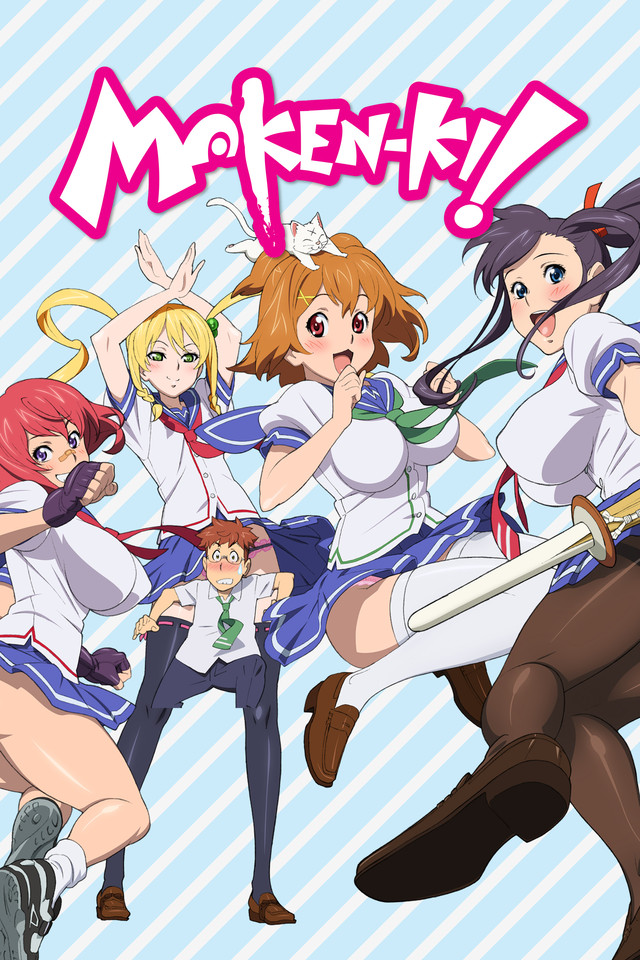
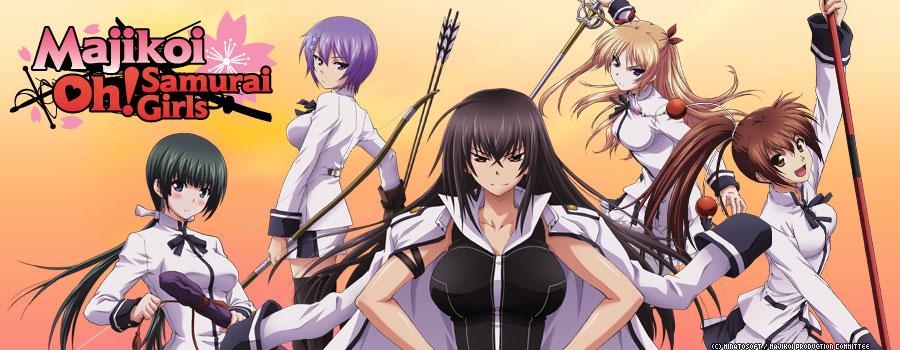
Maken-ki! and Maji de Watashi ni Koi Shinasai!
Number of episodes: 12 each
What Wikipedia says: "Maken-ki! is a Japanese manga series by Hiromitsu Takeda. An anime adaptation was recently completed. Takeru Ohyama, a young, normal, perverted minded guy, got accepted and goes to a school that, unknown to him, is where combat and magic is used and taught. Arriving at the school (which was once only for girls), he meets Haruko Amaya, his childhood friend, after three years, Inaho Kushiya, a girl who says she's his fiancée, and Kodama Himegami, a blonde who wants to kill him. Finding out that there are many girls there that just don't like him, he is told that everyone there uses a special magic ability while using an item or weapon called a Maken. Later, he finds that no Maken is acceptable for him and doesn't know what to do, since in this school the students get into duels that showcase their magic and combat power, of which he seemingly has none."
"Maji de Watashi ni Koi Shinasai! (lit. Do Love Me Seriously!) is a Japanese adult visual novel. Sentai Filmworks licensed the anime series. Kawakami City is famous for its strong dedication to its samurai ancestors. A healthy fighting spirit is always valued and it is even an important factor for success at school. Yamato, a second year student from Kawakami High School is always with his close friends (four boys and three girls). They have all known each other since they were young and have done many things together. While they have many other friends, this group of seven is a close-knit, inseparable group. They even have a secret base where they meet. With the new semester, they welcome two girls into their group and shortly after things begin to change."
What tTPO says: Both of these series share several similar traits - both are set in schools, both are harem series, both have fighting in abundance, neither is spectacularly good or bad, and both have very ample amounts of less than subtle fan service. Despite these similarities there are some important differences though.
Maken-ki! is all about the school, the students and the rather complex system of elemental power that the students use for fighting. The cast is large for a 12-episode series, and while their relationshop are interesting, the sheer weight of numbers of characters limits the possible development of them, leading to less empathy for many. The plot though leans heavily (as does the script) at times on the devlopment of elemental /weapon powers, and I cannot say, hand on heart, I always fully understood the nature of this. It was a bit like listening to Star Trek techno-babble. In Star Trek it was a poor substitute for an overall plot, and in Maken-ki! it is no different, and it ends up meandering and lacking in clear direction. Maybe you just need to be under 15 years old to get this completely? Having said that, some of the powers are quite imaginative.
Maji de Watashi ni Koi Shinasai! takes a different path. While still having some character development of the main characters, it takes many opportunities to poke fun at itself, often deconstructing the harem genre (and others where time permitted). This leads to some genuine LOL moments. It also takes a more serious look at the nature of modern Japanese nationalism and politics, and that is something I did not expect to be saying about a harem fighting series. Ever. And in there somewhere it manages to hold together some semblance of a plot.
How about the music?: Maken-ki!: The OP is a nice bit of J-pop and quite possibly the best bit about the series. The same canot be said for the ED which is a bit annoying.
Maji de Watashi ni Koi Shinasai!: The OP is some frenetic J-rock and is kinda cool without being brilliant. The ED is just a bit of bland J-pop.
So how does it end? (Spoiler Free): Harem show endings are trickier than some genres to get right because if there is a failure of commitment by the main character, it tend to trivialise any emotional weight the series may have had. With this in mind, both series have conclusions of sorts. However. Maken Ki's ending manages to feel contrived, and suffers (again) from Maken-babble. Some of the character arcs just faded away, along with any emotional impact they may have had.
In contrast, the ending of Maji de Watashi ni Koi Shinasai!, while at least roughly tying up most loose plot points, still manages one last brilliant harem genre deconstruction.
Overall Grade: Maken-ki! set the bar low, and much of the time failed to make it. I was thinking about giving this a C but that would be an injustice to other mediocre shows. Grade D.
Maji de Watashi ni Koi Shinasai! shows that within the same genre restrictions, you can have a much smarter and more involving series. Having said that, don't mistake this for an A grade show. Grade B- (and only just).
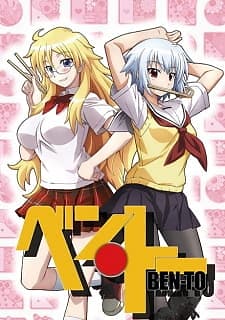
Ben-to
Number of episodes: 12
What Wikipedia says: "Ben-To is a Japanese light novel series written by Asaura, with illustrations by Kaito Shibano. The first volume was published in February 2008, and 10 volumes have been released by Shueisha as of December 2011. A 12-episode anime TV series adaptation produced by David Production aired in Japan between October and December 2011. While innocently reaching for some half-priced bento, Yō Satō finds himself beaten up on the floor of a supermarket. He soon learns that getting half-priced bento is an all-out brawl between customers. Yō is invited to the Half-Priced Food Lovers Club by one of the top fighters, Sen Yarizui, in order to train to compete in these battles. "
What tTPO says: It is difficult to know where to start. Having been to Japan on more than one occasion and bought bento from convenience stores late at night I loved the idea for this. Goddam genius. The fact it took itself seriously (sort of) and treated the idea in a similar fashion to other fighting genre shows made for a very dry kind of humour.
The series started well, with high energy levels and an air of intrigue as the characters (no problems here) were introduced. Somewhere in the middle of the season though it just lost momentum and while picking up a little towards the end it was too little too late. I think part of the problem was the delayed introduction of 3 main characters (one about episode 4 and the other around 8), and the other was the mini-arc format of the show. There were hints there may be a bigger city-wide story to tell with some history but these ideas generally remained underdeveloped before thing would move onto the next somewhat underdeveloped mini-arc.
How about the music?: Nothing much to write home about here. The OP is a competent bit of J-rock and the ED a slower melodic peice but neither, for me at least, were particularly noteworthy.
So how does it end? (Spoiler Free): Adequate but ultimately lacking in involvement. The final arc's conclusion revolves around a character we were only introduced to the previous episode, with a major character was sick in bed at home, and largely out of the story. Why bother developing these characters if they are just going to stay home! Aaaargh!
Overall Grade: C. I really wanted to like this series but it barely managed to snatch mediocrity from the jaws of brilliance. Disappointing. Would have been a D if not for the early part of the series.
Tuesday, 25 October 2011
Dog Days (with post-second season addendum)
Number of episodes: 13 + 13
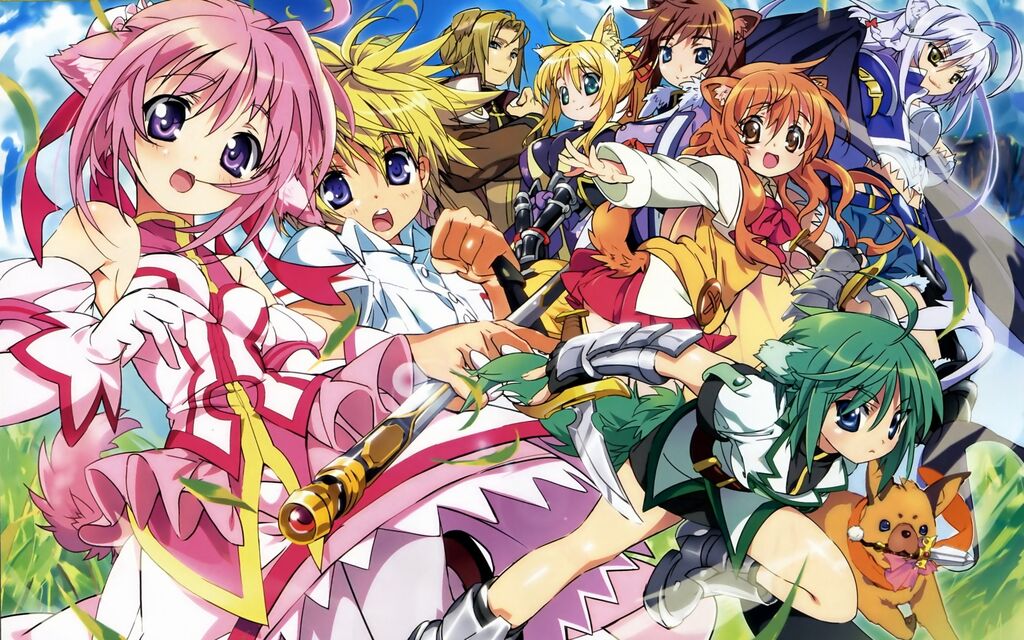
What Wikipedia says: "Cinque Izumi is a cheerful and athletic half-Japanese, half-English boy who studies at Kinokawa International School in Japan, and has a normal life everyday until he suddenly got summoned to the alternate world of Flonyard. The people there look no different from humans, except for one thing; they have animal ears and tails. The one who summoned him is Millhiore, the dog-like Princess of the Biscotti Republic, who requested his assistance in their war against the forces of the feline-like Galette Lion Army.
After responding to Millhiore's plea, he receives a sacred weapon, the Palladion, and is appointed as a Hero to fight for Biscotti in a war that unlike the ones in Earth, is waged with special rules and no casualties, in a fashion similar to a sports competition with the purpose to raise funds for the Kingdoms involved, where the winner faction claims a larger sum than the losing side. After winning his first battle for Biscotti, Cinque learns that when a hero is summoned into Flonyard he becomes unable to return to his homeworld, a fact that Millhiore also was unaware of.
The scientists of Biscotti promise to Cinque to find a way for him to return home in 16 days, the remaining time until his meeting with his friend Rebecca Anderson whom he promised to spend the last three days of his Spring Break with. Until then, he decides to keep serving Millhiore as Biscotti's hero."
What tTPO says: Unless you are allergic to either cats or dogs or cute things in general, this is a series that is mostly harmless. It is directed at the younger audience, so despite all the fighting, our characters never in anything resembling serious danger until the last couple of episodes when the series got a bit darker. The drama was on the distinctly beige side of things until that point. Having a young target market though is, as always, not a good enough reason on its own to avoid having some light fan service at times. The other downside from this old man's point of view was the lack of originality (think Final Fantasy crossed with K-ON!, the Chronicles of Thomas Covenant and just about any other shounen anime and you won't be too far off the mark). Maybe they were tying to appeal to the male and female audience simultaneously?
The overall plot is not complex, but is nicely structured over the course of the series, with a quite large cast of characters (there is some even some exploration of the main ones) and caricatures to stay entertaining. The pacing was also pretty much spot on - Angel Beats and Occult Academy could take some lessons from Dog Days in this respect. So while lacking in originality and fire, it did at least have a beginning, a middle, an end and a little heart, and that alone puts it above many other shows.
How about the music?: Much like the rest of this show the J-rock OP and ED are a bit cute, and a bit disposable.
So how does it end? (Spoiler Free): Neatly, with no important loose threads.
Overall Grade: Grade C (Nice enough, but not enough to spend time on). They set the bar low, but cleared it with ease. So much so that a second season has been announced. I probably won't be watching it though. Maybe a B for the young folk?
Addendum (after watching the second season): In contrast to my own advice I found time to watch the second season of this series - cunningly named Dog Days (apostrophe), or Dog Days' (or even DD') for short. Taking place in the next summer break of school, there were a few changes made to the formula (losing the generous amounts of fan service was not one of those changes) in that about 90% of the drama was stripped out, and the feel-good factor, which was already pretty high is now stratospheric. Seriously, even the token bad guys are good - the Demon-King's worst vice is looking at scantily clad ladies. The plot (what little there was) was also lost with the drama and DD' I think could fairly be called a slice of life series as a result. Having said that, they did actually start to deal with some of the harem / romance issues though in a very supportive way, and we got to hear about things from Cinque's perspective. Despite all of this they managed to increase the already formidable armada of characters by bringing 3 (not just 1) characters from Earth, introducing a new country for the sport-battles (with the associated rulers and retainers) and bringing a couple of historic heroes back from the past for good measure. And increase the number of insert songs performed by Millhiore from 1 to 3.
There was a very strong implication we would see a third series and maybe just maybe, we get a bit of drama back? I'll probably find myself watching again - the short format just makes it a bit easy to commit time-wise.
What Wikipedia says: "Cinque Izumi is a cheerful and athletic half-Japanese, half-English boy who studies at Kinokawa International School in Japan, and has a normal life everyday until he suddenly got summoned to the alternate world of Flonyard. The people there look no different from humans, except for one thing; they have animal ears and tails. The one who summoned him is Millhiore, the dog-like Princess of the Biscotti Republic, who requested his assistance in their war against the forces of the feline-like Galette Lion Army.
After responding to Millhiore's plea, he receives a sacred weapon, the Palladion, and is appointed as a Hero to fight for Biscotti in a war that unlike the ones in Earth, is waged with special rules and no casualties, in a fashion similar to a sports competition with the purpose to raise funds for the Kingdoms involved, where the winner faction claims a larger sum than the losing side. After winning his first battle for Biscotti, Cinque learns that when a hero is summoned into Flonyard he becomes unable to return to his homeworld, a fact that Millhiore also was unaware of.
The scientists of Biscotti promise to Cinque to find a way for him to return home in 16 days, the remaining time until his meeting with his friend Rebecca Anderson whom he promised to spend the last three days of his Spring Break with. Until then, he decides to keep serving Millhiore as Biscotti's hero."
What tTPO says: Unless you are allergic to either cats or dogs or cute things in general, this is a series that is mostly harmless. It is directed at the younger audience, so despite all the fighting, our characters never in anything resembling serious danger until the last couple of episodes when the series got a bit darker. The drama was on the distinctly beige side of things until that point. Having a young target market though is, as always, not a good enough reason on its own to avoid having some light fan service at times. The other downside from this old man's point of view was the lack of originality (think Final Fantasy crossed with K-ON!, the Chronicles of Thomas Covenant and just about any other shounen anime and you won't be too far off the mark). Maybe they were tying to appeal to the male and female audience simultaneously?
The overall plot is not complex, but is nicely structured over the course of the series, with a quite large cast of characters (there is some even some exploration of the main ones) and caricatures to stay entertaining. The pacing was also pretty much spot on - Angel Beats and Occult Academy could take some lessons from Dog Days in this respect. So while lacking in originality and fire, it did at least have a beginning, a middle, an end and a little heart, and that alone puts it above many other shows.
How about the music?: Much like the rest of this show the J-rock OP and ED are a bit cute, and a bit disposable.
So how does it end? (Spoiler Free): Neatly, with no important loose threads.
Overall Grade: Grade C (Nice enough, but not enough to spend time on). They set the bar low, but cleared it with ease. So much so that a second season has been announced. I probably won't be watching it though. Maybe a B for the young folk?
Addendum (after watching the second season): In contrast to my own advice I found time to watch the second season of this series - cunningly named Dog Days (apostrophe), or Dog Days' (or even DD') for short. Taking place in the next summer break of school, there were a few changes made to the formula (losing the generous amounts of fan service was not one of those changes) in that about 90% of the drama was stripped out, and the feel-good factor, which was already pretty high is now stratospheric. Seriously, even the token bad guys are good - the Demon-King's worst vice is looking at scantily clad ladies. The plot (what little there was) was also lost with the drama and DD' I think could fairly be called a slice of life series as a result. Having said that, they did actually start to deal with some of the harem / romance issues though in a very supportive way, and we got to hear about things from Cinque's perspective. Despite all of this they managed to increase the already formidable armada of characters by bringing 3 (not just 1) characters from Earth, introducing a new country for the sport-battles (with the associated rulers and retainers) and bringing a couple of historic heroes back from the past for good measure. And increase the number of insert songs performed by Millhiore from 1 to 3.
There was a very strong implication we would see a third series and maybe just maybe, we get a bit of drama back? I'll probably find myself watching again - the short format just makes it a bit easy to commit time-wise.
Subscribe to:
Posts (Atom)