aka Shōjo Shūmatsu Ryokō
Number of Episodes: 12
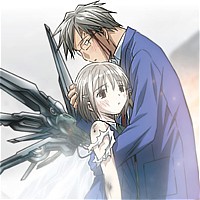
What Wikipedia says: The series follows two girls, Yuuri and Chito, as they navigate the ruins of civilization after an unknown apocalypse, and as they travel in their Kettenkrad, they seek food and supplies while surviving day-to-day.
What KoanMan says:
Talent hits a target no-one else can hit
Genius hits a target no-one else can see
- Schopenhauer
Girls’ Last Tour, like the quote above, is going to amaze those for whom it resonates, and will fall flat and mean nothing for others. It affected KoanMan deeply. It gets an A.
One immediate questions: why?
The story follows the journey of two girls, Chito and Yuuri, through a post-apocalyptic world in an endless search for food, shelter, and the higher levels in a multilayered hyper-urban cityscape. And like the philosophy of Schopenhauer, it is at once neither right nor wrong, neither positive nor negative, it simply is. Although, while Schopenhauer used negative language to relate his insights, Girls’ Last Tour presents a certain loss while simultaneously exploring the joy of simple pleasures. A hot bath, hunger giving way to a good meal. The shining spear of light that shines in the midst of desolation seems all the brighter for it, in spite of it, or perhaps because of it?
Chito and Yuuri are extremely well developed, and while very different, cling to each other for fundamental survival. The space afforded by their situation allows for far more depth than can usually be achieved in anime, like the view at the top of a mountain, with the entire world played out beneath, more is visible and the vastness is revealed without the distraction of detail. The manga, crafted by Tsukumizu, is faithfully reproduced in the anime directed by Takaharu Ozaki and written by Kazuyuki Fudeyasu. The background and scenery is superbly rendered and well supported musically by Kenichiro Suehiro and Jin Aketagawa as sound director. Tsukumizu’s contrasting 'cute versus bleak' creates an interesting dissonance in both the art-style and the story that is expanded in the anime over the manga.
So How Does it End? (Spoiler free):
Much like the rest of the anime, there is still the spectre of just the faintest hope in the ending. For better or worse the manga pushes on further. You may or may not wish to go down that road. [tTPO]
Overall Grade: Girls’
Last Tour emanates an existential aura that provokes serious
introspective thought. It did for KoanMan at least. It gets an A.
What tTPO says: tTPO (and Mrs tTPO) also found GLT an extrordinarily affecting anime. In recommending it to KoanMan, who has not got the greatest track record for enjoying slow moving anime, I was unsure as to if it would get through to him. I shouldn't have worried because this anime gets so much right, despite the glacial pacing which is so essential to the feel, it is hard not to appreciate it. Very few anime are as bitter, nor as sweet, as GLT. A+. It's just that good.
An anime review website for the older otaku, where work, family and life mean that every anime watching hour is precious and should not be wasted on shows that do not deserve it. Scoring is judged on overall enjoyment, music and the ending, with longer series having to stand up to more strict criteria than shorter ones. Reviews are kept short and to the point. Because time is always pressing.
Showing posts with label Science Fiction. Show all posts
Sunday, 13 October 2019
Wednesday, 24 July 2019
Saikano, The Last Love Song on this Little Planet
aka Saishuu Heiki Kanojo (translated into English as Ultimate Weapon Girlfriend)
Number of Episodes: 13
WhatWikipedia Anime News Network says: Shuji and Chise are two Hokkaido high school students barely starting a relationship with each other. Then, with no warning, a squadron of bombers from an unknown country destroy the city of Sapporo. All hope is lost when suddenly, the bombers are destroyed by a small red light floating across the sky. At this point, Shuji finds out that the one responsible for eliminating the enemy forces is Chise, who reveals herself as a cyborg engineered for mass-destruction.
What KoanMan says: This sounds like it would be great. It sounds like it would be packed with action. It sounds like a schoolboy's wet dream…
However… it is “sorry”, “dummy”, “idiot”, a little bleak, and more “sorry”. Much more “sorry”.
The take-home message: don’t judge a book by its cover. The feel of this series is dominated by the story-line, which meanders through the relationship of the main protagonists, high-schoolers Chise and Shuuji. Plenty is left out, and much is assumed as the plot plods along at a dreary pace. Brief glimpses of excitement are thwarted as the story is dragged back to its original pace, and yet it somehow flows steadily and consistently - just don’t expect to be thrilled by director Mitsuko Kase's anime rendition of Shin Takahashi’s manga.
The basic animation smacks of low budget, and possibly indicates a lack of artistic interest on the part of the production team (lead by Naoko Takahashi), although the artistic effects in the opening and closing credits were uncharacteristically well done.
How About the Music? The music generally is average, and the music for the opening and closing were in keeping with the general mood, although those more musically attuned may find the 1/8th flat notes of the singer irritating, but it does add a little more to the disjointed feel generally. Perhaps sound director Keiichirou Miyoshi has achieved the desired audience response? KoanMan is unsure.
So How Does it End? (Spoiler free): All endings are not created equal and while there won't be a sequel anytime soon, the ending perhaps lacks a little clarity. Reading the last chapter or two of the manga explains things a little more fully and is recommended. [tTPO]
Overall Grade: If you are after a borderline existential story that does not require adrenaline, then this could meet your needs. Despite the flaws KoanMan kept watching through to the end, indicating a certain something, perhaps the futility… ohhh the futility…
KoanMan rates this a C.
What tTPO says: tTPO has a soft spot for romantic anime. What I have not said previously is I also have a soft spot for slow moving existential post apocolyptic romantic anime also, and Saikano fits this description. There is little to enjoy here as the glacial car crash that is this anime grinds to its conclusion, and yet like any car crash, I found it difficult to look away. The basic artwork (it was 2002 when it was produced) and muted colours that annoyed KoanMan I thought appropriate for this often emotionally cold production.
Needless to say I rate it a bit higher than KoanMan, though Mrs tTPO would agree with him. I considered the possibilty I was wrong. Not possible though, is it? Grade B-.
Number of Episodes: 13
What
What KoanMan says: This sounds like it would be great. It sounds like it would be packed with action. It sounds like a schoolboy's wet dream…
However… it is “sorry”, “dummy”, “idiot”, a little bleak, and more “sorry”. Much more “sorry”.
The take-home message: don’t judge a book by its cover. The feel of this series is dominated by the story-line, which meanders through the relationship of the main protagonists, high-schoolers Chise and Shuuji. Plenty is left out, and much is assumed as the plot plods along at a dreary pace. Brief glimpses of excitement are thwarted as the story is dragged back to its original pace, and yet it somehow flows steadily and consistently - just don’t expect to be thrilled by director Mitsuko Kase's anime rendition of Shin Takahashi’s manga.
The basic animation smacks of low budget, and possibly indicates a lack of artistic interest on the part of the production team (lead by Naoko Takahashi), although the artistic effects in the opening and closing credits were uncharacteristically well done.
How About the Music? The music generally is average, and the music for the opening and closing were in keeping with the general mood, although those more musically attuned may find the 1/8th flat notes of the singer irritating, but it does add a little more to the disjointed feel generally. Perhaps sound director Keiichirou Miyoshi has achieved the desired audience response? KoanMan is unsure.
So How Does it End? (Spoiler free): All endings are not created equal and while there won't be a sequel anytime soon, the ending perhaps lacks a little clarity. Reading the last chapter or two of the manga explains things a little more fully and is recommended. [tTPO]
Overall Grade: If you are after a borderline existential story that does not require adrenaline, then this could meet your needs. Despite the flaws KoanMan kept watching through to the end, indicating a certain something, perhaps the futility… ohhh the futility…
KoanMan rates this a C.
What tTPO says: tTPO has a soft spot for romantic anime. What I have not said previously is I also have a soft spot for slow moving existential post apocolyptic romantic anime also, and Saikano fits this description. There is little to enjoy here as the glacial car crash that is this anime grinds to its conclusion, and yet like any car crash, I found it difficult to look away. The basic artwork (it was 2002 when it was produced) and muted colours that annoyed KoanMan I thought appropriate for this often emotionally cold production.
Needless to say I rate it a bit higher than KoanMan, though Mrs tTPO would agree with him. I considered the possibilty I was wrong. Not possible though, is it? Grade B-.
Saturday, 24 November 2018
Mob Psycho 100
Number of Episodes: 12
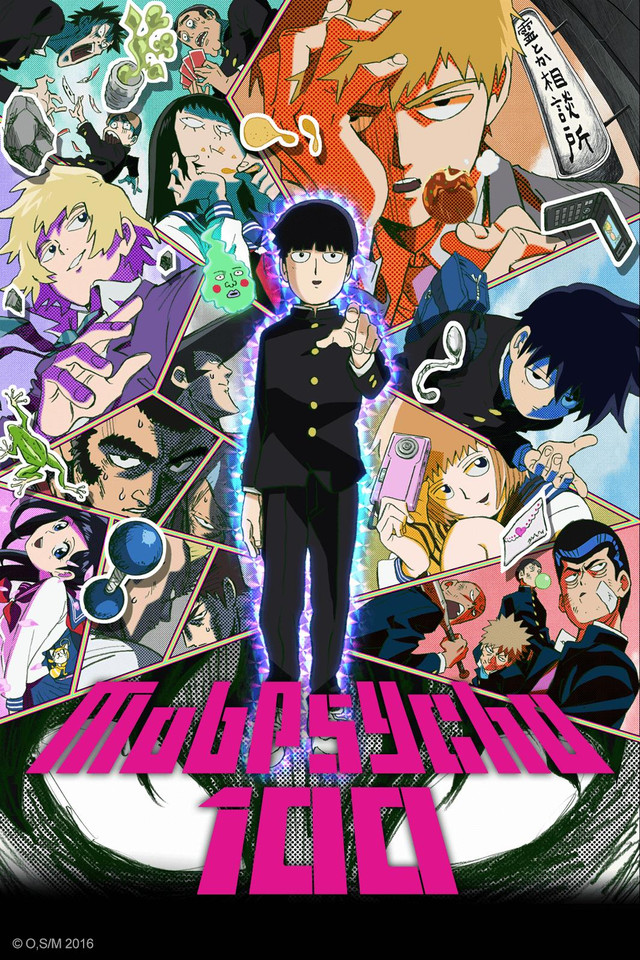
What Wikipedia says: Shigeo Kageyama is an average middle school boy, nicknamed Mob (モブ Mobu) (meaning "background character") for lacking a sense of presence. Although he looks like an inconspicuous person, he is in fact a powerful esper. As he grows older, Mob realizes that his psychic powers are strengthening and becoming more dangerous. To avoid his power getting out of control, he constantly lives a life under an emotional shackle. Mob wants to live a normal life just like the others, but a barrage of trouble keeps coming after him. With the suppressed emotions growing inside Mob little by little, his power threatens to break through its limits.
What KoanMan says: "Mob Psycho 100", by Yuzuru Tachikawa and produced by ONE, is a similar style of animation to One Punch Man by the same, though visually a little rough. The storylines are vaguely similar, however they present different viewing experiences. Characters centre on Mob, who is a socially clueless super-being, who follows a meandering plot through his personal development. Lots of action and likeable, though shallow, personalities make this an enjoyable watch, without much brain owner required.
What Wikipedia says: Shigeo Kageyama is an average middle school boy, nicknamed Mob (モブ Mobu) (meaning "background character") for lacking a sense of presence. Although he looks like an inconspicuous person, he is in fact a powerful esper. As he grows older, Mob realizes that his psychic powers are strengthening and becoming more dangerous. To avoid his power getting out of control, he constantly lives a life under an emotional shackle. Mob wants to live a normal life just like the others, but a barrage of trouble keeps coming after him. With the suppressed emotions growing inside Mob little by little, his power threatens to break through its limits.
What KoanMan says: "Mob Psycho 100", by Yuzuru Tachikawa and produced by ONE, is a similar style of animation to One Punch Man by the same, though visually a little rough. The storylines are vaguely similar, however they present different viewing experiences. Characters centre on Mob, who is a socially clueless super-being, who follows a meandering plot through his personal development. Lots of action and likeable, though shallow, personalities make this an enjoyable watch, without much brain owner required.
So How Does it End? (Spoiler free): Well rounded, but with plenty of room for season 2 (coming late 2018/early 2019).
How About the Music? The music is OK, and the Japanese phonetic counting in English in the opening credits song is very cute.
Overall Grade: Mob Psycho 100 is an enjoyable, non-taxing, short series, and is a good way to pass time, with some great visual ideas. Koan Man gives this a C.
Addendum by tTPO: This is one of those series where KoanMan doesn't quite know what he is talking about. While this is no One Punch Man, it is no C either, either enough humour, action and originality (a rare commodity) to well justify a B.
Labels:
Action,
Comedy,
Fighting,
Grade B,
Grade C,
School,
Science Fiction,
Supernatural
Sunday, 12 February 2017
Psycho Pass & Psycho Pass 2
Number of Episodes: 22 & 11 (this review ignores the rerun 1st season compilation) and 1 movie
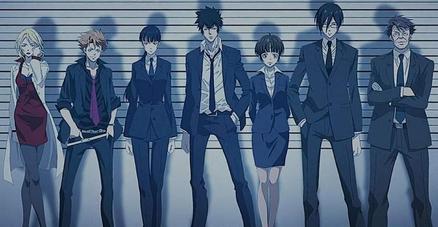
What Wipipedia says: The story takes place in an authoritarian future dystopia, where omnipresent public sensors continuously scan the mental states of every passing citizen. Collected data on both present mentality and aggregated personality data is used to gauge the probability of that citizen committing a crime, the rating referred to as that citizen's Psycho-Pass. Authorities are alerted whenever excessive ratings are detected, and officers of the Public Safety Bureau are dispatched with weapons called "Dominators", energy pistols that modulate their power in response to the target's Psycho Pass. The story follows Akane Tsunemori and Shinya Kogami among other members of Unit One of the Public Safety Bureau's Criminal Investigation Division.
What KoanMan says: Psycho-Pass is a detective/police action sci-fi that delivers on its brief. Supervising Director Katsuyuki Motohiro knew what he was doing when he employed the writer of Puella Magi Madoka Magica, the talented Gen Urobuchi. Interestingly, rather than give director Naoyoshi Shiotani artistic carte blanche, Motohiro gave him a brief to ensure everything they did could be adapted into a live action film. Well-read creator Tow Ubukata's story has been brought to life in a cohesive, well defined and complex plot. Arguments for and against the control of the state are played out in a dramatic style that keeps one coming back for more each episode.
Character development is organic, with personalities being revealed "on the job", as Investigators, Akane Tsunemori and Noguchika Ginoza direct their attack dogs, the Enforcers, primarily Shinya Kogami. They track their villains through a Sibyl-sanitised, and somewhat frightening, future Japan throughout seasons 1 and 2, and venture overseas in the movie. The apt name may be an acknowledgement of the multiple personality book and 1976 movie, "Sybil". The references do not stop there, with everyone from Plato and Marcel Proust to George Orwell and the Bible, getting a look in. Characters are believable and dedicated, and present their part of the story's societal comment with very few light-hearted moments, which might make this intellectually heavy for some. Good news is, there is plenty of action if one prefers to sit back and simply be entertained.
How About the Music? Opening and closing credits music is great in series 1 and the movie, though sound director Yoshikazu Iwanami may have gone a little too heavy with series 2. Otherwise, the music throughout is well suited.
So How Does it End? (Spoiler free): Both seasons 1 and 2 end satisfactorily though there is still enough in this rich world for more.
Overall Grade: A thoroughly enjoyable series, on so many levels. KoanMan gives Psycho-Pass a well-earnt A.
Addendum by tTPO: tTPO agrees. This is a series dense with ideas but with a distinct identity from Ghost in the Shell, probably its nearest comparison. There are some genuinely tense and shocking moments, moreso in season 1 for me, which I think mark a quality production. Season 2 was a bit weaker than season 1, but still well worth the time watching. A-.
Wednesday, 4 November 2015
Elfen Lied
Number of Episodes: 13
What
What tTPO says: This is an extreme series - extreme violence and gore, nudity, and much victimisation of innocents. This alone is enough to turn many people off, and understandably so. As Koanman points out below, character development is not profound for most and the plot, based on a much longer manga, ends up being hard to follow at times as to everyone's motivations.
Despite all of these imperfections it is a compelling and thought provoking series that treads similar thematic ground to Shiki in that it questions human nature and asks the same question - who are the monsters here?
How About the Music? I'll let KoanMan talk about this.
So How Does it End? (Spoiler free): The ending is not made perfectly clear, but it is emotionally satisfactory and surprisingly, just a little optimistic.
Overall Grade: This is an imperfect series, and not an easy ride. But somewhere in there is a story that needed to be told and questions that needed to be asked. Grade B
Addendum by KoanMan: Elfen Lied has loads of cool ideas and concepts, starting with the visuals right from the beginning, and coupled with the hauntingly brilliant choice of theme song by music director Katsunori Shimizu, "Lilium", by Kumico Noma. The closing theme "Be My Girl", by Cheiko Kawabe, is also a good choice, and certainly finishes each episode on a light note.
The plot is interesting, if not somewhat convoluted. This is where the first half of the series feels a little disjointed, and the storyline does not flow well from one scene to the next. Everything is there, but just a bit clunky. The invisible hand thing doesn't really appeal.
Similarly, character development falls short. All the elements are there, however, director Mamoru Kanbe just misses the mark. The main female characters all have plenty of quirks that could have generated legendary status, however, Kouta comes across as plain weak. That said, Yuka comes across weird and jealous, Mayu is a bit of a non-event, and Nana is confused, although with daddy issues, this at least gives her some interest.
Lucy/Nyu is the only character that really gets development, all the others get attempts at development. Lucy starts as a killing fiend humming a cutesy song, a disturbing blend of efficient murderous innocence. Then, as her dual personality becomes obvious it seems she becomes moody and bitter... No cutesy malevolent humming at all. KoanMan is not sure why she was a innocent and happy cute killing machine at first, then a dark and moody cute killing machine later.
KoanMan really wants to love this series, although it just doesn't quite get there. It is OK, but it could have been so much more- a solid B for this one.
Saturday, 28 February 2015
Attack on Titan Seasons 1&2
aka Shingeki no Kyojin
Number of Episodes: 25 + 9 shorts + 3 OVAs + 13
What Wikipedia says: "Attack on Titan is a 2013 anime series based on the manga by Hajime Isayama serialized in Bessatsu Shōnen Magazine. It is set in a world where humanity lives inside cities surrounded by enormous walls due to the Titans, gigantic humanoid creatures who devour humans seemingly without reason. The story centers around Eren Jaeger, his adopted sister Mikasa, and their friend Armin, whose lives are changed forever after a large Titan breaches the wall of their home town. Vowing revenge and to reclaim the world from the Titans, Eren and his friends join the Scout Regiment, an elite group of soldiers who fight Titans at the front lines."
KoanMan says (spoiler free): Strap yourself in and hit the GO button! This is a great ride, not unlike being in the surf... in a hurricane! The action hits you like a giant wave, then a brief lull before the next wave hits you. The action is fast and furious for the first half of the series, with a change of style at about mid-way which almost seemed like a change of director, including changes to the opening and closing credits. Thankfully this quiet period ends quickly and gets back to the good stuff to finish off the series in spectacular style. The opening credits of the first 12 episodes is a visual feast, with some disturbing images in a frenetic montage which sets the scene well.
There are a lot of characters that appear in this series, only to disappear again to feed the tremendous body count. This one is NOT for the kiddies, but would probably be of great interest to anatomy students. The central character, Eren, is a driven individual, well supported by his childhood friend, the intelligent Armin, and adoptive sister, the more than capable Mikasa. Their interactions with each other, and with an interesting take on a post-apocalyptic scenario, make this a thoroughly enjoyable series. Plot is light on in the early episodes but you don't really have time to notice, and the character development is equally superficial, though plot and character growth does build nicely toward the end.
How About the Music? tTPO here as KoanMan was so excited by the phenomenal level of action he forgot about this. But he shouldn't have. The opening (power metal) themes by Linked Horizon are light years away from the usual J-fluff and capture the epic nature of the series perfectly. Just sit back and enjoy.
OP1: "Feuerroter Pfeil und Bogen" ("Crimson Bow and Arrow")
OP2: "Die Flügel der Freiheit" ("The Wings of Freedom")
Overall Grade: KoanMan enjoyed is thoroughly and is eagerly awaiting Series 2. This gets an A.
Addendum (by tTPO): This series is brilliant with perhaps its only drawback being then end of the anime is by no means the end of the story (OK, and maybe a few hanging smaller plot threads), though it does make for an appropriate stopping point. There are some unexpectedly brave moves along the way and at no stage do we get complacent about the threat to humanity. The backstory also gets satisfyingly deeper (and some surprising attempts at science) with the progression of the series. Grade A. With bells on.
Season 2 Addendum from KoanMan: After careful consideration, I really have nothing much to add re S2 for AoT. It is still good…. very good….
Season 2 Addendum from tTPO: Amen.
Number of Episodes: 25 + 9 shorts + 3 OVAs + 13
What Wikipedia says: "Attack on Titan is a 2013 anime series based on the manga by Hajime Isayama serialized in Bessatsu Shōnen Magazine. It is set in a world where humanity lives inside cities surrounded by enormous walls due to the Titans, gigantic humanoid creatures who devour humans seemingly without reason. The story centers around Eren Jaeger, his adopted sister Mikasa, and their friend Armin, whose lives are changed forever after a large Titan breaches the wall of their home town. Vowing revenge and to reclaim the world from the Titans, Eren and his friends join the Scout Regiment, an elite group of soldiers who fight Titans at the front lines."
KoanMan says (spoiler free): Strap yourself in and hit the GO button! This is a great ride, not unlike being in the surf... in a hurricane! The action hits you like a giant wave, then a brief lull before the next wave hits you. The action is fast and furious for the first half of the series, with a change of style at about mid-way which almost seemed like a change of director, including changes to the opening and closing credits. Thankfully this quiet period ends quickly and gets back to the good stuff to finish off the series in spectacular style. The opening credits of the first 12 episodes is a visual feast, with some disturbing images in a frenetic montage which sets the scene well.
There are a lot of characters that appear in this series, only to disappear again to feed the tremendous body count. This one is NOT for the kiddies, but would probably be of great interest to anatomy students. The central character, Eren, is a driven individual, well supported by his childhood friend, the intelligent Armin, and adoptive sister, the more than capable Mikasa. Their interactions with each other, and with an interesting take on a post-apocalyptic scenario, make this a thoroughly enjoyable series. Plot is light on in the early episodes but you don't really have time to notice, and the character development is equally superficial, though plot and character growth does build nicely toward the end.
How About the Music? tTPO here as KoanMan was so excited by the phenomenal level of action he forgot about this. But he shouldn't have. The opening (power metal) themes by Linked Horizon are light years away from the usual J-fluff and capture the epic nature of the series perfectly. Just sit back and enjoy.
OP1: "Feuerroter Pfeil und Bogen" ("Crimson Bow and Arrow")
OP2: "Die Flügel der Freiheit" ("The Wings of Freedom")
Overall Grade: KoanMan enjoyed is thoroughly and is eagerly awaiting Series 2. This gets an A.
Addendum (by tTPO): This series is brilliant with perhaps its only drawback being then end of the anime is by no means the end of the story (OK, and maybe a few hanging smaller plot threads), though it does make for an appropriate stopping point. There are some unexpectedly brave moves along the way and at no stage do we get complacent about the threat to humanity. The backstory also gets satisfyingly deeper (and some surprising attempts at science) with the progression of the series. Grade A. With bells on.
Season 2 Addendum from KoanMan: After careful consideration, I really have nothing much to add re S2 for AoT. It is still good…. very good….
Season 2 Addendum from tTPO: Amen.
Wednesday, 6 August 2014
The Melancholy of Haruhi Suzumiya + The Disappearance of Haruhi Suzumiya movie
Number of Episodes: 24 + movie
What Wipipedia says: "The story follows the narrator and male protagonist Kyon, a cynical and incredulous student entering high school who is dragged along by the title character and female protagonist Haruhi Suzumiya (who is Kyon's classmate). She is an eccentric girl seeking supernatural phenomena and figures such as aliens, time travelers, and espers. With Kyon's reluctant help, Haruhi establishes a club called the SOS Brigade, to investigate mysterious events. Haruhi later recruits three additional members: the laconic bibliophile Yuki Nagato, the shy and timid Mikuru Asahina, and the extremely friendly transfer student Itsuki Koizumi. These members soon reveal themselves (to Kyon) to be the types of extraordinary characters that Haruhi is seeking. The three additional members have been sent by their various organizations to observe Haruhi, who is unaware of her own destructive reality warping powers and to prevent these powers from being unleashed. This leaves Kyon the task of maintaining the illusion of a normal life for Haruhi."
KoanMan says: KoanMan watched this series in the broadcast order, which meant some initial confusion re plot and characters. Starting with the least watchable episode straight up meant that if one did continue onto the next episode, it was all good from Ep2 onwards. In the end, watching in this way did make it a more interesting watch, as one felt just a little behind the storyline, trying to keep up with changes in direction that at the time presented as totally random. In retrospect, they still seem a little random, almost like they threw the episodes into a hat and let chance reveal the next episode. Character development did, however, seem perfectly done this way, so there must be some "method to the madness".
On that note, KoanMan found the characters difficult to associate with early on; the whining and sedentary Kyon, the OTT Haruhi Suzumiya, the uber-quiet bookworm Yuki Nagato, the "yes-man" Itsuki Koizumi, and the cutesy mascot girl Mikuru Asahina. Unusually, for KoanMan, all these characters grew on one, to the point where even Ep12 to Ep19 [Ttpo: that would be the infamous Endless Eight episodes] were watchable! Far more so than Straight Title Robot. The reader will know what this means by Ep13, suffice it to say that Ep13 to Ep18 could have been condensed by more brutal editing, however, this would beg the question....Would it have been the same series? Would it have had the same impact? The jury is out at this time.
The movie certainly had a far more cohesive plot and better direction to the story, most likely as it was based on The Disappearance of Haruhi Suzumiya, the 4th in a series of light novels by Nagaru Tanigawa. Thoroughly enjoyable, but do watch the series first.
How about the music?: The music was OK for the first few episodes, then the same music seemed to get better, and by the end, the very same music was something I looked forward to each episode. How did this happen?
Overall Grade: Between the unusual jumbling of episodes, well out of the story's chronological sequence, the mysteriously improving, though unchanging, music, and characters that grow on you, coupled with good delivery of a good story mean that series director Tatsuya Ishihara, and movie directors Tatsuya Ishihara and Yasuhiro Takemoto have done well.
KoanMan gives these series and movie a collective A.
Ttpo says: This series is not perfect but is brilliant. The fan service gets a little grating sometimes and the bullying of Mikuru occasionally a little uncomfortable. But these are minor gripes in a series that balances big questions in a deep world spanning mystery with day to day slice of life triviality with seeming ease. I loved the music (esp OP1, OP2 and insert song God Knows), and also the cheesy (and the oft mimicked) choreography over the ED1 (see here in live format by the seiyuu).
There are some very brave directional issues that KoanMan has already pointed out but these serve to further differentiate this series from the also-rans. The movie is everything good about the series in slighly higher resolution and is excellent from beginning to end, though without having first seen the series much would be lost to the casual viewer. An A for sure.
What Wipipedia says: "The story follows the narrator and male protagonist Kyon, a cynical and incredulous student entering high school who is dragged along by the title character and female protagonist Haruhi Suzumiya (who is Kyon's classmate). She is an eccentric girl seeking supernatural phenomena and figures such as aliens, time travelers, and espers. With Kyon's reluctant help, Haruhi establishes a club called the SOS Brigade, to investigate mysterious events. Haruhi later recruits three additional members: the laconic bibliophile Yuki Nagato, the shy and timid Mikuru Asahina, and the extremely friendly transfer student Itsuki Koizumi. These members soon reveal themselves (to Kyon) to be the types of extraordinary characters that Haruhi is seeking. The three additional members have been sent by their various organizations to observe Haruhi, who is unaware of her own destructive reality warping powers and to prevent these powers from being unleashed. This leaves Kyon the task of maintaining the illusion of a normal life for Haruhi."
KoanMan says: KoanMan watched this series in the broadcast order, which meant some initial confusion re plot and characters. Starting with the least watchable episode straight up meant that if one did continue onto the next episode, it was all good from Ep2 onwards. In the end, watching in this way did make it a more interesting watch, as one felt just a little behind the storyline, trying to keep up with changes in direction that at the time presented as totally random. In retrospect, they still seem a little random, almost like they threw the episodes into a hat and let chance reveal the next episode. Character development did, however, seem perfectly done this way, so there must be some "method to the madness".
On that note, KoanMan found the characters difficult to associate with early on; the whining and sedentary Kyon, the OTT Haruhi Suzumiya, the uber-quiet bookworm Yuki Nagato, the "yes-man" Itsuki Koizumi, and the cutesy mascot girl Mikuru Asahina. Unusually, for KoanMan, all these characters grew on one, to the point where even Ep12 to Ep19 [Ttpo: that would be the infamous Endless Eight episodes] were watchable! Far more so than Straight Title Robot. The reader will know what this means by Ep13, suffice it to say that Ep13 to Ep18 could have been condensed by more brutal editing, however, this would beg the question....Would it have been the same series? Would it have had the same impact? The jury is out at this time.
The movie certainly had a far more cohesive plot and better direction to the story, most likely as it was based on The Disappearance of Haruhi Suzumiya, the 4th in a series of light novels by Nagaru Tanigawa. Thoroughly enjoyable, but do watch the series first.
How about the music?: The music was OK for the first few episodes, then the same music seemed to get better, and by the end, the very same music was something I looked forward to each episode. How did this happen?
Overall Grade: Between the unusual jumbling of episodes, well out of the story's chronological sequence, the mysteriously improving, though unchanging, music, and characters that grow on you, coupled with good delivery of a good story mean that series director Tatsuya Ishihara, and movie directors Tatsuya Ishihara and Yasuhiro Takemoto have done well.
KoanMan gives these series and movie a collective A.
Ttpo says: This series is not perfect but is brilliant. The fan service gets a little grating sometimes and the bullying of Mikuru occasionally a little uncomfortable. But these are minor gripes in a series that balances big questions in a deep world spanning mystery with day to day slice of life triviality with seeming ease. I loved the music (esp OP1, OP2 and insert song God Knows), and also the cheesy (and the oft mimicked) choreography over the ED1 (see here in live format by the seiyuu).
There are some very brave directional issues that KoanMan has already pointed out but these serve to further differentiate this series from the also-rans. The movie is everything good about the series in slighly higher resolution and is excellent from beginning to end, though without having first seen the series much would be lost to the casual viewer. An A for sure.
Labels:
Comedy,
Drama,
Grade A,
Harem,
Mystery,
School,
Science Fiction,
Slice of Life
Wednesday, 12 March 2014
Straight Title Robot Anime
Number of Episodes: 12 (13:30 minute episodes)
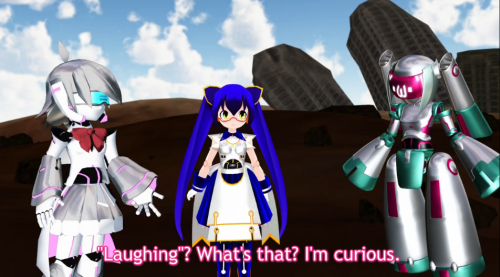
What Wikipaedia says: The story is set in the year Mobile Century 8013 where humans no longer inhabit the planet Earth. However, remaining military robots continue to fight for unknown purpose(s). Three non-combatant robots, Fuji, Kato, and Mori attempt to end the war that lasted for 7 millennia by investigating on human laughter.
KoanMan says: KoanMan is not really sure about this series. It is definitely not an action, not terribly serious, and is not fast-paced. It will not tax the viewer. What it is, seems to be a repetitive documentary on humour/comedy. Despite this, KoanMan actually blitzed this whole series in just 2 sittings, and the small differences between episodes became the feature that kept one watching. How many different scenarios will still lead to the same annihilation of the planet in a continual robot war several thousand years in duration? Well, a lot, as it happens - and perhaps this is the point. The "futility of hostility"...History repeating itself...
The female worker-bee robots, Fujii, Mori and Kato carry the exploration of laughter, with random voice-overs by a particularly dandy male (DELETED - Possible spoiler) narrator (DELETED - Possible spoiler). The characters do develop in interesting ways, a quiet feature of the series that requires some close attention.
How About the Music?: The music is frenetic during the high action opening sequence and the "experiments", and, well, actually that's about it.
Overall Grade: KoanMan has mixed feelings. The series is s-l-o-w. However, the episodes are short, and there are not many of them. For the TPO these are positives, as are the characters themselves and KoanMan found some potential here, and the pinnacle of the series, Episode 11, without which it would have been rated much harder. As it was, it simply slowed right down to a C.
tTPO says: I took a different view to this series than KoanMan. While at first glance it seems an awful lot like the Endless 8 from Haruhi (though mercifully shorter and more varied) there is steady character development, that by the time the end hits (and it does hit surprisingly hard considering the rest of the series) I cared about the characters. The repititous nature of the episodes I found really quite educational about the nature of comedy and so for me, while the structure of each episde was very similar, the content varied enough to keep me interested. I think to be fair though you could remove about 5 or 6 episodes from the middle of this series and not lose too much.
This is no Attack on Titan but I enjoyed this more than (the apparently heartless) KoanMan. With the short episode format working its favour I give it a B.
What Wikipaedia says: The story is set in the year Mobile Century 8013 where humans no longer inhabit the planet Earth. However, remaining military robots continue to fight for unknown purpose(s). Three non-combatant robots, Fuji, Kato, and Mori attempt to end the war that lasted for 7 millennia by investigating on human laughter.
KoanMan says: KoanMan is not really sure about this series. It is definitely not an action, not terribly serious, and is not fast-paced. It will not tax the viewer. What it is, seems to be a repetitive documentary on humour/comedy. Despite this, KoanMan actually blitzed this whole series in just 2 sittings, and the small differences between episodes became the feature that kept one watching. How many different scenarios will still lead to the same annihilation of the planet in a continual robot war several thousand years in duration? Well, a lot, as it happens - and perhaps this is the point. The "futility of hostility"...History repeating itself...
The female worker-bee robots, Fujii, Mori and Kato carry the exploration of laughter, with random voice-overs by a particularly dandy male (DELETED - Possible spoiler) narrator (DELETED - Possible spoiler). The characters do develop in interesting ways, a quiet feature of the series that requires some close attention.
How About the Music?: The music is frenetic during the high action opening sequence and the "experiments", and, well, actually that's about it.
Overall Grade: KoanMan has mixed feelings. The series is s-l-o-w. However, the episodes are short, and there are not many of them. For the TPO these are positives, as are the characters themselves and KoanMan found some potential here, and the pinnacle of the series, Episode 11, without which it would have been rated much harder. As it was, it simply slowed right down to a C.
tTPO says: I took a different view to this series than KoanMan. While at first glance it seems an awful lot like the Endless 8 from Haruhi (though mercifully shorter and more varied) there is steady character development, that by the time the end hits (and it does hit surprisingly hard considering the rest of the series) I cared about the characters. The repititous nature of the episodes I found really quite educational about the nature of comedy and so for me, while the structure of each episde was very similar, the content varied enough to keep me interested. I think to be fair though you could remove about 5 or 6 episodes from the middle of this series and not lose too much.
This is no Attack on Titan but I enjoyed this more than (the apparently heartless) KoanMan. With the short episode format working its favour I give it a B.
Friday, 3 January 2014
Miss Monochrome, the Animation
Number of Episodes: 13
WhatWikipaedia Crunchyroll says: "In this short animated series, Miss Monochrome is an android who decides
to try and become a top idol singer in the ever growing competitive market."
tTPO says: I love me a short anime series. And by that I mean the magic 4 minute ones. Including the credits. That is not to say they are all good by any means but I find it pleasantly surprising what can be fit into such a short time frame. It just goes to show how much fat there can be in a full length show.
Miss Monochrome is mostly a lightweight slice of life series, but along the way they manage to squeeze in very decent slabs of humour (mostly based around Miss Monochrome's being an android in a human world), pathos (not least of which is for Ru-chan, her robotic vaccum cleaner) and an epic backstory (which only takes part of a couple of episodes - economic storytelling at its best).
How About the Music?: Here is the irony. Miss Monochrome is an original design by singer and voice actress Yui Horie (who also voiced Miss Monochrome via heavily effected autotune on her voice) so she could, amongst other things, compete with virtual idols. Very post-modern.
There is only one song, the ED ("Poker face" by, er, Yui Horie), and it is a sweet bit of J-pop.
So How Does it End? (Spoiler Free): Satisfactorily. With lots of room for a season 2.
Overall Grade: There is much joy in this show, and for tTPO, its hard to argue with the 4 minute investment. B+
What
tTPO says: I love me a short anime series. And by that I mean the magic 4 minute ones. Including the credits. That is not to say they are all good by any means but I find it pleasantly surprising what can be fit into such a short time frame. It just goes to show how much fat there can be in a full length show.
Miss Monochrome is mostly a lightweight slice of life series, but along the way they manage to squeeze in very decent slabs of humour (mostly based around Miss Monochrome's being an android in a human world), pathos (not least of which is for Ru-chan, her robotic vaccum cleaner) and an epic backstory (which only takes part of a couple of episodes - economic storytelling at its best).
How About the Music?: Here is the irony. Miss Monochrome is an original design by singer and voice actress Yui Horie (who also voiced Miss Monochrome via heavily effected autotune on her voice) so she could, amongst other things, compete with virtual idols. Very post-modern.
There is only one song, the ED ("Poker face" by, er, Yui Horie), and it is a sweet bit of J-pop.
So How Does it End? (Spoiler Free): Satisfactorily. With lots of room for a season 2.
Overall Grade: There is much joy in this show, and for tTPO, its hard to argue with the 4 minute investment. B+
Saturday, 30 March 2013
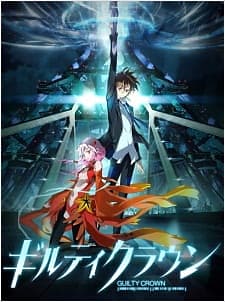
Guilty Crown
Number of Episodes: 22 + OVA prequel
What Wikipedia says: "On Christmas Eve, 2029, the unidentified "Apocalypse Virus" spreads and plunges Japan into a state of emergency in a chaos known as the "Lost Christmas" incident. An international organization known as the GHQ intervenes with martial law and restores order to Japan at the cost of its independence.
Ten years later in 2039, Shu Ouma, a 17-year-old high school student who keeps to himself in school, meets Inori Yuzuriha, the lead singer of Egoist, while visiting one of his favorite places before heading home from school. Shu is a big fan of Inori, a singer who has taken the Internet world by storm. However, he also discovers another side of her: she is a member of the Undertakers, a resistance group that aims to liberate Japan from the GHQ. Shu inadvertently gets involved with the Undertaker and the King's Mark appears on his right hand after the Void Genome canister in his pocket broke. This mark bestows him the power to reach inside another person's heart to extract and materialize a weapon or item from it. The anime tells the story of Shu's reluctant involvement with the Undertakers and the hardship involving the battles they fight and the lost truth of Shu's past."
What tTPO says: If only it was that straightforward.This is a series that clearly a lot of people have put a lot of money and a lot of effort into. It certainly looks the part. But it really does just make for such a spectacular trainwreck.
The basic mcguffin was pretty cool (extracting stuff from peoples hearts) but after that it was all downhill. Shu is generally weak and whiney (only getting a bit of spine quite late in the series), Inori is kinda cool but is a bit of a nonevent personality, our main 'other' character suffers a mid season transition from one characature to a different characature, while the rest of the side characters are actually reasonably likeable don't get enough screen time to save the series.
Aside from character issues there are major plot and direction problems. Halfway through the series there is a MAJOR change of direction and focus, and not for the better. It really may as well just be 2 separate series. Where difficult to believe plot events and turns work so well in the enjoyment of Code Geass, they really just don't here. And when we do get some exposition about what is going on it is not always easy to understand.
It's not all bad though - there are some good moments with the side characters, when Shu gets a spine, a bit of drama when some characters die, and when there is a bit of exposition which actually improves understanding (including the OVA). But it is so not enough to save the series.
How About the Music? There is little doubt that this aspect of the series is the best. Except for the actual animation which is also rather good. In any case the first OP ("My Dearest" by supercell) and ED ("Departures ~Anata ni Okuru Ai no Uta~" by EGOIST) are fantastic, and give the series a sense of purpose the actual series lacked. The second OP ("The Everlasting Guilty Crown" by EGOIST) and ED ("Kokuhaku" (Confession) by supercell) didn't work so well for me but the first ones more than made up for it.
So how does it end? (Spoiler Free.): The series is so frayed that no ending was ever going to able to answer everything. But it is is an ending that provides some degree of closure. Even if, much like the rest of the show, it doesn't really make a lot of sense.
Overall Grade: Really, really, wonderfully bad. Occult Academy looks spineless in comparison with Guilty Crowns true committment to epically bad writing. Grade D. Seriously, what were they thinking?
Tuesday, 18 September 2012
Planetes
Number of Episodes: 26
What Anime News Network
What tTPO says: This is a special series. If you went on the description above (itself is really an injustice to the scale of the series) and the first few episodes you would be questioning whether it was worth continuing or not - standalone episodes loaded with apparent anime caricatures. But you would then miss out on a rare anime experience.
The characters which at first appear so shallow bloom over the course of the series. Some change markedly for good or ill, others less so but gain a backstory that explains why they are the way they are. And the secondary characters, that in other series may be discarded in one-shot episodes, start to recur and have their own arcs, as small as they may be. But inherently you can't appreciate this snowballing of richness and development of the bigger world of the story until many episodes have passed.
The bigger story itself doesn't really start till the second half of the series with the first half a series of (near) standalone episodes with sometimes a slice-of life feel laying the groundwork which is essential to later development. As big as the story gets though (and it is a decent story), it is really just a vehicle for the characters.
Of note are a few other aspects of the series. Firstly, because it ends up taking place over the course of about 18 months, the episodes more often than not fail to immediately follow one another. This means that it is not uncommon for one episode to end on a cliffhanger, then the next episode start sometime after, with the cliffhanger explained in hindsight. Or for an episode to start halfway through an event we have not seen yet, with the details filled out later on. The result of this is a story where the viewer is left a little disoriented as to how the story got where it is (in a good way). But you are not left hanging and things are explained sooner or later. Both this and the character arcs reminded me in some ways of Babylon 5.
Secondly the science in the series is hard. No giant robots, FTL drives or big laser weapons. Just the hard slog of humanity leaving the planet a bit at a time. The research by the author and production team just shows and they succeed (within the bounds of an anime) to make this future as plausible as possible. The designs to my eye all looked great. If you like your science fiction over your science fantasy, this is a show for you.
Lastly the series asks some serious questions about space, its development and the future directions we may take as a planet. Some of these are not pretty but we need art to make us think about these things before it is too late.
How About the Music? Meh. The music was mostly unobtrusive (except for the final episode ED that reminded me overwhelmingly of Code Geass - which all makes sense now since Hitomi was responsible for the offending, though not offensive, music in question) but in truth the flavour of the show seemed to get on just fine without it being a focus. And this from a guy that likes his anime music. The OP was "Dive in the Sky" by Mikio Sakai and the ED 1-25 "Wonderful Life" also by Mikio Sakai.
So how does it end? (Spoiler Free.): Loose ends virtually all wrapped up with only a couple of small unanswered questions of minor consequence. The thoroughness of the end of the last episode (as well as the music) was again very reminiscent of Code Geass, and this was no bad thing. Did I mention some of the production team were the same as Code Geass?
Overall Grade: Grade A-. The strength of this show is also its weakness - if the ball got rolling just a bit faster this would have been an A but that's not how this series rolls. But the science, the unusual structure (for an anime), the asking of big questions, the shameless and brave main character development and the care given to even minor characters means that this definitely deserves a seat at the table reserved for the best.
Labels:
Action,
Drama,
Grade A,
Romance,
Science Fiction,
Slice of Life
Sunday, 29 April 2012
Freezing + Freezing Vibrations
Number of Episodes: 12 (+ 6 mini-OVAs) + 12 (+ 1 special episode)
What Wikipedia says: "Set in a slightly futuristic world, Earth has been invaded and is at war with aliens from another dimension called the Nova. In order to counter them, Pandoras and Limiters, genetically modified girls with super fighting skills and their male partners who use special "freezing" powers to limit their opponent's mobility, are made to fight against the Nova. The series focuses on Kazuya Aoi, a Limiter whose late sister was a Pandora, and Satellizer el Bridget, a powerful Pandora with a cold personality, both who are enrolled at the West Genetics Academy, one of the many academies where Pandoras and Limiters are trained. In spite of the warnings of all his friends about Satellizer, who has intense aphephobia, Kazuya decides to be her friend and Limiter. They are later joined by Lana Linchen, a Pandora from Tibet in search for her Limiter who believes Kazuya to be her "soulmate", sparking a rivalry with Satellizer. The story follows Kazuya's Relationship with Satellizer, the students of the Academy, and Earth's war against the Nova."
What tTPO says: More to the point is what Wikipedia does not say - that this series has its fair share of blood and boobs. So if you are offended by nudity (no sex though - the worst it gets is some humiliation in episode 3) or reasonable amounts of violence I would be turning off about now. If you put up with this though what awaits is an interesting experience. The blood and boobs are often incorporated (as much as they can ever be) into the plot. The main characters have a fair amount of depth and backstory to them, and the mechanics of the Pandoras / Limiters / Novas are pretty well thought out - moreso if you freeze frame and read the Jinglish-ridden data screens that litter the episodes at various points. The pacing of the plot as it progresses to its inevitable climax is good, and even with the 'fight-of-the-week' phase it goes through I found myself looking to next weeks biff with anticipation. So much so that after watching 3 episodes of this on my own because I was indecisive about whether she would enjoy it or not, I introduced Mrs tTPO to it and she enjoyed it through to the end also.
The big weakness of the anime (as I discovered when I subsequently read the manga) was the lack of depth of the various secondary characters (with the exception of Ingrid Bernstein whose episode was one of the stronger ones as a consequence). In the anime they were often poorly developed charactures acting only as foils to the Aoi and Satellizer, with some of their redeeming battles in the final episodes in the manga, played right down in the anime. The other weakness of the anime in its adaptation of the manga is, that in contrast to what I said above, there were occasions when the fan service was gratuitous, and no more so than episode 8 (a prom queen episode with more wardrobe malfunctions than a Superbowl half-time show) which was an anime original. Or indeed any of the OVAs. Thankfully this episode is a stand alone and can be left out along with the OVAs without too many problems. If this sort of stuff floats your boat though you are in for a treat.
How About the Music? There are occasions I don't need to listen back to remind myself how a song went. The OP (Color by MARiA, a cover of the Hatsune Miku song, and much much better) is one of these, a thumping piece of J rock with some awesome use of synthesiser. The ED (Kimi wo Mamoritai aka To Protect you by Aika Kobayashi) is another pumping electronic J-rock number and while full of energy not quite as catchy as the OP for me.
So how does it end? (Spoiler Free.): Pretty well, but at risk of repeating myself, not quite as well as the manga, with a little bit too much focus on the main characters. That notwithstanding, it's not disappointing.
Overall Grade: Grade B. Don't get me wrong - I liked Freezing a lot, and probably more than this grade would indicate. The story, action and main character development are good enough to carry this series through its weaknesses. But I am not sure the anime adaptation does justice to the source material. Watch this then go and read the manga, because the manga goes all sorts of places after the events covered by the anime finish.
Addendum: Freezing Vibrations continued with a largely self contained story arc. Seeing the first series is not essential but it helps a lot. Unlike Freezing though, I had read the manga upon which this was based before seeing the series and I did wonder how they were going to do it and make it interesting since the 3rd and 4th arcs of the manga do stray away from Satellizer and Kazuya as the central characters and make it more of a ensemble story. So did it work?
For the most, yes. Some nifty writing meant the sometimes drawn out manga was condensed to a neat 12 episode arc, and they shoehorned the rather personal 2nd story arc from the manga into the middle of the 3rd manga arc which was more action oriented and made up the bulk of the story. There were good character moments for many, though Rana did not see much development this time around. There is after all only so much you can do in 12 episodes.
On the downside there were a couple of clunky moments as a consequence of the rearrangement of the arcs (mostly involving Satellizer's step-brother) as well as a vanishing Nova which was forgotten about but in the main the pacing I though was actually better than the manga, leaving the ending neatly wrapped up while still leaving the door open for an eventual series 3.
And there were boobs. And blood. And somehow it all just worked again. Still Grade B. And the OVA was still stunningly gratuitous and can be left out.
KoanMan says: When KoanMan started watching this series (by director Takashi Watanabe as an extension of the manga written by Korean manhwa author Dall-Young Lim and illustrated by Kwang-Hyun Kim) it was immediately obvious that mammophiles will love this. The irony is that the stand-out feature (pardon the pun) of this pair (OK, no more from now) series was in fact not the décolletage, but the story, which could easily have carried the whole production on its own. Of particular note, is that one became strangely accustomed, almost desensitised, to the thoracic theatrics - to the point that by the end of the first series, they were simply there. Just participating as part of the wall-paper....part of the background.
That said, the clothing is linked to the character and their state of composure/health. An interesting detail that actually fits well with the plot, led by a first year student "limiter" Kazuya Aoi, and the aphenphosmphobic second year student "pandora" Satellizer el Bridget (for those interested also see haphephobia and haptephobia). They are joined by Tibetan exchange student "pandora" Rana Linchen to form a comical love triad that continues to entertain. This relieves a lot of the heavy themes of world cataclysm running almost continuously, as characters discover themselves and their place in the world.
Character development is good, and this continued to deepen throughout both series. With the variety of personalities it is easy to have favourites, KoanMan likes the "never give up" attitudes of Rana Linchen and Ganessa Roland. Fantastic!
The second series particularly impressed with its dark undertones, as concepts alluded to in the first are given texture. This, despite what appears to be a complete "changing of the guard" between the series - it is almost as if the whole crew were changed over, with different music, different character portraits, and a mild, though obvious, lower grade of animation production in the second series.
The series one music is awesome, the opening theme is "Color" by MARiA (a cover of a song voiced by a singing synthesiser vocaloid Hatsune Miku), while the ending theme is "To Protect You" by Aika Kobayashi. Awesome. Alas, in series two, the theme music is not so awesome (opening theme "AVENGE WORLD", end theme "The World Embraces Scars" both performed by Konomi Suzuki).
Overall, a good story, good plot and character development. KoanMan enjoyed this, not because of the fan service, but almost in spite of it. KoanMan rates this a solid B.
Wednesday, 25 April 2012
Rinne no Lagrange (season 1; with season 2 addendum)
aka Lagrange: The Flower of Rinne, Flower Declaration of your Heart
Number of Episodes: 12 (first season) + 12 (second season) + 5 mini-OVAs
What Viz Media via Myanimelist.net
Madoka's life is turned upside down when she is suddenly asked by a mysterious girl named Lan to pilot a robot. Motivated by her desire to protect the people and city of Kamogawa, Madoka agrees to pilot the resurrected Vox robot to fight against extraterrestrials that have come to attack Earth."
What tTPO says: From one Madoka to another in the space of three reviews. Compared with Puella Magi though, this series is a bit less coherent and tries just a little hard to be too many things. Describing it as a slice of life-mecha-space opera would not be too far off the mark, but it doesn't really succeed spectacularly as any of these things. The issue for me was that it tended to lose a bit of momentum as it swayed through the different aspects to the series, leaving me a little disconnected with the characters. Having said that is it not an epic fail either, and there is enough character, plot (with the odd hard hitting surprise), background plot and occasional humour to maintain some level of interest. I suspect this may end up being a series that would be better served being seen all at once, rather than week to week as I did, when I found myself asking myself 'so where are we up to with this?' More focused series leave me in no doubt where things are at and looking forward to the next episode despite the gaps between viewings.
How About the Music? For me the ED ("Hello!" by Megumi Nakajima) was the highlight of the music, capturing the generally upbeat mood of Madoka. Not to say the OP ("TRY Unite!" by Megumi Nakajima) was bad, it just didn't work quite as well for me.
So how does it end? (Spoiler Free.): This actually ends in a pretty satisfactory manner, so long as you think the Empire Strikes Back ended in a satisfactory manner - with character development and distinct closure to this chapter, but without closure to the whole story. This clearly is heading into a second season which apparently will start around July 2012. And there is an OVA coming too. I must admit I find it a bit sad that average shows like this get second seasons when better shows (like Chiarafuru) probably won't.
Overall Grade: Grade C. This series is almost the definition of a C. Mrs tTPO thought so to. It did not too much wrong, but really was not otherwise outstanding in plot, characterisation, ideas or execution to rate higher. I am not sure if I will bother with the second season to see how things turn out. We'll see.
Season 2 Addendum: Season 2 is virtually a direct continuation of season 1, to a point where if you are going to sit through this, you should do all 24 episodes, or (more wisely) look at some other and better series. Now that is not to say that this is a bad series. On the contrary, season 2 deals with all the left over plot points from season 1 and wraps them up, and even has a bit of character development. However it does none of these things particularly well, with the various plot endings not really particularly well explained or satisfying, with more than a little deus ex machina required to pull everything back together. Apparently I should have listened to my own advice above.
Still grade C.
Labels:
Action,
Fighting,
Grade C,
School,
Science Fiction,
Slice of Life
Friday, 20 April 2012
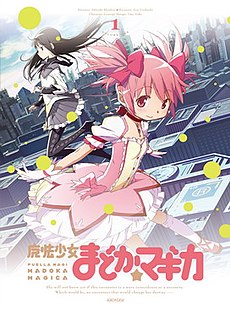
Puella Magi Madoka Magica
Number of Episodes: 12
What Wikipedia says: "In this world, there exist strange creatures who have the power to grant one wish to a chosen girl. However, in exchange, that girl must then become a magical girl and use her powers to fight against witches, evil creatures born from darkness that are responsible for murders and suicides.
In the city of Mitakihara, a schoolgirl named Madoka Kaname and her friend Sayaka Miki are approached by a familiar named Kyubey, who offers to grant each of them one wish in return for making each of them a magical girl. Another magical girl named Homura Akemi tries to prevent Madoka from making such a deal, while Kyubey urges Madoka by telling her she will become the most powerful magical girl. However, contrary to the glamorous notions one would expect, a magical girl finds herself dealing with death, isolation, loss of humanity, agony over the value of her wish, and existential crisis. Madoka, following her friends, soon sees the darker side of being a magical girl, and because of knowing the truth about being a magical girl, she questions if she should become one as well."
What tTPO says: Holy crap. Just finished this and my mind is melting with the goodness of this series. For tTPO anything this good crammed into 12 episodes where the pacing never faulters is a great start. It seems that each episode has a reveal of some sort that changes the direction of the whole series and to keep this up for the whole series is just amazing. It really is a masterclass in pacing.
Some anime series leave a lot to the imagination and for the viewer to do the work (see Mawaru-Penguindrum). This is not one of those series and it goes to great lengths to make sure (maybe with the exception of the last episode) the viewer knows what is going on. Usually not at the time you see it, so you still have time to puzzle it out yourself, but eventually most things are explained well. And boy does the plot all tie together nicely. Even the 'physics' of the show. I liked that.
The animation of this was also facinating. On one hand you get the impression that the budget for this show was not a lot (I have no idea if this is the case or not) but what they did with artistic vision and imagination was just stunning, making this (in my limited experience) a unique visual presentation for the genre and anime generally.
Lastly there is the feel of the show. Many other reviews talk about the deconstructive nature of this series and it is just so true. It really does dismember the magical girl genre in the face of 'reality' methodically and brilliantly. For me it ended up with the same sinking feeling as Watchmen when I first saw (then read) it. I am guessing the core themes of the superhero genre and the magical girl genre are not so far apart.
How About the Music? The OP (Connect by ClariS, and while a video is hard to find this one is particularly awesome) is a fully serviceable bit of J-Pop that I think is improved by the series it fronts. Usually its the other way round but I do like this song. While on that note the opening credits are amusing in that they are typical for the genre but really only serve to lead the viewer astray as to the direction of the series. ED1 is a light J-pop song but only last 2 episodes before the series and the EDs tread a darker path. The ED2 (Magia by Kalafina) is a lot more epic in an emo-rock kind of way but did not work quite so well for me. ED3 (And I'm Home by Ai Nonaka & Eri Kitamura) only lasts a single episode (#9) but for me is the pick of the EDs. And then someone slowed it down by 8 times thus producing shoegaze epic which sounds even better (and uncannily like Slowdive). Who would have thought?
So how does it end? (Spoiler Free): I did wonder how the hell this was going to end and they managed to do it on an epic scale in a way that actually made sense within the context of the story, and was not just a big hit of the reset button. In a strange way it ends up establishing the typical ground rules for the genre it deconstructs. If I had a complaint though it would be that the epic nature of the ending made it just a little less personal and consequently less involving with the characters we knew and loved. But that is a very minor complaint.
Overall Grade: Grade A. Ignore that fact this seems to be a show about magical girls. Just watch it. I'm talking to you Beukesy and Koanman.
Addendum by Koanman: Every now and then, a series provokes genuine thought, and this series is one of those. It is nothing short of majestic in its scope. It challenges the idea of universal morality, or confirms natural amorality, depending on your stance. This series was riveting from start to finish, with interesting new additions to the plot constantly keeping things on the move. The visual effects are second to none, at times disturbing, and yet appear fashioned from the simplest animation techniques.
Madoka Kaname and her side-kick Sayaka Miki are super-sweet personalities, luckily balanced by some sincerely dark undertones. Which brings us to Homura Akemi, who is a more interesting character that really does take the entire series to fully develop. This is a real personal-power story, incorporating beautiful images at some times, and superb portrayals of anger at others. There is a lot that one can associate closely with in this series. It gets an A.
Addendum by Koanman: Every now and then, a series provokes genuine thought, and this series is one of those. It is nothing short of majestic in its scope. It challenges the idea of universal morality, or confirms natural amorality, depending on your stance. This series was riveting from start to finish, with interesting new additions to the plot constantly keeping things on the move. The visual effects are second to none, at times disturbing, and yet appear fashioned from the simplest animation techniques.
Madoka Kaname and her side-kick Sayaka Miki are super-sweet personalities, luckily balanced by some sincerely dark undertones. Which brings us to Homura Akemi, who is a more interesting character that really does take the entire series to fully develop. This is a real personal-power story, incorporating beautiful images at some times, and superb portrayals of anger at others. There is a lot that one can associate closely with in this series. It gets an A.
Labels:
Action,
Arty,
Drama,
Fighting,
Grade A,
Mystery,
School,
Science Fiction,
Supernatural
Thursday, 12 April 2012
Ano Natsu de Matteru
aka Waiting in the Summer
Number of Episodes: 12
WhatWikipedia Anime News Network says: "While testing his 8mm camera at night, Kaito Kirishima is caught
amid a mysterious explosion in his small town. Strangely, Kaito wakes up
the next day perfectly fine, but with no recollection of what exactly
happened the day before. Unfazed by what seems to have been just a
dream, he heads to school not giving much thought to the incident.
Discussing with his friends about the camera, they decide to make a
movie during summer break. They invite two upperclass students to
participate in the project: recently arrived Ichika Takatsuki and the
odd Remon Yamano. In a strange twist of fate, Ichika starts living with
Kaito as his sister has to work overseas. Summer days are about to get
exciting for the small film crew."
tTPO says: This is the second romance series in a row to review and again it is also not a dud. It is not really a harem show proper, though there is a bit of competition, and probably more accurately is a love square with several unrequited loves. These relationships do travel and develop (some characters more than others - go Mio!) over the series, and happily and unhappily, decisions are made by characters with consequences for the relationships.
What
tTPO says: This is the second romance series in a row to review and again it is also not a dud. It is not really a harem show proper, though there is a bit of competition, and probably more accurately is a love square with several unrequited loves. These relationships do travel and develop (some characters more than others - go Mio!) over the series, and happily and unhappily, decisions are made by characters with consequences for the relationships.
The plot framing this is not so original (Senpai? Tick. Aliens? Tick. Cute inexplicable mascot? Tick. Childhood friends? Tick. School? Tick. Summer movie? Tick. No parents in the picture? Tick.) and the movie is largely a device to keep the relationship issues rolling on in the mid part of the series. Suprisingly the plot leaps to the fore in the last 2 episodes turning it into an action-lite series. And it manages this without jarring, which is surprising.
Despite this smooth execution at the end, the main fault to me lay with the pacing of the show in the middle, highlighted by a rather distracting 2-episode beach arc which introduced some unnecessarily annoying characters and fan service which was not prominent in the rest of the series. Unlike some other reviewers I think a 1 or 2 episodes less would have relieved the mid season sag.
How About the Music?: Not much to say here. I have just finished watching the series and can't remember too much about it. It is simply neither memorably good or bad. Listening back now both the OP (sign by ray) and ED (Vidro Moyo by Nagi Yanagi) are exactly that - competant if forgettable J-pop.
So how does it end? (Spoiler Free): Fantasically well. Interestingly for a romantic series, the relationship issues are cleared up a couple of episodes before the plot, and the very end is cleverly executed, with some great reveals and wrapping up all the major bits, while leaving out a few teasing details, either for the viewers imagination or an OVA to fill in.
Overall Grade: Yet another romance show that does a lot right, especially at the end. However, the mid season sag was significant and the broad idea stayed just a little close to the genre (despite the great ending) to go full marks. Grade B-.
Saturday, 22 October 2011
Denpa Onna to Seishun Otako
Number of episodes: 12 + OVA
What Wikipedia says: Not much in the way of a decent synopsis, but myanimelist.net says "The story revolves around a highschool boy named Niwa Makoto. He lives with his aunt’s family since his parents are away on business. It is there where he meets his mysterious cousin of the same age Touwa Erio — who happens to tie a futon mattress around her upper body and is a self-proclaimed alien. Her staple food is pizza. Erio had been missing for half a year and was found floating in the sea. She doesn't remember anything about what happened during that period of time, but she began to think that it was the act of an alien and wanders the neighbourhood wrapped in the futon."
What tTPO says: This is an extraordinarily kawaii (cute) looking and feeling series, as well as being gorgeously rendered. The series opens with the setup above and this, along with the extra moe feel, hooked me and Mrs tTPO in quite quickly. With Makoto being the usual transfer student we soon get to meet with new characters at the school and in the neighbourhood. In tune with the overall kawaii-ness there is nary a bad bone in any of these character's bodies and while this may sound like it makes for flat characterisations, all the main & secondary characters have their own story to tell. This keeps the hooks in, especially with Meme, Erio's mother and Makoto's aunt, who turns out to have a surprising amount of depth. And breasts. Did I mention there was a bit of fan service here? All pretty harmless though. The girls all have a soft spot for Makoto but not much drama is made over this making it very much a 'light' harem series and not the focus of the story. Unfortunately the basic premise of the series slips away as it progresses, leaving us more with a slice-of-life feeling rather than plot driven series. This is only emphasised by the introduction of a new female character in the latter part of the series who just ends up posing more questions about the extra-terrestrial nature of the series.
How about the music?: The music in this show is evil. When I first heard the OP I was in awe of the atonality of the singing. A few listens later though and I could not get it out of my head and now I just love it. The ED is too cute for it's own good (up there but not quite as good as the Dango song from Clannad) but is just as catchy and appropriate for the show.
So how does it end? (Spoiler Free): Bizarrely, the major plotline introduced in the beginning of the series is completely left hanging, as are a few sideplots. What does get finished are some mini-arcs along the way, one of which is very neatly plotted, which just shows they could have done it if they wanted to. Frustrating.
Overall Grade: Grade B (Near miss). Truth be told this is not too near a miss but I liked the music, characters, the setup, and the outrageously moe animation enough that somehow it rates a bit better than a C. If only there was some resolution to the original mystery, then godammit, this would have been an excellent series!
NB: There is an extra DVD only episode coming out December 21st. I am not getting my hopes up too high for some resolution.
What Wikipedia says: Not much in the way of a decent synopsis, but myanimelist.net says "The story revolves around a highschool boy named Niwa Makoto. He lives with his aunt’s family since his parents are away on business. It is there where he meets his mysterious cousin of the same age Touwa Erio — who happens to tie a futon mattress around her upper body and is a self-proclaimed alien. Her staple food is pizza. Erio had been missing for half a year and was found floating in the sea. She doesn't remember anything about what happened during that period of time, but she began to think that it was the act of an alien and wanders the neighbourhood wrapped in the futon."
What tTPO says: This is an extraordinarily kawaii (cute) looking and feeling series, as well as being gorgeously rendered. The series opens with the setup above and this, along with the extra moe feel, hooked me and Mrs tTPO in quite quickly. With Makoto being the usual transfer student we soon get to meet with new characters at the school and in the neighbourhood. In tune with the overall kawaii-ness there is nary a bad bone in any of these character's bodies and while this may sound like it makes for flat characterisations, all the main & secondary characters have their own story to tell. This keeps the hooks in, especially with Meme, Erio's mother and Makoto's aunt, who turns out to have a surprising amount of depth. And breasts. Did I mention there was a bit of fan service here? All pretty harmless though. The girls all have a soft spot for Makoto but not much drama is made over this making it very much a 'light' harem series and not the focus of the story. Unfortunately the basic premise of the series slips away as it progresses, leaving us more with a slice-of-life feeling rather than plot driven series. This is only emphasised by the introduction of a new female character in the latter part of the series who just ends up posing more questions about the extra-terrestrial nature of the series.
How about the music?: The music in this show is evil. When I first heard the OP I was in awe of the atonality of the singing. A few listens later though and I could not get it out of my head and now I just love it. The ED is too cute for it's own good (up there but not quite as good as the Dango song from Clannad) but is just as catchy and appropriate for the show.
So how does it end? (Spoiler Free): Bizarrely, the major plotline introduced in the beginning of the series is completely left hanging, as are a few sideplots. What does get finished are some mini-arcs along the way, one of which is very neatly plotted, which just shows they could have done it if they wanted to. Frustrating.
Overall Grade: Grade B (Near miss). Truth be told this is not too near a miss but I liked the music, characters, the setup, and the outrageously moe animation enough that somehow it rates a bit better than a C. If only there was some resolution to the original mystery, then godammit, this would have been an excellent series!
NB: There is an extra DVD only episode coming out December 21st. I am not getting my hopes up too high for some resolution.
ADDENDUM: Having watched the OVA now my love for this show comes flooding back. It does not provide complete plot resolution (though it does tidy up the final baseball mini-arc) and indeed adds some more questions to the original mystery (which was not forgotten after all!). But goddamit it does provide a degree of emotional resolution (for the viewer at tleast, though not Niwa-kun) to the series that was sorely lacking from episode 12. It remains the most kawaii moe-packed show of recent memory, and is gagging for a second series. Maybe still not quite an A but the OVA certainly improved things: Grade B (plus).
Labels:
Comedy,
Grade B,
Harem,
Mystery,
Science Fiction,
Slice of Life
Wednesday, 12 October 2011
Tactical Roar
Number of episodes: 13
What Wikipedia says: "In the near future, a hypercane has appeared in the Pacific Ocean, causing a series of worldwide climate changes. This storm, dubbed "Grand Roar" by people, has been stable for over 50 years. Climate changes make air travel and transport less reliable, and thus the world has begun reverting to a second naval age, particularly in the Asian region. However, the world's condition also heralds the return of piracy and the growth of maritime terrorism, causing many large international companies to arm themselves and setting up their own private naval security forces.
At the outset of the series, Systems Engineer Hyosuke Nagimiya runs into the crew of the Pascal Magi, one such maritime security ship. He gets into a few typical compromising situations before finally being introduced as a software engineer assigned to update the systems on-board the ship. He meets his stepsister, the captain of the war vessel, Captain Misaki Nanaha, who treats him as a stranger. Although he refers to her as 'sister,' he still thinks of her as a woman nonetheless. During the duration of his duties, the ship is called into combat, where Hyosuke begins to understand the nature of the Pascal Magi and its crew's battle potential as the vessel flings itself into the fight."
What tTPO says: This is an odd show, and I have to admit a slight conflict of interest in that my dad was in the navy so I have a bit more interest and experience in naval military action than the casual viewer. Even if it happens to be set a few years in the future and on a ship staffed almost completely by women, a substantial number of whom happen to be school age. No, really. However, the actual make-up of the bridge crew of the Pascal Magi (the ship our main characters crew) is actually not too far off reality as it is right now, and the naval battles and terminology used again have at least some grounding in reality, all of which pleasantly surprised me. The slightly computerised animation for a lot of the military action actally works pretty well, though the rest of the animation looks just a little dated. The over-reaching plot is a not uninteresting philosophical and political thiller with action elements, but it loses a bit of momentum with individual episodes focusing more on drama between the large cast, and a harem romance between Hyosuke and his step sister (as well as just about everyone else on the Pascal Magi) with occasional bursts of fan service. And if you think this is an odd mix, it's because it is, leaving Tactical Roar the Jack-of-all-trades, but master of none.
How about the music?: Both the OP (J-rock) and ED (ballad) are easy on the ears but much like the rest of this show are not outstanding. The singing in the ED gets a bit flat occasionally though. WTF?
So how does it end? (Spoiler Free): Surprisingly cleanly with most loose ends tidied up.
Overall Grade: Grade C (Pleasant enough, but you don't really have time for this). Tactical Roar tries a little hard to be too many things at once, and while not failing, never really excels at any.
What Wikipedia says: "In the near future, a hypercane has appeared in the Pacific Ocean, causing a series of worldwide climate changes. This storm, dubbed "Grand Roar" by people, has been stable for over 50 years. Climate changes make air travel and transport less reliable, and thus the world has begun reverting to a second naval age, particularly in the Asian region. However, the world's condition also heralds the return of piracy and the growth of maritime terrorism, causing many large international companies to arm themselves and setting up their own private naval security forces.
At the outset of the series, Systems Engineer Hyosuke Nagimiya runs into the crew of the Pascal Magi, one such maritime security ship. He gets into a few typical compromising situations before finally being introduced as a software engineer assigned to update the systems on-board the ship. He meets his stepsister, the captain of the war vessel, Captain Misaki Nanaha, who treats him as a stranger. Although he refers to her as 'sister,' he still thinks of her as a woman nonetheless. During the duration of his duties, the ship is called into combat, where Hyosuke begins to understand the nature of the Pascal Magi and its crew's battle potential as the vessel flings itself into the fight."
What tTPO says: This is an odd show, and I have to admit a slight conflict of interest in that my dad was in the navy so I have a bit more interest and experience in naval military action than the casual viewer. Even if it happens to be set a few years in the future and on a ship staffed almost completely by women, a substantial number of whom happen to be school age. No, really. However, the actual make-up of the bridge crew of the Pascal Magi (the ship our main characters crew) is actually not too far off reality as it is right now, and the naval battles and terminology used again have at least some grounding in reality, all of which pleasantly surprised me. The slightly computerised animation for a lot of the military action actally works pretty well, though the rest of the animation looks just a little dated. The over-reaching plot is a not uninteresting philosophical and political thiller with action elements, but it loses a bit of momentum with individual episodes focusing more on drama between the large cast, and a harem romance between Hyosuke and his step sister (as well as just about everyone else on the Pascal Magi) with occasional bursts of fan service. And if you think this is an odd mix, it's because it is, leaving Tactical Roar the Jack-of-all-trades, but master of none.
How about the music?: Both the OP (J-rock) and ED (ballad) are easy on the ears but much like the rest of this show are not outstanding. The singing in the ED gets a bit flat occasionally though. WTF?
So how does it end? (Spoiler Free): Surprisingly cleanly with most loose ends tidied up.
Overall Grade: Grade C (Pleasant enough, but you don't really have time for this). Tactical Roar tries a little hard to be too many things at once, and while not failing, never really excels at any.
Friday, 7 October 2011
Steins;Gate
What Wikipedia says: "Steins;Gate is an anime adaptation of a visual novel game by 5pb. and Nitroplus. It follows a self-proclaimed mad scientist named Rintarō Okabe who, along with his friends, manage to invent a microwave that can send text messages into the past, allowing him to travel between alternate worlds. As they perform different experiments, an organization named SERN who has been doing their own research on time travel tracks them down and now the characters have to find a way to avoid being captured by them."
What tTPO says: I have not played the game (only available in Japanese commercially unfortunately) so my only experience of this was the anime. And what an anime it was. It started out posing more questions than it answered, and with a pretty unlikeable main character (let's face it - Okabe was a bit of a dick) but gradually the questions get answered and big decisions need to be made by Okabe which will profoundly affect the friends he has gathered around him, and indeed the world. As the weight of responsibility gets greater his facade of arrogance fades allowing us to see that he cares a lot more than he tends to let on. This is more a self revelation as most of his friends see through the facade most of the time. But it is the plot that drives this show and the pacing is perfect through the 24 episodes - they are all needed. The internal physics (nicely explained here - spoiler alert) of the time travel are treated consistently and, rather than being used as a convenient deus-ex-machina, are absolutely essential to the plot. Somewhere while watching this I thought a timeline would be nice to see everything at once. Fortunately, someone else also thought of this (definite spoiler alert). And while it is still complex, not surprisingly, follows its own rules and is consistent. Kudos for anyone that holds all this in their head while watching the show. Fortunately you don't have to memorise every trip that gets taken, but paying attention to events in the early episodes does pay off later in the series.
How about the music?: For me all the music, the OP, the ED and the ED for episode 23 all kind of fell into the interesting and appropriate without being compelling category. Probably not something I would listen to in my spare time.
So how does it end? (Spoiler Free): Tough choices are made and there are consequences. This adds up to an emotionally satisfying finish, even if the internal physics of the last episode didn't quite seem to add up as well as the rest of the series (or maybe I just missed something). However, given the ambitious nature of the games and the anime, and the potential for gaping plot holes in any time travelling story, I can well forgive it. But who is Daru's future wife?
ADDENDUM: The OVA might just answer this question.... And the OVA overall is a nice bookend to things. Not completely brilliant, but well worth it.
Overall Grade: A (Don't miss it). This is a compelling, complex (and proud of it) plot driven series whose only mild weakness (the lack of empathy with the main character) is overcome by its conclusion. Well that and not enough screen time for Feyris-chan in maid mode (-nyan!). Otherwise bloody brilliant. And so is the t-shirt I bought with Kirisu on it.
What tTPO says: I have not played the game (only available in Japanese commercially unfortunately) so my only experience of this was the anime. And what an anime it was. It started out posing more questions than it answered, and with a pretty unlikeable main character (let's face it - Okabe was a bit of a dick) but gradually the questions get answered and big decisions need to be made by Okabe which will profoundly affect the friends he has gathered around him, and indeed the world. As the weight of responsibility gets greater his facade of arrogance fades allowing us to see that he cares a lot more than he tends to let on. This is more a self revelation as most of his friends see through the facade most of the time. But it is the plot that drives this show and the pacing is perfect through the 24 episodes - they are all needed. The internal physics (nicely explained here - spoiler alert) of the time travel are treated consistently and, rather than being used as a convenient deus-ex-machina, are absolutely essential to the plot. Somewhere while watching this I thought a timeline would be nice to see everything at once. Fortunately, someone else also thought of this (definite spoiler alert). And while it is still complex, not surprisingly, follows its own rules and is consistent. Kudos for anyone that holds all this in their head while watching the show. Fortunately you don't have to memorise every trip that gets taken, but paying attention to events in the early episodes does pay off later in the series.
How about the music?: For me all the music, the OP, the ED and the ED for episode 23 all kind of fell into the interesting and appropriate without being compelling category. Probably not something I would listen to in my spare time.
So how does it end? (Spoiler Free): Tough choices are made and there are consequences. This adds up to an emotionally satisfying finish, even if the internal physics of the last episode didn't quite seem to add up as well as the rest of the series (or maybe I just missed something). However, given the ambitious nature of the games and the anime, and the potential for gaping plot holes in any time travelling story, I can well forgive it. But who is Daru's future wife?
ADDENDUM: The OVA might just answer this question.... And the OVA overall is a nice bookend to things. Not completely brilliant, but well worth it.
Overall Grade: A (Don't miss it). This is a compelling, complex (and proud of it) plot driven series whose only mild weakness (the lack of empathy with the main character) is overcome by its conclusion. Well that and not enough screen time for Feyris-chan in maid mode (-nyan!). Otherwise bloody brilliant. And so is the t-shirt I bought with Kirisu on it.
Subscribe to:
Posts (Atom)